Share
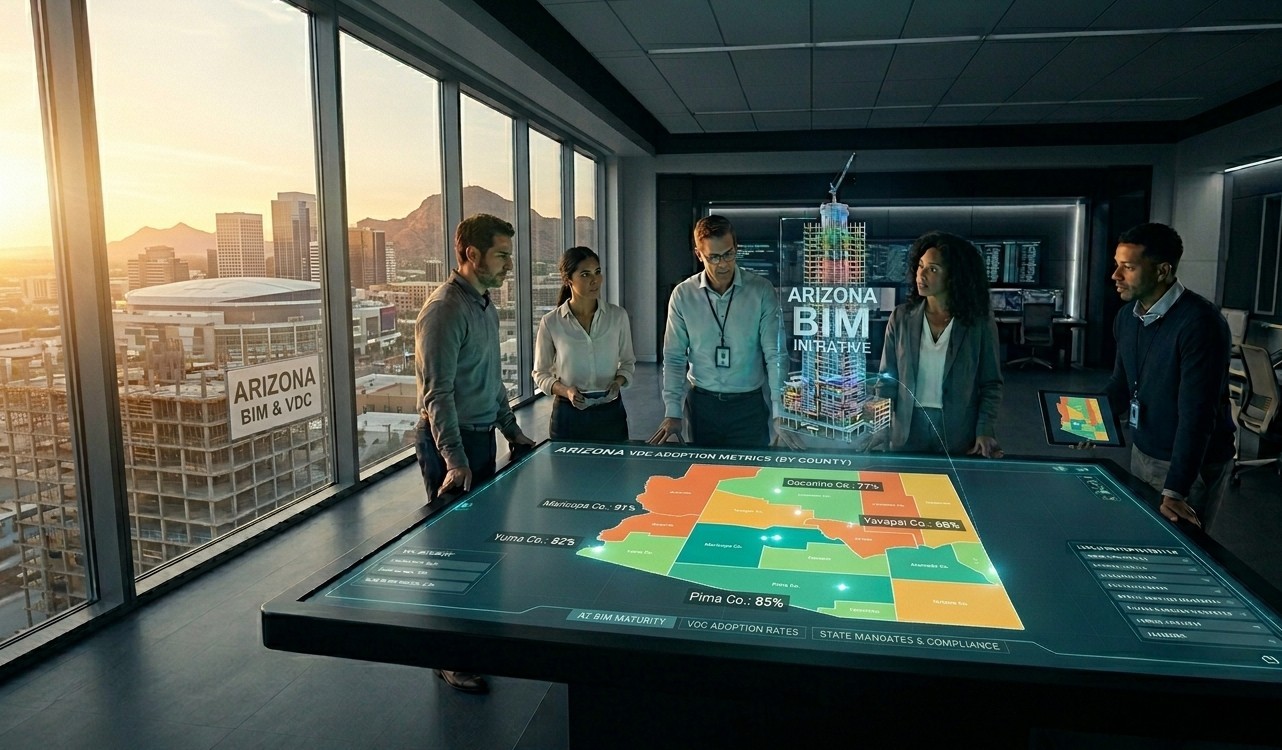
Arizona’s construction sector has expanded rapidly over the past decade, fueled by population growth, data center development, infrastructure investment, and a strong commercial real estate market. In this evolving landscape, Building Information Modeling (BIM) and Virtual Design and Construction (VDC) have become essential tools for managing complexity, improving coordination, and accelerating project delivery.
For contractors, developers, and engineering firms in Arizona, BIM and VDC are no longer experimental, they are practical, results-driven approaches that directly impact project performance.
How BIM and VDC Took Shape in Arizona
BIM adoption in Arizona gained momentum in the early 2010s, particularly within large-scale commercial and institutional projects. As developers pushed for faster delivery and higher quality, BIM became a natural solution for improving design coordination and reducing rework.
Over time, this evolved into broader VDC practices. Instead of using BIM only for modeling, leading firms began integrating it with construction scheduling, cost estimation, and logistics planning, turning BIM into a full project delivery framework.
Arizona’s growth in sectors like data centers and advanced manufacturing accelerated this shift, where precision and speed are critical.
Codes, Requirements, and Standards
Arizona does not have a statewide BIM mandate, but BIM and VDC requirements are increasingly embedded within project contracts.
Key influences include:
Federal guidelines for public and institutional projects
Owner-defined BIM Execution Plans (BEP)
Adoption of ISO 19650-based workflows
Internal BIM standards developed by major contractors
In practice, BIM expectations are driven by project complexity. The larger and more technical the project, the more likely BIM and VDC are required.
Adoption Across Contractors and Design Firms
BIM and VDC adoption in Arizona is relatively strong compared to many states:
Approximately 65–75% of large contractors use BIM for coordination and planning
Around 50–60% of design firms rely on BIM as a core workflow
VDC adoption is particularly high in data center, healthcare, and infrastructure projects
Arizona’s fast-paced construction environment encourages firms to adopt digital workflows to stay competitive and meet aggressive timelines.
Leading BIM and VDC Companies in Arizona
Several firms operating in Arizona are recognized for their advanced BIM and VDC capabilities:
DPR Construction – known for data centers and healthcare projects
Sundt Construction – infrastructure and commercial developments
McCarthy Building Companies – large-scale commercial and institutional projects
AECOM – engineering and infrastructure
Kitchell – healthcare and education construction
These companies integrate BIM and VDC into their delivery processes to improve coordination and reduce project risk.
BIM and VDC in Major Arizona Projects
Arizona’s construction boom includes several BIM-driven projects:
Large data center campuses in Phoenix and surrounding areas
Healthcare expansions across major cities
University developments and research facilities
Transportation and infrastructure upgrades
These projects rely heavily on BIM coordination, 4D scheduling, and digital construction workflows to manage scale and maintain efficiency.
BIM and VDC Roles and Salaries in Arizona
Demand for BIM and VDC professionals is increasing as adoption grows across the state.
Estimated salary ranges:
BIM Modeler: $55,000 – $75,000
BIM Coordinator: $70,000 – $95,000
BIM Manager: $95,000 – $125,000+
VDC Engineer: $80,000 – $115,000
VDC Manager: $105,000 – $145,000+
Compensation depends on experience, company size, and project complexity.
Most Common BIM and VDC Tools in Arizona
Arizona firms rely on a standard set of tools to support BIM and VDC workflows:
Autodesk Revit (~80%) for BIM modeling
Navisworks (~70%) for clash detection and coordination
Autodesk Construction Cloud / BIM 360 (~65%) for collaboration
Bluebeam Revu (~70%) for document management
Primavera P6 (~60%) for scheduling and 4D integration
These tools form the foundation of modern digital construction workflows in the state.
BIM and VDC in Phoenix: The Largest City
Phoenix, the largest city in Arizona, is one of the fastest-growing metropolitan areas in the U.S. Its construction boom, particularly in data centers, residential developments, and infrastructure, has driven widespread BIM and VDC adoption.
Projects in Phoenix use BIM and VDC for:
Coordinating complex building systems in high-density developments
Accelerating construction schedules for data centers
Managing logistics and sequencing in large-scale projects
The city’s growth rate makes BIM essential for maintaining efficiency and controlling costs.
The Future of BIM and VDC in Arizona
Arizona’s construction market shows strong potential for further BIM and VDC expansion.
Key trends include:
Increased use of BIM in data center and industrial construction
Growth of prefabrication and modular construction
Integration of BIM with digital twins and real-time data
Expansion of VDC for schedule and cost optimization
As projects become more complex and timelines more aggressive, BIM and VDC will continue to play a central role.
Why BIM and VDC Matter in Arizona
For construction leaders in Arizona, BIM and VDC offer clear advantages:
Improved coordination and reduced design conflicts
Faster project delivery through better planning
More accurate cost estimation and budgeting
Enhanced communication between teams
In a competitive and fast-moving market, these benefits are essential.
The Bottom Line
BIM and VDC in Arizona reflect a shift toward smarter, more efficient construction practices. While not mandated at the state level, they are widely adopted in sectors where performance and speed matter most.
For contractors, developers, and engineering firms, BIM and VDC are no longer just tools, they are key drivers of project success.
In Arizona’s dynamic construction environment, they are helping redefine how projects are planned, coordinated, and delivered.