Share
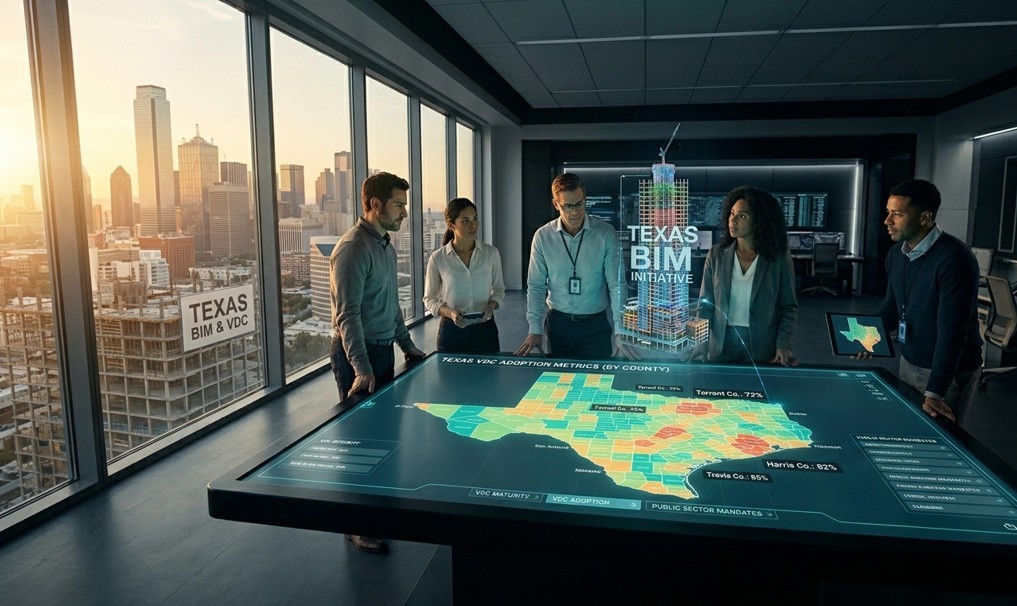
Texas is one of the fastest-growing construction markets in the United States, driven by population growth, infrastructure expansion, and large-scale commercial development. In this environment, Building Information Modeling (BIM) and Virtual Design and Construction (VDC) have become essential for managing complexity, improving coordination, and delivering projects efficiently.
For contractors, developers, and engineering firms, BIM and VDC are becoming core capabilities for staying competitive in Texas.
BIM and VDC Adoption History in Texas
BIM adoption in Texas accelerated in the early 2010s, following national trends led by federal agencies and large private developers. Major contractors and engineering firms began integrating BIM for clash detection, coordination, and construction planning.
Over time, BIM evolved into a broader VDC approach, where models are combined with construction scheduling (4D), cost estimation (5D), and logistics planning. Today, VDC is widely used on complex projects across infrastructure, healthcare, energy, and commercial sectors.
Texas universities and large public agencies have also contributed to workforce development, supporting the growth of BIM and VDC expertise across the state.
Codes, Requirements, and Standards
Texas does not have a statewide BIM mandate, but BIM and VDC are often required at the project level.
Key drivers include:
Federal requirements from the U.S. General Services Administration (GSA)
Owner-driven BIM Execution Plans (BEP)
Adoption of ISO 19650 principles for information management
Standards set by large contractors and private developers
In practice, BIM and VDC requirements in Texas are defined contractually, with expectations increasing for large and complex projects.
BIM and VDC Adoption by Contractors and Design Firms
BIM and VDC adoption in Texas is high among mid-to-large firms:
Over 70% of large contractors use BIM for coordination and design integration
Approximately 50–60% of design firms use BIM as a standard workflow
VDC adoption is growing rapidly, especially in infrastructure and data center projects
Leading contractors increasingly integrate BIM with scheduling, cost control, and field execution, moving toward full VDC implementation.
Top BIM and VDC Companies in Texas
Texas is home to several leading firms known for BIM and VDC capabilities:
HNTB Corporation – infrastructure and transportation projects
Fluor Corporation – large-scale industrial and energy projects
Jacobs Engineering Group – global engineering and VDC integration
Zachry Group – industrial construction and digital delivery
Page (Page Southerland Page) – architecture and engineering with BIM expertise
These companies leverage BIM and VDC to deliver complex, high-value projects across the state.
BIM and VDC-Driven Projects in Texas
Several major projects in Texas demonstrate the impact of BIM and VDC:
Dallas/Fort Worth International Airport expansions
Texas Medical Center developments in Houston
Austin-Bergstrom International Airport upgrades
Large-scale data center campuses in Dallas and Austin
These projects rely heavily on BIM coordination, 4D scheduling, and digital construction workflows to manage complexity and maintain schedule control.
BIM and VDC Roles and Salaries in Texas
As adoption grows, demand for BIM and VDC professionals continues to increase.
Estimated salary ranges:
BIM Modeler: $55,000 – $75,000
BIM Coordinator: $70,000 – $95,000
BIM Manager: $95,000 – $130,000+
VDC Engineer: $80,000 – $120,000
VDC Manager: $110,000 – $150,000+
Salaries vary by experience, company size, and project complexity.
Most Used BIM and VDC Tools in Texas
Construction firms in Texas rely on a consistent set of tools for BIM and VDC workflows:
Autodesk Revit (high adoption ~80%) – BIM modeling
Navisworks (70–75%) – clash detection and coordination
Autodesk Construction Cloud / BIM 360 (60–70%) – collaboration
Bluebeam Revu (65%) – documentation and review
Primavera P6 (60%) – scheduling and 4D integration
These tools form the backbone of digital construction workflows across projects.
BIM and VDC in Houston: The Largest City in Texas
Houston, the largest city in Texas, is a major hub for BIM and VDC adoption. With its concentration of energy, healthcare, and commercial developments, the city relies heavily on digital construction methods.
Projects in the Texas Medical Center and energy sector use BIM and VDC for:
Multidisciplinary coordination
Complex system integration
Construction sequencing and logistics planning
Houston’s scale and complexity make BIM and VDC essential for reducing risk and improving efficiency.
The Future of BIM and VDC in Texas
The future of BIM and VDC in Texas is strongly aligned with digital transformation in construction.
Key trends include:
Increased integration of BIM with digital twins
Greater use of 4D and 5D modeling for cost and schedule control
Expansion of prefabrication and modular construction supported by BIM
Adoption of AI and data analytics for project optimization
As projects become more complex and competitive, BIM and VDC will continue to evolve from optional tools into standard industry practices.
Why BIM and VDC Matter for Decision Makers
For construction leaders, BIM and VDC are strategic enablers.
They improve:
Coordination between disciplines
Cost accuracy and budget control
Schedule reliability
Overall project performance
In a fast-growing market like Texas, where scale and speed define success, BIM and VDC provide the structure needed to manage complexity and deliver consistent results.
The Bottom Line
BIM and VDC in Texas reflect a broader shift toward data-driven, integrated construction delivery. While not mandated statewide, they are widely adopted across major projects and sectors.
For contractors, developers, and engineering firms, investing in BIM and VDC is no longer a choice. It is a requirement for competing in one of the most dynamic construction markets in the United States.