Share
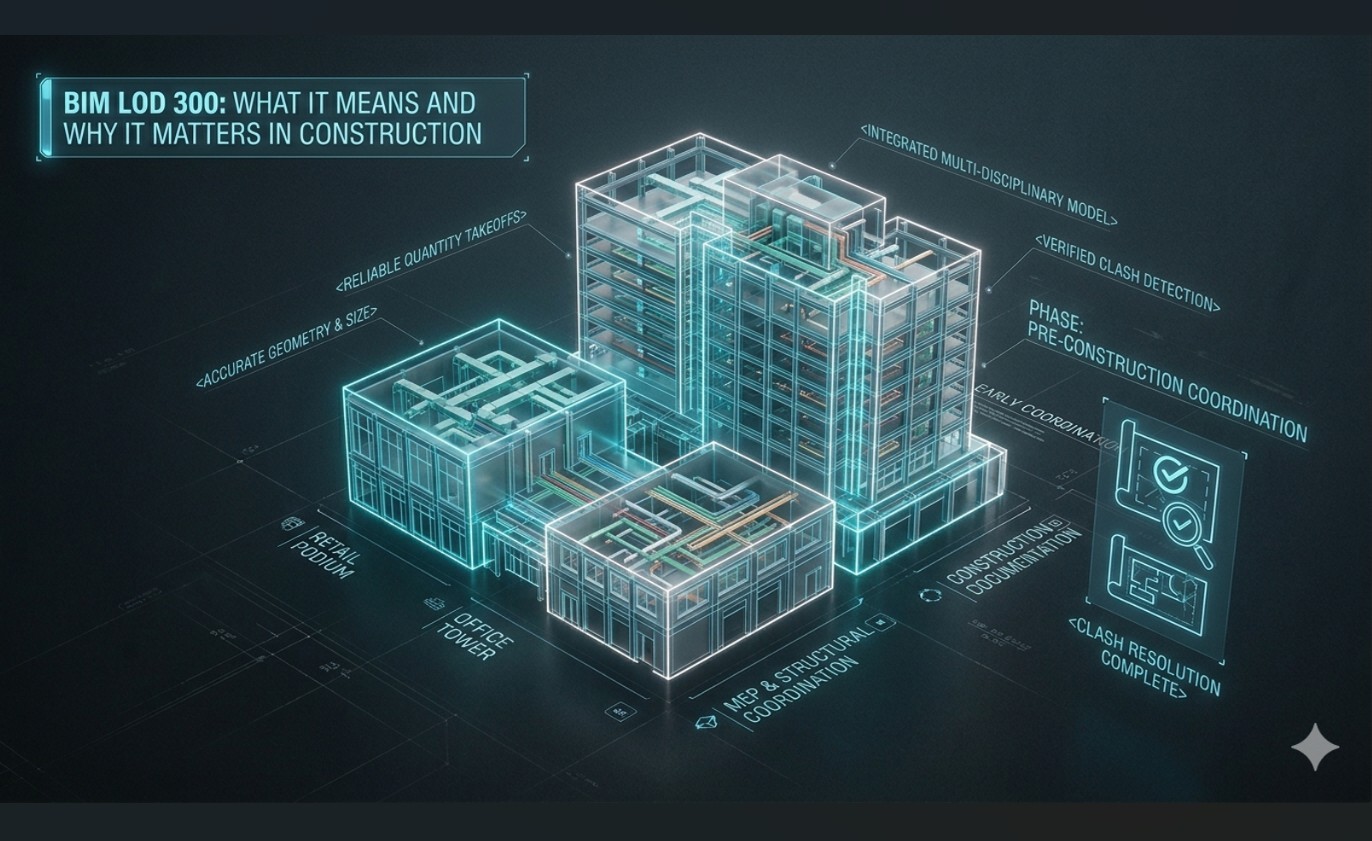
In Building Information Modeling (BIM), not all models are created equal. The Level of Development (LOD) defines how reliable and detailed a model is, and among all levels, LOD 300 is one of the most critical for project execution.
For contractors, consultants, and project managers, understanding BIM LOD 300 is essential to achieving accurate coordination, reliable quantity takeoffs, and smoother construction workflows.
At this stage, BIM models move beyond approximate geometry and become precise enough for coordination across disciplines.
What Is BIM LOD 300?
LOD 300 represents a model where elements are defined with accurate geometry, size, shape, location, and orientation. Unlike earlier stages, LOD 300 models can be used for coordination and construction documentation.
This level allows teams to extract reliable quantities and verify that systems fit within the defined space.
Why LOD 300 Is Critical for Coordination
One of the main benefits of LOD 300 is its role in clash detection and multidisciplinary coordination. Architectural, structural, and MEP systems can be integrated into a single model, allowing conflicts to be identified before construction begins.
Resolving clashes at this stage significantly reduces rework, RFIs, and delays on site.
Impact on Cost Estimation and Planning
LOD 300 models support more accurate quantity takeoffs and cost estimation. Because elements are precisely defined, estimators can rely on model-based quantities instead of assumptions.
This improves budget accuracy and helps decision makers maintain cost control during pre-construction.
Supporting Construction Execution
At LOD 300, models provide enough detail for contractors to plan installation sequences and logistics. While not yet at fabrication level, the model is reliable enough to guide construction workflows and coordination between trades.
This improves productivity and reduces uncertainty during execution.
Why It Matters for Decision Makers
For project directors and executives, BIM LOD 300 is not just a technical milestone, it is a control point. It marks the transition from conceptual design to coordinated, buildable information.
Projects that achieve well-coordinated LOD 300 models early benefit from fewer conflicts, better cost predictability, and improved schedule performance.
In modern construction, LOD 300 is where BIM begins to deliver real value.