Share
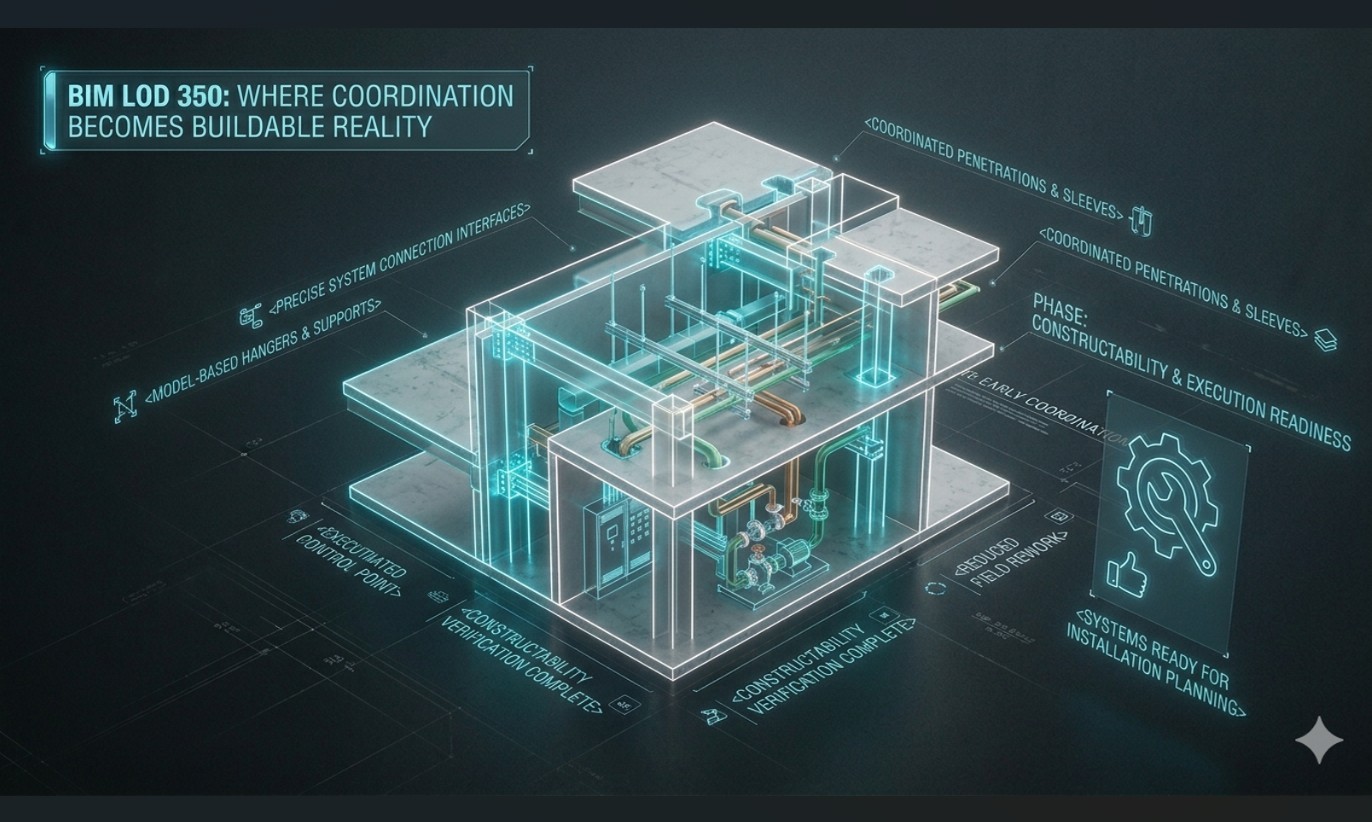
In BIM, moving from coordination to constructability is where real project value begins. LOD 350 sits exactly at that transition point, where models don’t just show systems, but how they actually connect and interact.
At this stage, models include interfaces between systems, supports, hangers, penetrations, and connections. Many project teams rely on coordinated BIM modeling workflows to ensure LOD 350 models reflect real installation conditions and align with site requirements.
What Is BIM LOD 350?
LOD 350 builds on LOD 300 by adding connection details and system interfaces. Elements are modeled with precise geometry, along with the components required to connect them to other systems.
This level enables teams to understand how different trades interact within shared spaces.
Why LOD 350 Is Critical for Trade Coordination
LOD 300 identifies clashes. LOD 350 resolves them.
By including supports, clearances, and connection points, LOD 350 allows teams to coordinate installation paths more accurately. This is particularly important for MEP systems where space constraints are tight.
Coordinated LOD 350 models reduce field conflicts and improve constructability before work begins.
Impact on Construction Planning
With LOD 350, contractors gain better visibility into sequencing and installation constraints. The model provides enough detail to plan trade workflows, identify access requirements, and avoid interference between systems.
This improves schedule reliability and reduces site-level adjustments.
Reducing Rework and Site Risk
One of the main benefits of LOD 350 is its ability to reduce rework. When the BIM modelers address the coordination at a deeper level, teams minimize unexpected conflicts during construction.
Fewer surprises on site mean better productivity and more controlled project outcomes.
Why It Matters for Decision Makers
For project leaders, BIM LOD 350 represents a shift from design coordination to execution readiness. It strengthens confidence that systems will fit, connect, and perform as intended.
Projects that achieve well-coordinated LOD 350 models typically experience fewer delays, lower rework costs, and smoother construction phases.
In modern construction, LOD 350 is where coordination becomes buildable reality.