Share
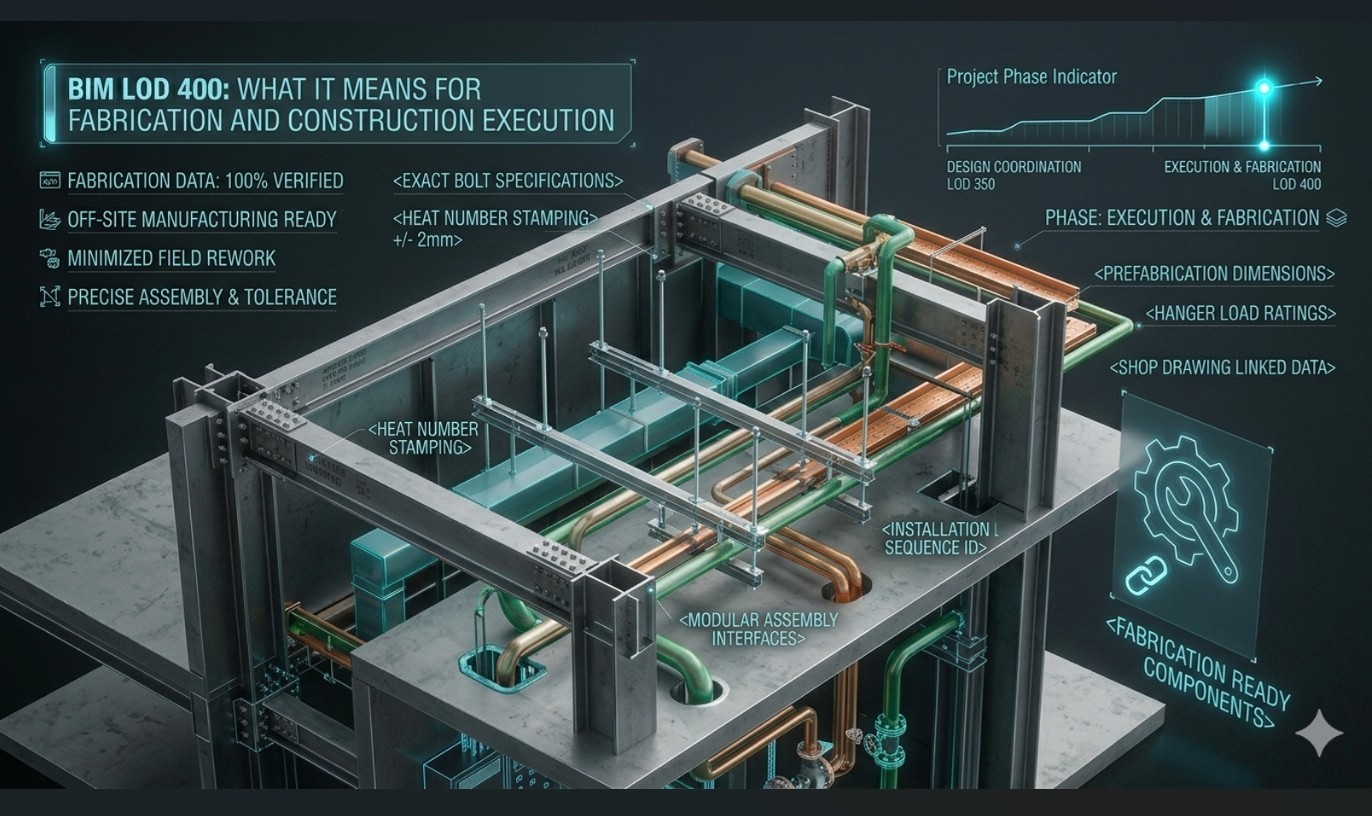
As projects move from coordination into execution, the level of detail required in BIM models increases significantly. LOD 400 represents this shift, where models are no longer just coordinated, but ready for fabrication and installation.
At this stage, BIM models are developed to include fabrication-level information. Elements are detailed with exact dimensions, tolerances, and assembly requirements. Many project teams rely on advanced BIM modeling workflows to ensure LOD 400 models align with shop drawings, manufacturing processes, and on-site installation needs.
What Is BIM LOD 400?
LOD 400 defines a model where elements are developed with fabrication and installation detail. This includes:
Exact geometry and dimensions
Assembly and connection details
Fabrication-specific components
Installation requirements and tolerances
At this level, models can be directly used for shop drawings and off-site manufacturing.
Why LOD 400 Is Critical for Fabrication
Unlike earlier LOD levels, LOD 400 supports prefabrication and modular construction. Fabricators can extract detailed information directly from the model, reducing reliance on separate documentation.
This improves accuracy, minimizes interpretation errors, and accelerates production workflows.
Impact on Construction Efficiency
LOD 400 models allow contractors to plan installation with a high degree of certainty. Components arrive on site ready to install, reducing adjustments and rework.
This improves productivity, shortens construction timelines, and supports more predictable project delivery.
Reducing Risk Through Precision
At LOD 400, the margin for error is significantly reduced. Precise modeling ensures that components fit as intended, minimizing conflicts during installation.
This level of detail is particularly valuable in projects with complex systems or tight coordination requirements.
Why It Matters for Decision Makers
For project leaders, BIM LOD 400 is a critical milestone. It marks the transition from coordinated design to executable construction data.
Projects that leverage LOD 400 effectively benefit from improved fabrication accuracy, reduced site rework, and better schedule control.
In modern construction, LOD 400 is where BIM delivers measurable efficiency in execution.