Share
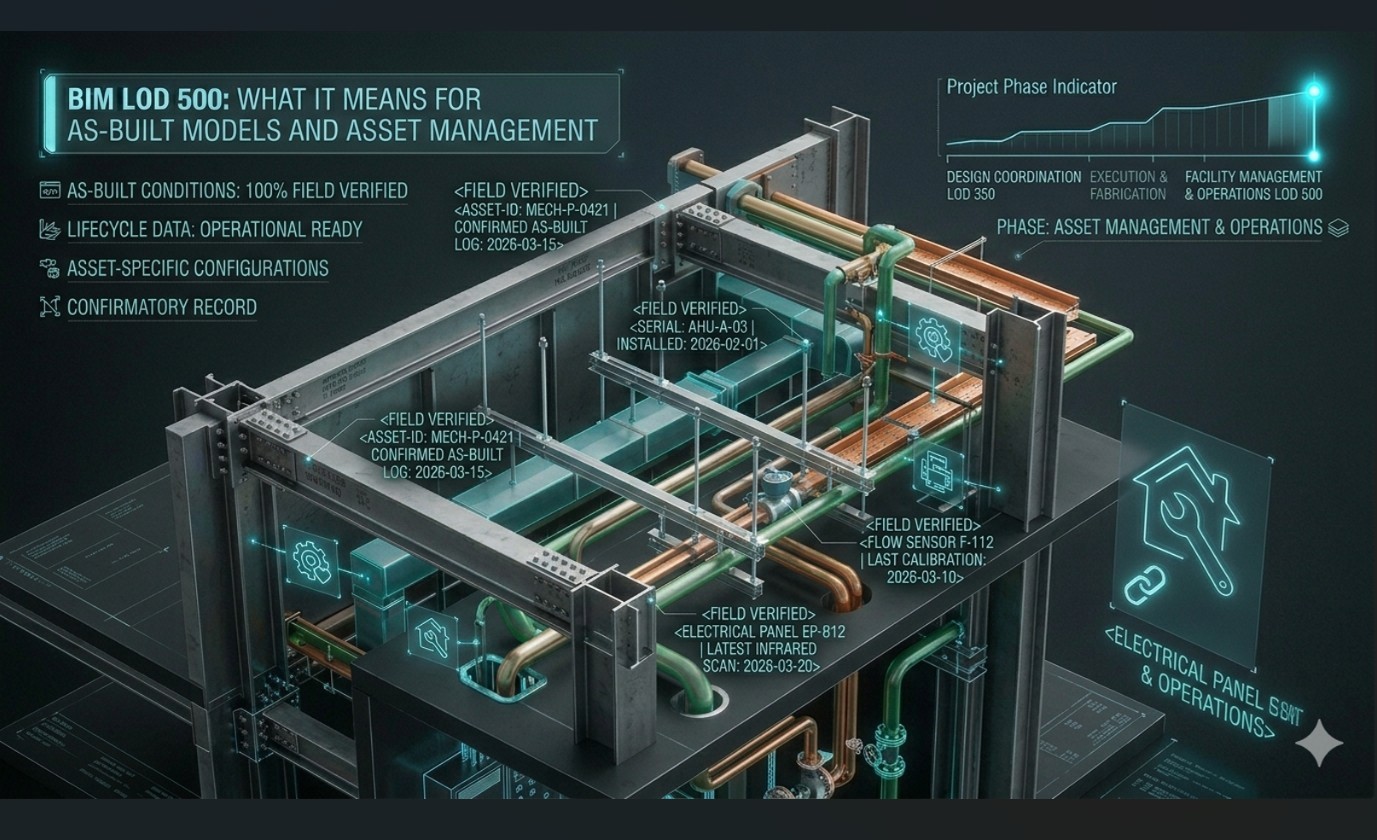
As construction projects reach completion, the focus shifts from building to operating. This is where BIM LOD 500 becomes critical. At this level, models are no longer design or coordination tools, they become verified records of what was actually built.
For owners, facility managers, and project leaders, understanding BIM LOD 500 is important to unlocking long-term value beyond construction.
At this stage, BIM modelers update the models to reflect as-built conditions, incorporating field-verified dimensions, installed equipment, and finalized system configurations. Many project teams rely on structured BIM workflows to ensure LOD 500 models accurately capture real site conditions and align with asset management requirements.
What Is BIM LOD 500?
LOD 500 represents a model where elements are field verified and accurately reflect installed conditions. This includes:
Final geometry and location of components
Verified system configurations
Equipment data and specifications
Asset and maintenance information
Unlike earlier LOD levels, LOD 500 is not predictive, it is confirmatory.
Why LOD 500 Matters for Asset Management
The primary value of LOD 500 lies in facility management and operations. Owners can use the model as a digital record to manage maintenance, track assets, and plan future upgrades.
Accurate as-built models reduce reliance on outdated drawings and improve operational efficiency over the asset lifecycle.
Supporting Long-Term Cost Control
BIM LOD 500 enables better lifecycle cost management. With accurate data on installed systems, facility teams can plan maintenance schedules, forecast replacement needs, and optimize asset performance.
This reduces unexpected failures and improves budget planning.
Improving Handover Quality
Project handover is often one of the weakest stages in construction. Incomplete or inconsistent documentation creates challenges for owners after project completion.
LOD 500 models provide structured, reliable information that improves handover quality and ensures continuity between construction and operations.
Why It Matters for Decision Makers
For executives and project owners, BIM LOD 500 is not just a final deliverable. It is a long-term asset.
Projects that invest in accurate as-built modeling gain better visibility into their assets, reduce operational risk, and improve lifecycle performance.
In modern construction, LOD 500 is where BIM transitions from a project tool into a business advantage.