Share
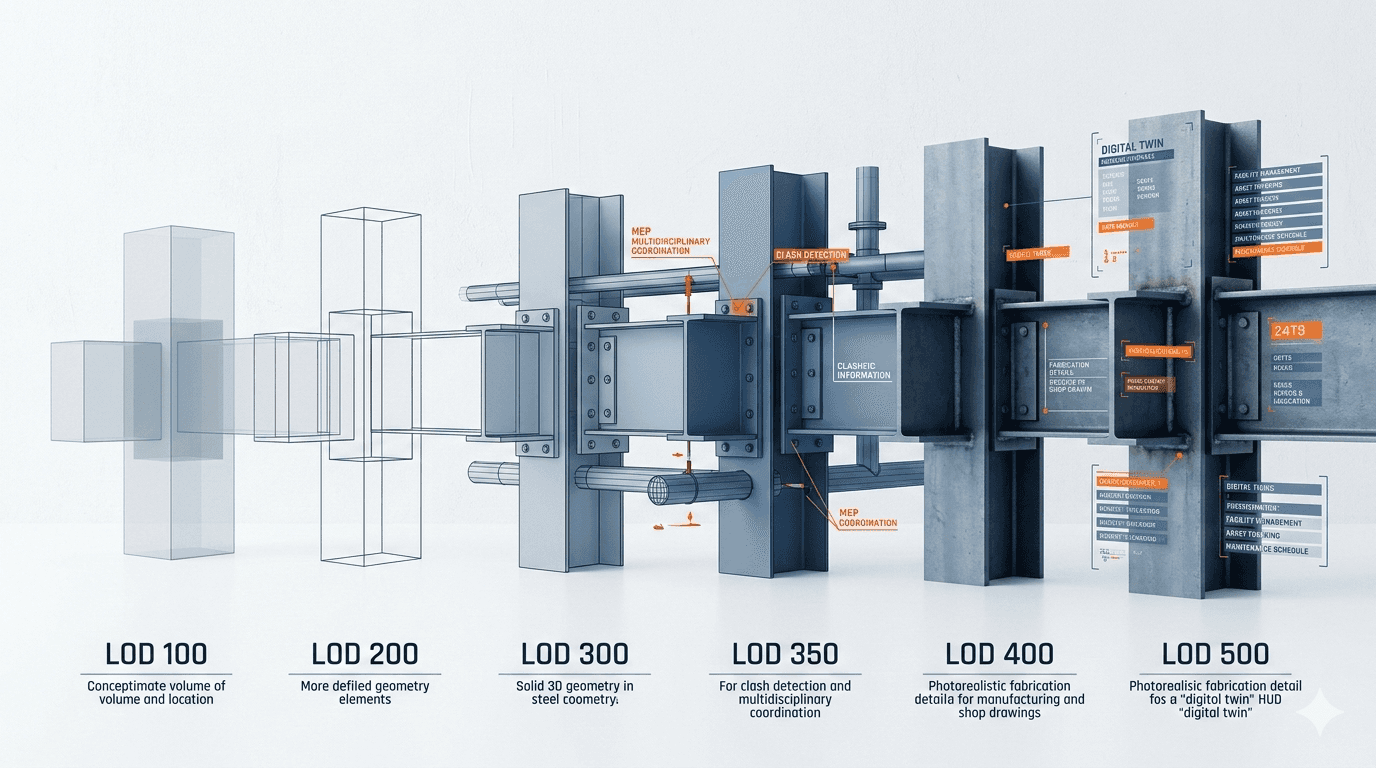
In Building Information Modeling (BIM), Level of Development (LOD) defines the reliability, geometric precision, and information content of model elements at specific project stages. Misalignment in BIM LOD expectations is one of the leading causes of coordination disputes, inaccurate quantity takeoffs, and fabrication delays.
For contractors, design managers, and project directors, understanding BIM LOD standards is essential for controlling scope definition and managing risk.
BIM models must align with project delivery phase and contractual information requirements. Defining LOD accurately at the outset, often supported by structured BIM modeling workflows and coordinated production BIM teams, ensures that model outputs match estimation, coordination, and fabrication needs.
Technical Definition of BIM LOD Levels
Industry standards commonly reference LOD 100 through LOD 500:
LOD 100 – Conceptual representation; massing models used for feasibility studies and preliminary cost analysis.
LOD 200 – Generic system-level elements with approximate quantities, size, shape, and location.
LOD 300 – Precisely defined geometry suitable for multidisciplinary coordination and clash detection.
LOD 350 – Includes interfaces, supports, penetrations, and connections between building systems.
LOD 400 – Fabrication-level detail including shop drawing information, installation tolerances, and manufacturing data.
LOD 500 – Field-verified as-built conditions for asset management and facility operations.
Each LOD level increases both geometric accuracy and non-graphical data reliability.
LOD Applications Across Project Lifecycle
During conceptual and schematic design, LOD 100–200 supports parametric cost modeling and option evaluation. At the design development stage, LOD 300 enables accurate clash detection and coordinated quantity extraction.
For design-build and prefabrication projects, LOD 350–400 becomes critical for constructability validation, sequencing simulations, and trade coordination. Post-construction, LOD 500 models support facility management systems and digital asset registers.
Risk Allocation and Information Certainty
The technical purpose of LOD is to define model reliability thresholds. Higher LOD reduces geometric uncertainty but increases modeling effort and cost.
Specifying LOD too early may result in rework if design changes occur. Specifying insufficient LOD can lead to fabrication conflicts and installation errors.
Clear LOD matrices within BIM Execution Plans (BEP) improve accountability and reduce scope ambiguity.
Strategic Value for Decision Makers
For executives and construction leaders, BIM LOD is not simply a modeling metric. It directly impacts estimation accuracy, procurement sequencing, and contractual clarity.
Aligning LOD definitions with project milestones strengthens cost control, reduces rework risk, and improves coordination efficiency.