Share
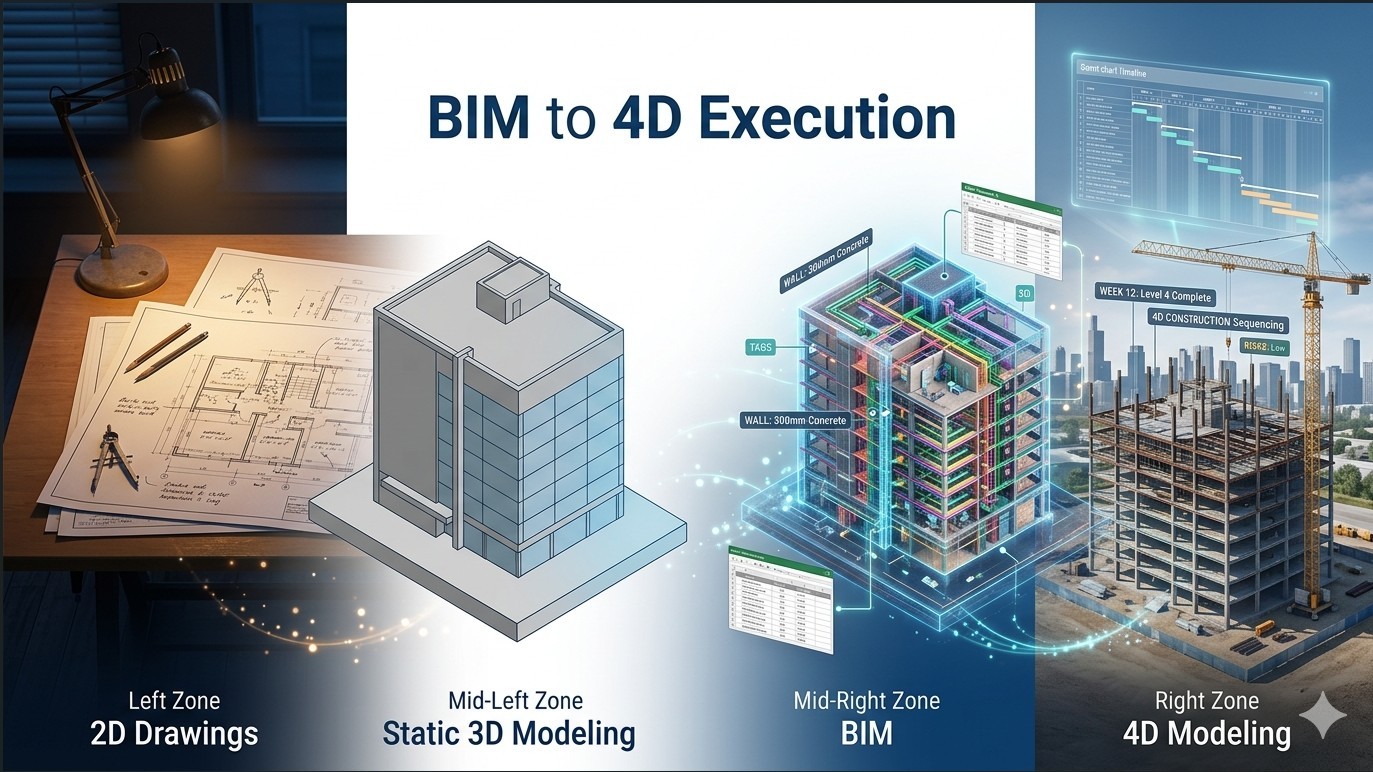
The construction industry is moving rapidly toward digital workflows, yet many project leaders still face confusion around terms like Building Information Modeling (BIM), 3D modeling, 2D drawings, and 4D modeling. While they are often used interchangeably, each plays a different role in design, coordination, and construction execution.
For contractors, developers, and engineering firms, understanding these differences is critical to improving construction coordination, cost control, and project delivery performance.
BIM vs 2D Drawings: Which Is Better?
2D drawings have been the foundation of construction documentation for decades. They are familiar, widely used, and relatively simple to produce. However, they come with limitations.
2D drawings are static and fragmented. Changes in one drawing often require manual updates across multiple sheets, increasing the risk of inconsistencies. Coordination between disciplines becomes challenging, especially in complex projects.
BIM addresses these limitations by providing a centralized, coordinated model. When a change is made in a BIM model, it is reflected across all views and disciplines automatically.
From a construction perspective, BIM improves:
Coordination between architectural, structural, and MEP systems
Accuracy of quantity takeoffs and cost estimation
Identification of clashes before construction
Overall project visualization and communication
While 2D drawings are still required for documentation, BIM provides a more reliable foundation for construction planning and execution.
BIM vs 3D Modeling: What’s the Difference?
At first glance, BIM and 3D modeling may appear similar because both involve creating digital representations of a project. However, the difference lies in the depth of information and functionality.
3D modeling focuses on geometry. It creates visual representations of buildings or systems but typically lacks embedded data. These models are useful for visualization, presentations, and basic spatial understanding.
BIM modeling, on the other hand, is a data-rich process. A BIM model includes not only geometry but also information about materials, quantities, specifications, and system relationships. This allows teams to perform clash detection, quantity takeoffs, and construction sequencing.
In practical terms:
3D modeling shows how a project looks.
BIM shows how a project is built and managed.
For decision makers, BIM provides actionable insights, while 3D modeling remains primarily visual.
BIM vs 4D Modeling
4D modeling builds on BIM by adding the time dimension to the model. While BIM focuses on geometry and data, 4D modeling integrates scheduling information to simulate construction sequences.
With 4D BIM, project teams can visualize how a building will be constructed over time. This enables better planning of:
Construction sequencing
Resource allocation
Site logistics
Project milestones
For example, teams can simulate installation sequences to identify potential conflicts before they occur on site.
In simple terms:
BIM = model + data
4D modeling = BIM + time
For large and complex projects, 4D modeling improves schedule reliability and helps decision makers anticipate risks earlier.
Why These Differences Matter in Construction
Confusing BIM with 3D modeling or relying solely on 2D drawings can limit project performance. Each method has its place, but modern construction requires a more integrated approach.
Organizations that adopt BIM and extend it into 4D modeling gain significant advantages:
Improved coordination and reduced rework
More accurate cost estimation and quantity takeoffs
Better construction scheduling and planning
Enhanced communication between stakeholders
These benefits directly impact profitability and project success.
Keywords Driving Digital Construction
To stay competitive, construction firms are increasingly focusing on:
BIM modeling and BIM coordination
BIM implementation strategies
BIM consulting and BIM engineering
Construction project management tools
Digital construction workflows
Clash detection and constructability analysis
3D modeling and 4D BIM scheduling
Construction cost estimation and quantity takeoffs
Virtual design and construction (VDC)
These capabilities are shaping how projects are delivered across the industry.
From Drawings to Data-Driven Execution
The shift from 2D drawings to BIM and 4D modeling represents a fundamental change in how construction projects are managed. Instead of relying on fragmented information, teams now operate within integrated digital environments.
This improves transparency, reduces errors, and enables better decision-making at every stage of the project lifecycle.
Why Decision Makers Should Care
For executives and project directors, the choice between BIM, 3D modeling, 2D drawings, and 4D modeling is not just technical, it is strategic.
The right approach impacts:
Cost control and budget accuracy
Schedule reliability and project timelines
Coordination efficiency between teams
Risk management and project predictability
Organizations that adopt BIM and advanced modeling workflows are better positioned to deliver projects faster, with fewer errors and stronger financial outcomes.
The Bottom Line
3D modeling, 2D drawings, BIM, and 4D modeling are not competing approaches, they are part of an evolving construction ecosystem. However, BIM serves as the foundation that connects them all.
For construction leaders, the future lies in leveraging BIM not just as a modeling tool, but as a platform for smarter, more coordinated, and more predictable project delivery.