Share
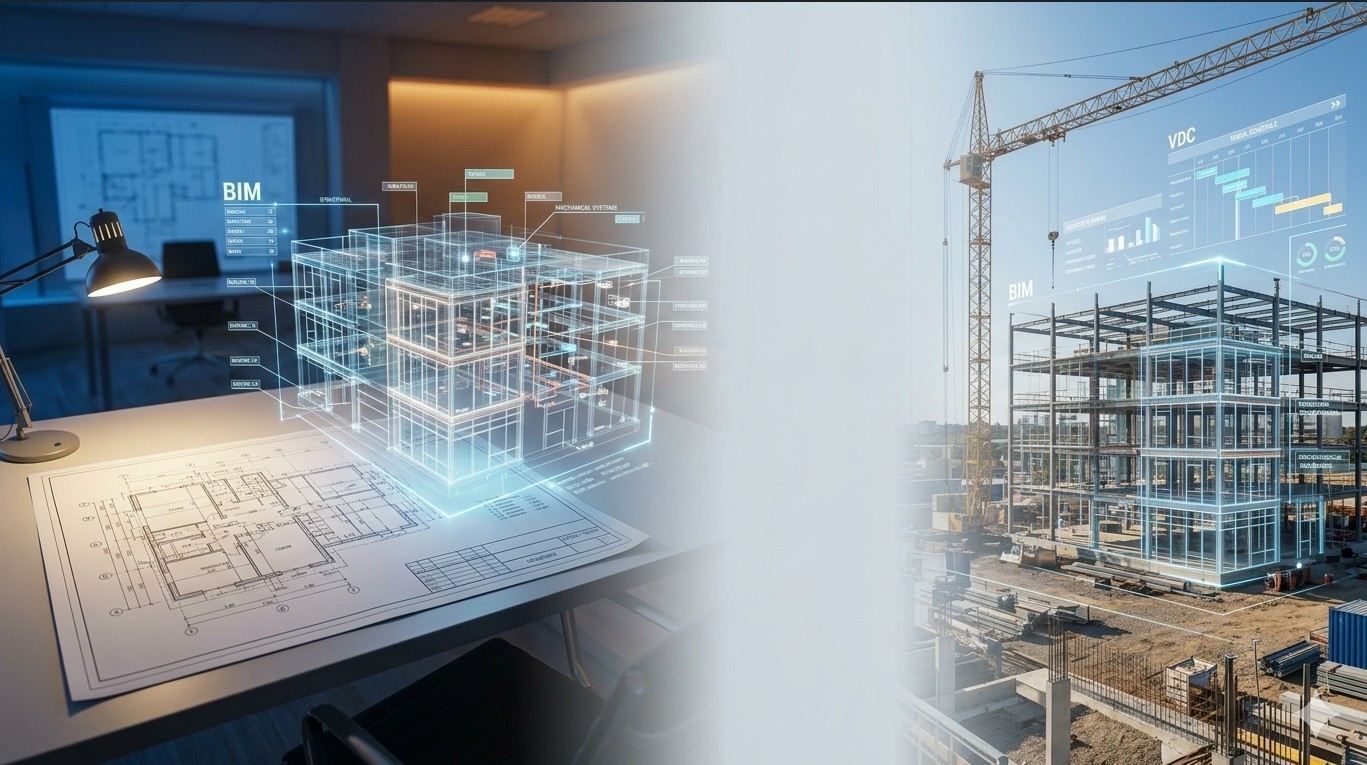
The construction industry is rapidly evolving, and with it comes a growing number of digital terms, Building Information Modeling (BIM), CAD, and Virtual Design and Construction (VDC). While they are often used interchangeably, they serve very different purposes.
For contractors, developers, and engineering firms, understanding the difference between BIM, CAD, and VDC is essential for improving coordination, reducing rework, and delivering projects more efficiently.
What is the Difference Between BIM and CAD?
At a fundamental level, the difference between BIM and CAD lies in how information is created, managed, and used.
Computer-Aided Design (CAD) is primarily a drafting tool. It focuses on creating 2D drawings or basic 3D representations of a project. CAD drawings are static and typically require manual updates across multiple files when changes occur.
In contrast, Building Information Modeling (BIM) is a process that integrates geometry with data. BIM models are dynamic and contain information about materials, quantities, systems, and performance. When one element changes, the entire model updates automatically.
From a construction perspective, CAD answers the question:
“What does the design look like?”
BIM answers:
“How will the project be built, coordinated, and managed?”
This difference has a major impact on project outcomes. BIM supports clash detection, quantity takeoffs, construction sequencing, and cost estimation, while CAD remains focused on documentation.
BIM vs VDC: What’s the Difference?
While BIM is often confused with VDC, the two are not the same.
BIM is a tool and process for creating and managing digital models.
Virtual Design and Construction (VDC) is a broader methodology that uses BIM, along with other technologies, to plan and manage the entire construction process.
VDC integrates:
BIM models
Construction scheduling (4D BIM)
Cost estimation (5D BIM)
Logistics and sequencing planning
Field execution strategies
In simple terms:
BIM = the model
VDC = how the model is used to manage the project
For decision makers, VDC represents a shift from design-focused workflows to execution-focused project management. It aligns design, cost, and schedule into a unified strategy.
Why This Distinction Matters in Construction
Confusing BIM with CAD or VDC often leads to missed opportunities. Organizations that treat BIM as just a modeling tool fail to capture its full value.
Projects that integrate BIM within a VDC framework achieve:
Better coordination between disciplines
Reduced rework and fewer RFIs
Improved cost estimation accuracy
More reliable construction schedules
This is particularly important for complex projects where multiple systems must work together seamlessly.
Terms Driving Modern Construction Workflows
To stay competitive, construction firms are increasingly adopting:
BIM modeling and BIM coordination
BIM implementation strategies
BIM consulting and BIM engineering
Construction scheduling and cost estimation tools
Digital construction workflows
Clash detection and constructability analysis
3D modeling and 4D/5D BIM
Construction project management software
From Drafting to Data-Driven Construction
The shift from CAD to BIM and VDC represents a broader transformation in construction. Projects are no longer managed through isolated drawings but through integrated data environments.
This shift improves transparency, enhances collaboration, and allows teams to make better decisions earlier in the project lifecycle.
For contractors and developers, this means fewer surprises during construction and more predictable project outcomes.
Why Decision Makers Should Care
For executives and project directors, understanding BIM, CAD, and VDC is not just technical, it is strategic.
Choosing the right approach affects:
Project cost control
Schedule reliability
Coordination efficiency
Risk management
Organizations that adopt BIM and VDC effectively gain a significant competitive advantage by delivering projects faster, with fewer errors, and better financial performance.
The Bottom Line
CAD remains a useful drafting tool, but it is no longer sufficient for managing modern construction complexity. BIM provides the data and coordination needed for better planning, while VDC ensures that this information is used effectively to guide execution.
For construction leaders, the future is not about choosing between BIM, CAD, or VDC. It is about understanding how they work together to deliver smarter, more efficient projects.