Share
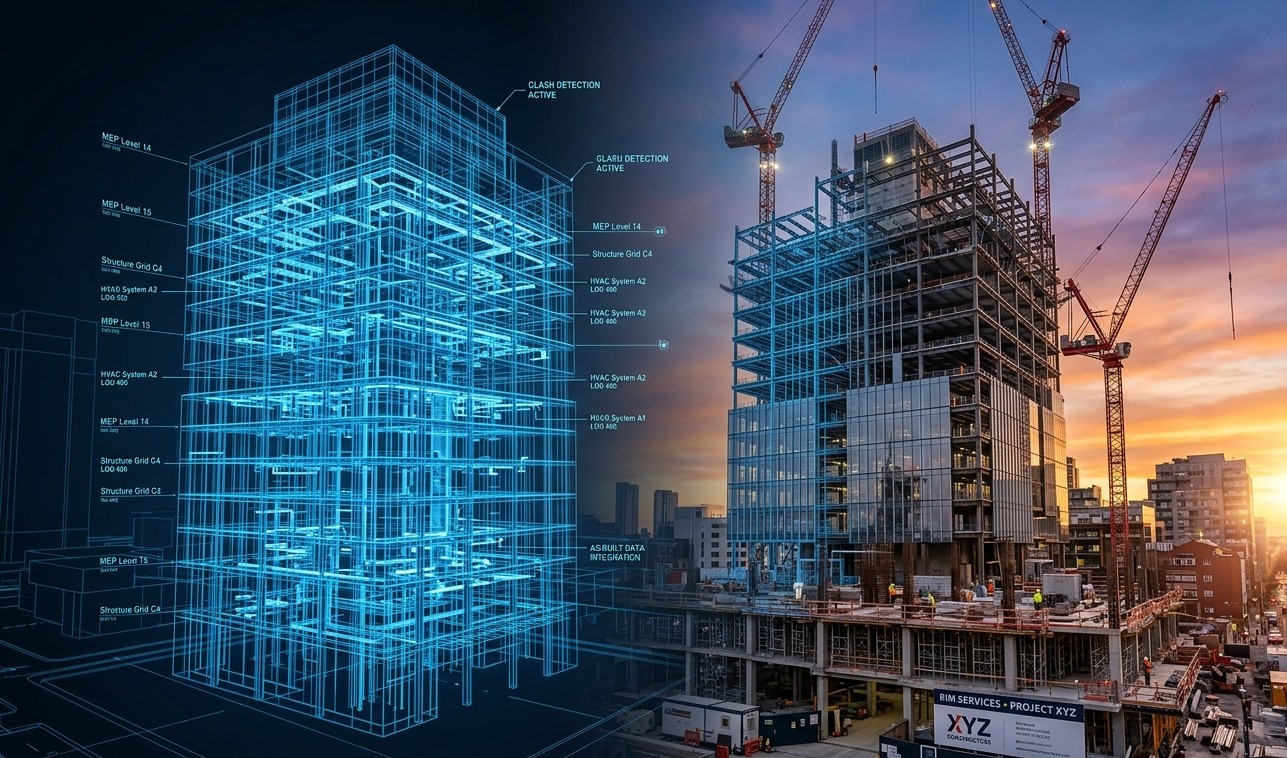
The construction industry is undergoing a major shift toward digitalization, and Building Information Modeling (BIM) is at the core of this transformation. What was once viewed as a 3D modeling tool has evolved into a comprehensive process that integrates design, engineering, and construction into a single, data-driven workflow.
For contractors, developers, and engineering firms, BIM is a strategic capability that directly impacts coordination, cost control, and project delivery performance.
Today, organizations adopt BIM services not only to create models, but to improve collaboration, reduce risk, and enhance decision-making. By working with experienced BIM specialists and structured BIM workflows, project teams can align design intent with real construction conditions and significantly improve outcomes.
What Is BIM and Why It Matters
At its core, BIM is a digital representation of physical and functional characteristics of a building or infrastructure asset. Unlike traditional 2D drawings, BIM models combine geometry with data, enabling teams to visualize, analyze, and coordinate projects more effectively.
Through structured BIM implementation, teams can identify clashes, simulate construction sequences, and extract accurate quantities before work begins. This reduces rework, improves schedule reliability, and enhances overall project efficiency.
For decision makers, BIM provides visibility. It allows stakeholders to understand project risks, evaluate alternatives, and make informed decisions early, when changes are still manageable.
Core BIM Services in Modern Construction
A professional BIM company typically delivers a range of services tailored to different project phases and requirements.
BIM modeling is the foundation, involving the creation of accurate 3D models for architectural, structural, and MEP systems. These models are not just visual, they are data-rich and support coordination and analysis.
BIM coordination is where real value emerges. By integrating all disciplines into a shared model, teams can identify conflicts, resolve clashes, and align systems before construction begins.
BIM consulting helps organizations define workflows, standards, and strategies for effective BIM adoption. This includes developing BIM Execution Plans (BEP), defining Level of Development (LOD), and establishing Common Data Environment (CDE) processes.
BIM engineering bridges design and construction by ensuring that models reflect constructability, installation constraints, and sequencing requirements.
Advanced BIM solutions extend into 4D scheduling (time), 5D cost estimation, and facility management integration, supporting the entire lifecycle of the project.
BIM Coordination and Its Impact on Project Delivery
One of the most common causes of project delays is poor coordination between disciplines. Architectural, structural, and MEP systems often conflict when developed in isolation.
Structured BIM coordination addresses this challenge by creating a unified model where all systems are integrated. Clash detection identifies issues early, allowing teams to resolve them before they impact construction.
This proactive approach reduces RFIs, minimizes rework, and improves productivity on site. For large and complex projects, the impact on cost and schedule can be substantial.
BIM Outsourcing and Scalability
As project demands increase, many organizations turn to BIM outsourcing to scale their capabilities. Outsourcing provides access to specialized expertise, advanced tools, and flexible resources without increasing fixed overhead.
By leveraging BIM outsourcing, contractors can manage peak workloads, accelerate model production, and maintain consistency across multiple projects.
However, successful outsourcing depends on clear communication, defined standards, and integration with internal teams. When aligned properly, outsourced BIM services act as an extension of the organization rather than a separate function.
BIM Implementation: From Technology to Process
A common misconception is that BIM is simply about software. In reality, BIM implementation is a process that involves people, workflows, and standards.
Effective implementation requires:
Clear definition of project objectives
Structured information management processes
Alignment between design, engineering, and construction teams
Continuous coordination and validation
Organizations that treat BIM as a process rather than a tool achieve significantly better results.
BIM as a Strategic Advantage
In today’s construction environment, BIM is increasingly a requirement rather than a differentiator. Clients expect coordinated models, accurate data, and transparent workflows.
For contractors and developers, adopting BIM provides a competitive advantage by improving bid accuracy, reducing risk, and enhancing project delivery.
More importantly, BIM supports better collaboration across stakeholders. It aligns architects, engineers, and contractors around a shared source of truth, reducing miscommunication and improving decision-making.
Why Decision Makers Should Prioritize BIM
For executives and project directors, the value of BIM goes beyond technical benefits. It directly impacts profitability, schedule performance, and risk management.
Projects that leverage BIM effectively experience:
Reduced rework and fewer conflicts
Improved cost estimation accuracy
Better schedule predictability
Enhanced coordination between teams
In an industry where margins are tight and complexity is increasing, these advantages are critical.
The Future of BIM in Construction
As digital transformation continues, BIM will play an even greater role in construction. Integration with technologies such as digital twins, automation, and data analytics will further enhance its capabilities.
Organizations that invest in BIM today are not just improving current projects, they are preparing for the future of construction.
In practical terms, BIM is no longer just a modeling approach. It is a framework for delivering projects more efficiently, more accurately, and with greater control.