Share
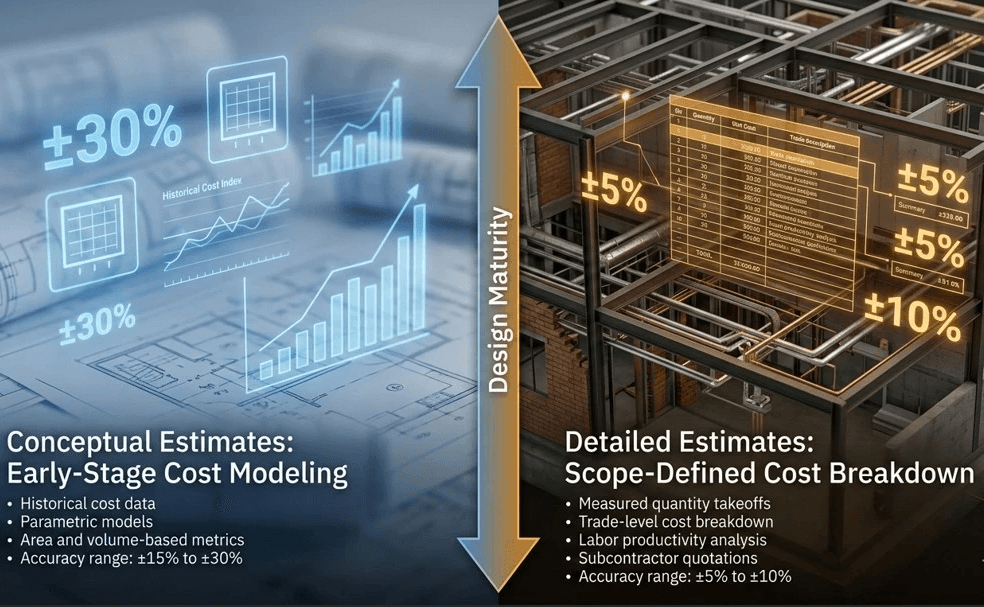
In construction cost management, the accuracy of an estimate depends on the level of design definition. One of the most common budgeting mistakes is applying the wrong estimating methodology to the wrong project phase.
Understanding the technical difference between conceptual estimates and detailed estimates is essential for cost control, risk management, and financial forecasting.
At early project stages, limited design data restricts estimating precision. During this phase, conceptual cost estimation techniques such as parametric modeling, cost per square meter benchmarking, and historical cost database analysis are used. As design progresses and coordinated drawings become available, projects transition to detailed construction estimates supported by structured quantity takeoffs and trade-level pricing. Many contractors enhance this transition by working with specialized construction estimation teams to validate quantities, productivity rates, and procurement assumptions before bid submission.
Conceptual Estimates: Early-Stage Cost Modeling
Conceptual estimates are typically developed during feasibility or schematic design. They rely on:
Historical cost data and cost indices
Parametric cost models
System-based estimating
Area and volume-based metrics
Accuracy ranges are generally wider (±15% to ±30%) due to limited scope definition. These estimates are used for feasibility studies, budget approvals, and high-level financial modeling.
They support strategic decision-making but are not suitable for contractual commitments.
Detailed Estimates: Scope-Defined Cost Breakdown
Detailed estimates are prepared once design documentation reaches sufficient maturity. They are based on:
Measured quantity takeoffs
Trade-level cost breakdown structures (CBS)
Labor productivity analysis
Subcontractor quotations
Equipment and logistics planning
Accuracy ranges narrow significantly (±5% to ±10%), depending on documentation quality. These estimates form the basis for tender submissions, baseline budgets, and cash flow projections.
Risk Allocation and Estimate Selection
The key technical distinction lies in risk allocation. Conceptual estimates absorb higher uncertainty through contingencies. Detailed estimates distribute risk more precisely across scope elements.
Using a conceptual estimate to fix contract values introduces exposure to scope gaps and cost overruns. Conversely, investing in a detailed estimate too early may lead to rework if design changes significantly.
Strategic Application for Decision Makers
For executives and project directors, the objective is cost predictability. Conceptual estimating informs early feasibility and option analysis. Detailed estimating safeguards execution and margin control.
Aligning the estimating methodology with design maturity improves bid accuracy, reduces change orders, and strengthens financial governance.
In construction, cost certainty is not achieved by estimating more, it is achieved by estimating appropriately.