Share
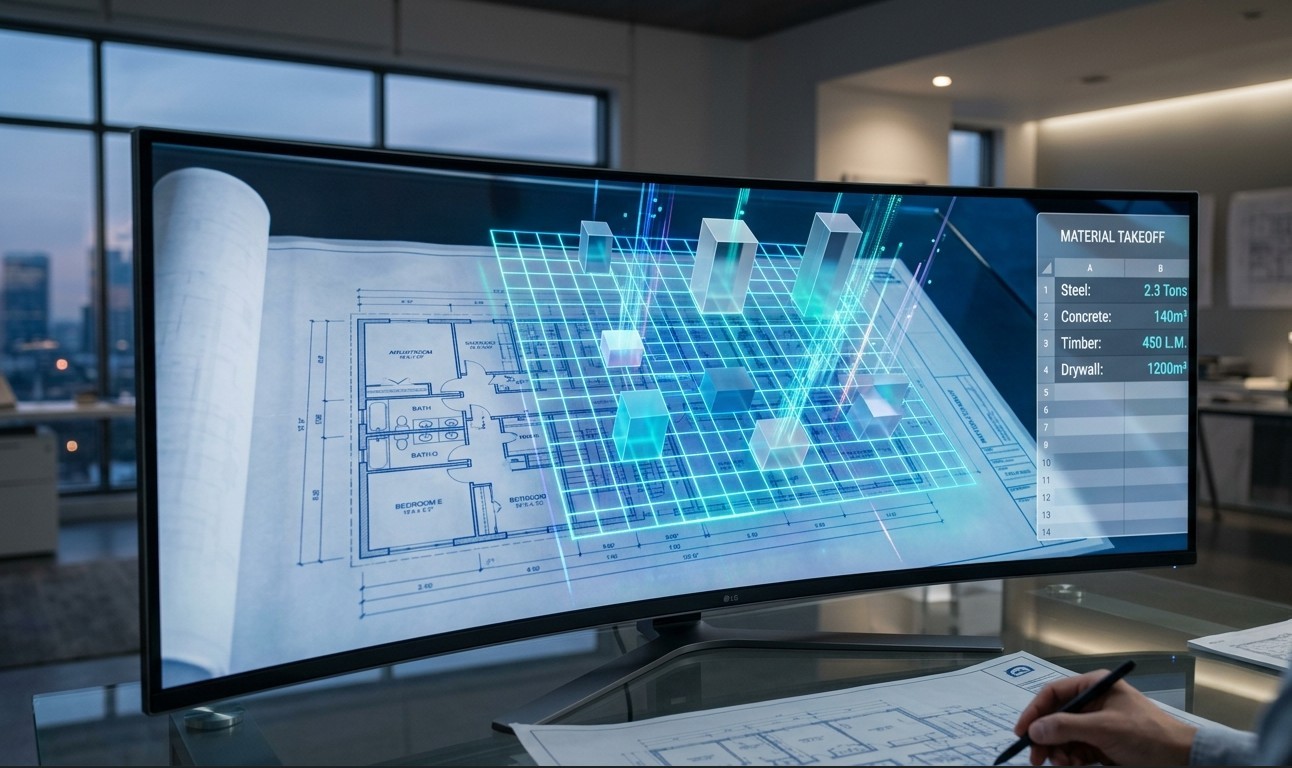
Construction cost estimation has become more complex as projects grow in scale and technical requirements. Today, contractors rely on construction estimating software, digital takeoff tools, and cost databases to improve accuracy and speed.
But tools alone do not guarantee reliable estimates. For decision makers, the real question is how to use estimation tools effectively to control cost, reduce risk, and support better project outcomes.
Modern estimation workflows combine software capabilities with professional expertise. While tools automate quantity takeoffs and standardize pricing, many contractors still rely on experienced estimation specialists to validate assumptions, adjust productivity rates, and align estimates with real project conditions.
Types of Construction Estimation Tools
Construction estimation tools generally fall into three main categories:
Digital takeoff tools such as PlanSwift, Bluebeam, and Autodesk Takeoff extract quantities directly from drawings or BIM models, reducing manual errors and improving speed.
Estimating software platforms like ProEst, CostX, and Sage Estimating help organize cost data, apply pricing, and generate structured cost breakdowns for bidding and budgeting.
Cost databases such as RSMeans provide historical pricing, labor rates, and material costs that help standardize estimates across projects.
Benefits of Using Estimation Software
Estimation tools help contractors:
Improve bid preparation speed
Enhance consistency across estimates
Reduce manual errors
Enable scenario analysis and cost comparison
For large-scale projects, these tools support better data management and handling of complex scope.
Limitations of Estimation Tools
Despite their advantages, estimation tools rely on input quality and predefined assumptions. They do not fully account for site constraints, constructability challenges, or real-time market changes.
Without expert review, automated estimates can create false confidence.
Combining Tools with Expertise
The most reliable construction estimates come from combining digital tools with human judgment. Experienced estimators interpret incomplete drawings, assess risks, and validate cost assumptions.
This integrated approach improves accuracy, reduces uncertainty, and strengthens cost control.
Why Estimation Strategy Matters
For construction leaders, estimation is not just a technical task. It is a strategic function that directly impacts profitability and delivery performance.
Choosing the right tools, and applying them with expertise, helps organizations achieve more predictable project outcomes.
In modern construction, tools increase efficiency, but expertise ensures accuracy.