
The baseline schedule is the project's first contract-level commitment about how long the work will take and how it'll get sequenced. Once it's accepted, every future analysis, every variance argument, every delay claim, every owner conversation references it. Get the baseline wrong and every downstream conversation runs against a flawed reference.
Baseline submissions get rejected for predictable reasons: logic gaps, missing constraints, inconsistent calendar, durations without basis, resource loading that doesn't match the contract requirement, schedule narrative that doesn't support the network. Most rejections are avoidable on first submission.
AEdigo gives general contractors, subcontractors, and project management firms on-demand access to pre-vetted schedulers who specialize in baseline submission. They build baselines that survive owner review on first pass, working inside your contract requirements, your office's coding standards, and the project's actual logic.
What baseline schedule preparation services actually deliver
Typical outputs from a baseline schedule professional working through AEdigo:
Activity development and coding aligned to contract specifications
Logic relationship building with documented basis
Duration development based on production rates and crew sizing
Calendar setup including weather, holidays, and shift patterns
Resource loading where the contract requires it
Critical path identification and float analysis
Schedule narrative supporting the baseline submission
Owner submission package and comment response cycles
When you actually need baseline preparation support
A new project requires baseline submission and your in-house team is committed.
A baseline submission was rejected and you need a clean re-submission.
Multiple projects are in startup simultaneously and need parallel baseline preparation.
A contract format requires methodology your team isn't familiar with.
Schedule reviews are repeatedly returning the baseline with comments your team can't keep pace with.
An owner has imposed a tight baseline submission window.
A claims-stage baseline rebuild is required to support delay analysis.
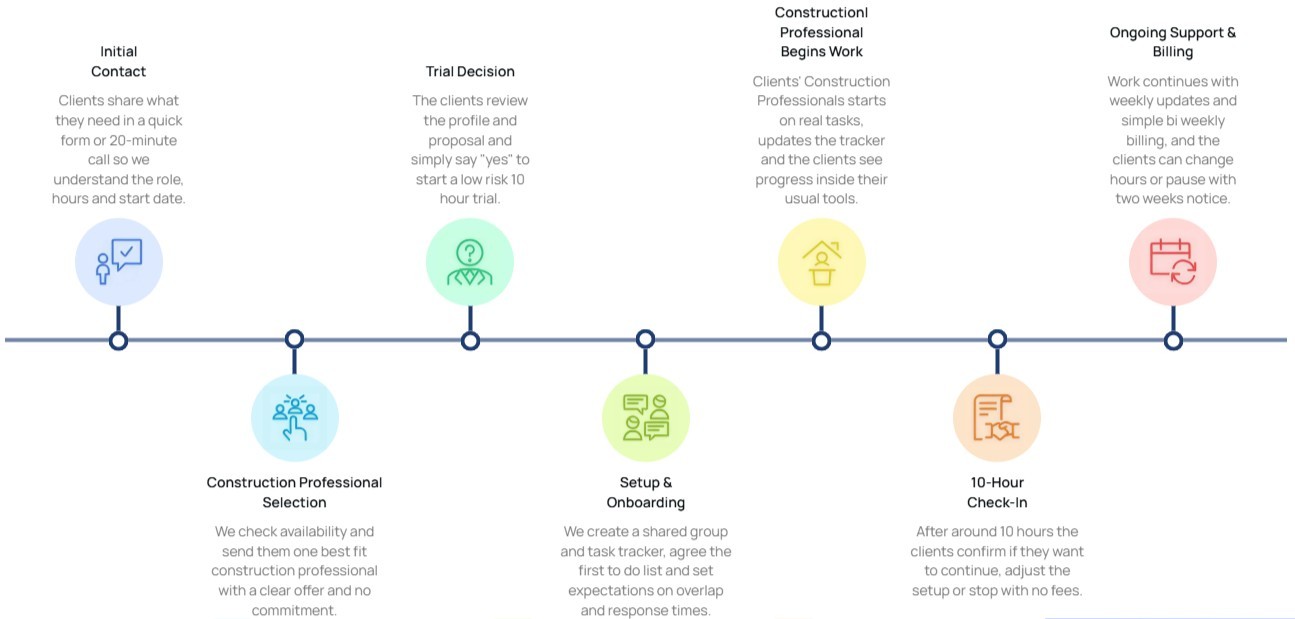
How AEdigo runs baseline preparation work
1. Match against contract format and project type
The match accounts for the contract format and the project type, so the scheduler is already familiar with the submission framework.
2. Kick-off on contract requirements
Contract-specific activity coding, calendar requirements, resource loading methodology, narrative format, submission package format, and review cycle structure. The kick-off locks all of these before development begins.
3. Baseline development
Activity development, logic building, duration assignment, calendar application, resource loading where required, and critical path identification. Documentation gets built as the baseline develops, not assembled at submission.
4. Internal QA against contract checklist
Before submission, the baseline goes through QA against the contract's specific submission checklist and against general CPM QA standards (logic gaps, dangling activities, calendar consistency, narrative completeness).
5. Submission and comment response
The baseline gets prepared in the contract's submission format and tracked through owner review. Comment response cycles are part of standard scope until the baseline is accepted.
Tools baseline schedule professionals work in
Primavera P6 for primary baseline development
Microsoft Project for MS Project-led contracts
Asta Powerproject for Asta-driven projects
Acumen Fuse for schedule QA and logic verification
Excel for activity development and resource analysis
Microsoft Word for schedule narrative
What separates a baseline professional from a CPM operator
Anyone can build a CPM network. The scheduler who delivers a baseline that owners accept on first submission knows what reviewer comment patterns look like, what contract-specific requirements drive rejection, and what documentation depth supports acceptance.
AEdigo vets baseline schedule professionals on:
P6 or MS Project fluency at production level
Contract-specific submission experience across major forms
Logic discipline including constraint usage and predecessor completeness
Duration development methodology
Resource loading experience
Schedule narrative writing skill
QA habits including logic gap and dangling activity detection
Comment response and revision discipline
Use cases by stakeholder
General contractors
Baseline submission preparation across project types
Multi-project parallel baseline development
Baseline rebuild after rejection
Claims-stage baseline reconstruction
Subcontractors
Trade-side baseline submission to GC schedules
Internal baseline development for self-perform scopes
Owners and program managers
Owner-side baseline review and acceptance support
Independent baseline development for capital projects
Claims-stage baseline analysis
Common baseline rejection reasons
Owner reviewers reject baselines for predictable reasons. If your past submissions have hit any of these, the issue is process, not effort.
Activity coding inconsistent with the contract specification.
Logic gaps including dangling activities, missing predecessors, or backward logic.
Constraints used to manipulate the critical path instead of represent reality.
Durations without production rate or crew sizing basis.
Calendar setup inconsistent with the project's actual working pattern.
Resource loading missing or inconsistent where the contract requires it.
Schedule narrative incomplete, leaving the baseline undefendable.
Documentation discipline that supports future claims
A baseline that the owner accepts is the first deliverable. A baseline that holds up if a claim emerges six months later is the second. The two require different documentation discipline, and most baselines miss the second.
What baseline-stage documentation looks like when it's claims-defensible:
These habits don't require special tools or new processes. They require consistent calendar attention and someone whose role is dedicated to the work, not someone for whom this is an extra responsibility on top of project management or field operations. That's the difference between a workflow that runs cleanly and one that has to be rescued at closeout.
Basis of schedule narrative covers production rates, crew sizing assumptions, and calendar logic.
Logic decisions get documented at the time, not reconstructed later from memory.
Constraint usage gets justified in the narrative, with reasoning available for audit.
Resource loading methodology gets locked and documented before the baseline issues.
Critical path identification carries documented float analysis.
Submission package archives original baseline files alongside the accepted version.
Owner comment cycles get logged with response documentation.
Baseline preparation services vs. the alternatives
The alternatives are: have the in-house scheduler develop baseline alongside active updates, contract to a freelance scheduler without contract-specific experience, or accept that baselines will go through multiple rejection cycles.
In-house schedulers stretched between baseline development and active updates usually deliver one badly. The baseline gets rushed and rejected, generating multiple revision cycles.
Freelance schedulers without contract-specific experience produce baselines that look complete and miss the contract-specific format requirements that drive rejection.
Multiple rejection cycles delay project mobilization and create owner relationship damage.
AEdigo runs baseline preparation as a managed engagement: contract-fluent schedulers, your office's coding standards, with internal QA and full comment-cycle coverage.
How engagement works
10-hour free trial
Flexible billing tied to actual hours worked
Cancel or pause with two weeks' notice
Engagements scoped per project baseline cycle
Self-managed and managed tiers available
Frequently asked questions
Implementation note: Wrap this section in FAQPage schema markup (schema.org/FAQPage) to qualify for rich results in Google.
Can the scheduler work to our contract's specific baseline format?
Yes. The match process and kick-off both account for contract-specific submission requirements. Activity coding, calendar requirements, resource loading methodology, and narrative format get locked at kick-off.
What happens if the owner rejects the first baseline submission?
Comment response cycles are part of standard scope. The scheduler implements comments, revises the baseline, and re-submits until the owner accepts.
Does the scheduler handle resource-loaded baselines?
Yes. Resource loading is part of standard scope on engagements where the contract requires it. Methodology aligns to the contract specification.
Can the baseline support a future delay claim?
Yes. Baselines built to claims-defense standard carry documentation including basis-of-schedule narrative, duration justification, logic decisions, and constraint usage. This documentation is what allows the baseline to support a future delay analysis or claims defense.
How quickly can a baseline submission be prepared?
Timeline depends on project complexity, contract format, and submission requirements. The kick-off scopes the development cycle and aligns to the owner's submission deadline.