
A bid is more than a price. It's a takeoff, a pricing run, an assembled vendor package, an alternates structure, a clarifications schedule, a cost narrative, and a submission package that lands on the owner's desk on time and complete.
Most contractors lose bids on submission discipline more than on price. The package shows up incomplete. The clarifications conflict with the cost narrative. An alternate is missing pricing. The bid bond paperwork is wrong. The owner moves on.
AEdigo gives general contractors, subcontractors, and estimating teams a pre-vetted bid preparation professional who runs the package end-to-end, working inside your bid template, your office standards, and your submission requirements.
What bid preparation services actually deliver
The deliverable is a complete, on-time, audit-ready bid submission. Every component is integrated, reconciled, and packaged to the owner's submission standard.
Typical outputs from a bid preparation professional working through AEdigo:
Quantity takeoff coordination across self-perform and subcontracted scopes
Pricing roll-up integrating vendor quotes and assembly-level costs
General conditions, fee, and contingency build-up
Alternates pricing and structure
Cost narrative covering assumptions, exclusions, and clarifications
Bid clarification and exception schedules
Submission package preparation in the owner's required format
Bid bond, insurance, and qualification documentation coordination
When you actually need bid preparation support
Your estimating team is stacked across multiple bids and at least one is going to slip.
A bid landed late and the submission window is shorter than your team can absorb.
The submission requires a non-standard format your office doesn't have a template for.
An owner is requesting 20+ alternates and your team can't structure them in time.
You're chasing a multi-package bid and need parallel preparation across scopes.
Bid season hits and your team can't carry the prep volume on top of pricing work.
A complex submission requires qualification packages, narrative responses, or proposal documents in addition to price.
How AEdigo runs bid preparation work
1. Bid pursuit alignment
The bid prep professional reviews the project documents, identifies submission requirements, and aligns to the bid date and review cycle. Most lost bids start with a missed submission requirement, not a missed price.
2. Office template and standards alignment
Bid template, cost narrative format, alternates structure, clarifications schedule, and submission package format. The kick-off locks the office's standards before any preparation work begins.
3. Component-by-component build
Takeoff coordination, pricing integration, alternates, narrative, clarifications, qualifications, and submission package. Each component is built in sequence with reconciliation against the bid summary at each step.
4. Internal review pass
Before bid submission, the package goes through a self-review against the owner's submission requirements and client’s review. Missed components, conflicting clarifications, and submission format issues get caught here.
5. Submission and revision coverage
The package gets prepared for submission per the owner's format. If the bid period generates revisions or addenda, the package updates without restarting the engagement.
Tools bid preparation professionals work in
Sage Estimating, Trimble WinEst, B2W Estimate, and CostX for pricing integration
PlanSwift, OST, and Bluebeam Revu for takeoff coordination
Microsoft Word and Excel for narrative, clarifications, and qualification documents
Procore, Building Connected, and Autodesk Construction Cloud for bid management workflows
Adobe Acrobat and Bluebeam for submission package assembly
Office's internal bid templates, alternates structures, and clarification schedules
What separates bid preparation from estimating
Estimating produces a number. Bid preparation produces a submission. The professional who delivers a complete, on-time bid does the integration work most estimators don't have time for.
AEdigo vets bid preparation professionals on:
Submission discipline and owner-format fluency
Cost narrative writing skill
Alternates structure and breakout discipline
Clarifications and exceptions drafting experience
Qualification document and proposal narrative experience
Coordination instinct across takeoff, pricing, and submission components
Schedule discipline against the bid date
Document control habits across submission components
Use cases by stakeholder
General contractors
Multi-trade bid preparation across self-perform and sub scopes
GMP and design-build proposal preparation
Public bid submission preparation against agency-specific formats
Qualification and proposal narrative drafting
Subcontractors
Parallel bid preparation across multiple GCs
Trade-specific bid packages with cost narrative and clarifications
Specialty scope qualification documents
Estimating leaders
Bid season volume coverage
Bid integration coordination across in-house and external pricing
Submission package quality control
Common bid preparation failures that lose work
Most lost bids that traced back to preparation rather than price hit the same handful of failures.
Submission package missing a required component the owner explicitly listed.
Cost narrative and clarifications schedule contradicting each other.
Alternates pricing structured in a format the owner can't compare across bidders.
General conditions calculated against a stale template instead of project-specific scope.
Bid bond, insurance, or qualification paperwork incomplete on submission.
Submission filed in the wrong format or to the wrong portal.
Clarifications written in language that creates exposure during contract negotiation.
What good bid preparation actually looks like in practice
Bid preparation done well is invisible. The estimator hits submission with the bid summary reconciled, the cost narrative coherent, the alternates structured, and the package complete. Bid preparation done badly leaves visible gaps that owner reviewers and selection committees notice immediately.
These are the markers of a bid prep process that's actually working:
The bid hits submission with time to spare for senior review, not rushed in the final hour.
The cost narrative reads as a coherent story, not a stack of disconnected assumption statements.
Alternates are structured so the owner can compare across bidders without reformatting.
Clarifications are written in language that doesn't create unintended scope exposure during contract negotiation.
Submission package components are complete and in the owner's required format on first delivery.
The internal reconciliation between takeoff, pricing, and submission catches errors before the senior estimator sees them.
Bid preparation services vs. the alternatives
The alternatives are: load preparation onto the senior estimator alongside pricing, hand it to an admin who doesn't understand the construction context, or accept that some bids will be incomplete during peak season.
Senior estimators stretched across pricing and preparation usually deliver one badly. Pricing wins. Preparation slips. Submissions go out incomplete.
Admin support without construction context produces submission packages that look right and read wrong. Cost narratives miss key assumptions. Clarifications create unintended scope exposure.
Accepting incomplete submissions has the highest hidden cost. Every bid you submit incomplete is the equivalent of skipping the bid, with the additional cost of having burned the pricing time.
AEdigo runs bid preparation as a managed engagement with construction-context professionals, your office templates, and full submission coverage.
How engagement works
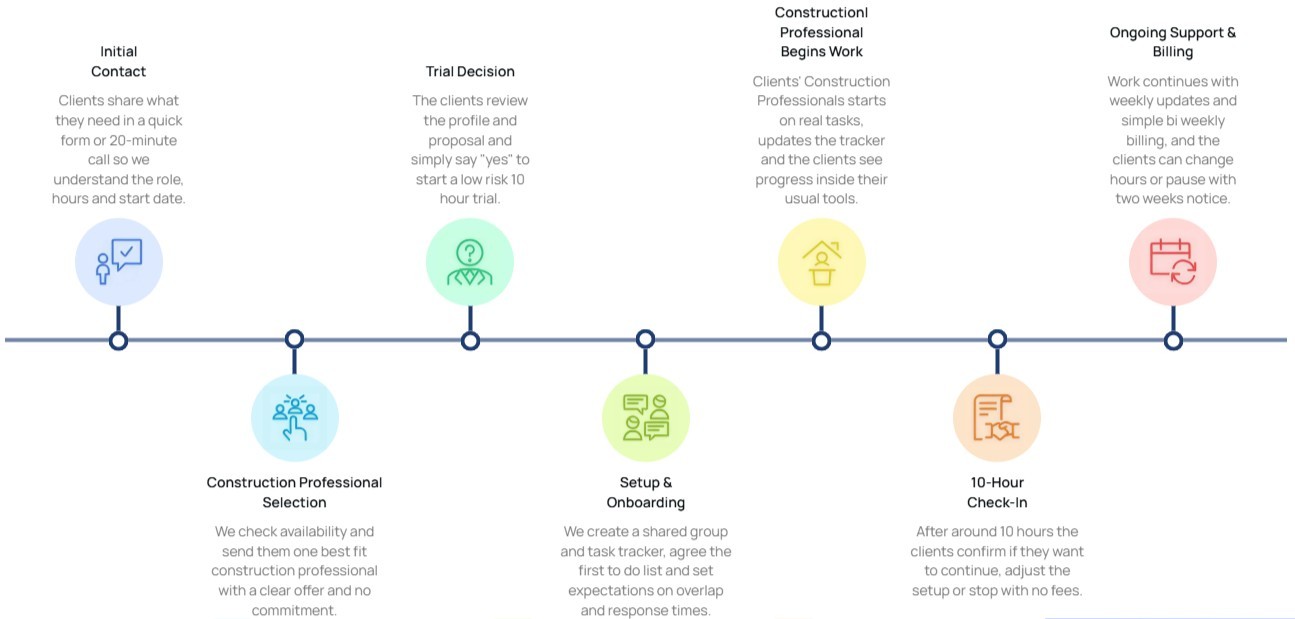
10-hour free trial
Flexible billing tied to actual hours worked
Cancel or pause with two weeks' notice
Capacity scales with bid volume
Self-managed and managed tiers available
Frequently asked questions
Implementation note: Wrap this section in FAQPage schema markup (schema.org/FAQPage) to qualify for rich results in Google.
Does bid preparation include takeoff and pricing, or just the submission package?
Both options exist. Some clients use AEdigo only for the submission preparation layer (narrative, alternates, clarifications, package assembly). Others have AEdigo run takeoff and pricing through to submission. The kick-off scopes the work to your office's needs.
Will the bid use our office's cost narrative and clarifications template?
That's the default. The kick-off captures your office's bid template, narrative format, alternates structure, and clarifications schedule. The bid comes back in your office's format, ready for senior review and submission.
Can AEdigo support proposal narrative writing for design-build or GMP pursuits?
Yes. Qualification documents, proposal narratives, and design-build response writing are part of the offering. The professional pool includes pursuit writers with construction context.
How do you handle addenda and revisions during the bid period?
Revisions are part of standard scope. When addenda issue or scope changes during the bid period, the bid prep professional incorporates the changes and updates the submission package without restarting the engagement.