
Change orders are where margin is made or lost during execution. The number of contractors who price changes correctly, document them defensibly, and get them paid on time is smaller than most owners would believe. The contractors who don't lose 1 to 3 points of margin per project to changes that didn't get processed properly.
Change order work isn't hard in theory. It's hard in practice because it competes with the daily work of running the project. Field issues happen, the team responds, and the documentation catches up two weeks later, by which point the supporting evidence is gone.
AEdigo gives general contractors and subcontractors on-demand access to pre-vetted change order professionals. They handle pricing, documentation, tracking, and owner negotiation support, working inside your contract structure and your office's CO process.
What change order services actually deliver
The output is a documented, priced, defensible change order package, traceable to its origin and ready for owner submission. The discipline is in the documentation, not the math.
Typical outputs from a CO professional working through AEdigo:
Change order pricing including labor, material, equipment, and indirect costs
Schedule impact analysis tied to the baseline schedule
Supporting documentation packaging including RFIs, field directives, and email trails
Cost narrative documenting basis of pricing and reference to contract provisions
Change order log tracking and aging analysis
T&M ticket review and reconciliation against CO submissions
Subcontractor change order coordination and roll-up
Owner submission package preparation and revision tracking
When you actually need change order support
Your CO log is growing faster than your team can process it.
Margin on the project is slipping and you suspect changes aren't being captured properly.
An owner is questioning CO pricing and you need defensible documentation.
A T&M-heavy project is generating tickets faster than reconciliation can keep up.
Schedule impact arguments on COs aren't being supported and you're losing time entitlement.
A claim is forming and the underlying CO documentation isn't strong enough.
Subcontractor COs are coming in unstructured and someone has to roll them up before owner submission.
How AEdigo runs change order work
1. Origin and entitlement review
The CO professional reviews the change origin (RFI, directive, owner-driven scope, design issue) and confirms entitlement under the contract. Pricing without entitlement support is a CO that gets rejected.
2. Cost development
Labor, material, equipment, and indirect costs get developed against the contract's CO methodology. Markups, overheads, and bond cost get applied per the contract terms, not the office default.
3. Schedule impact analysis
Schedule impact, including time entitlement, gets analyzed against the baseline schedule and the current update. Unsupported time arguments lose entitlement, even when the cost argument is strong.
4. Documentation packaging
Supporting documentation (RFIs, directives, email trails, daily reports, photos) gets packaged into a CO submission that an owner reviewer can audit. Documentation strength is what determines CO acceptance more often than pricing.
5. Tracking and progress reporting
CO log status, aging, owner response time, and outstanding entitlement get reported. Project leadership sees CO health as a leading indicator, not a closeout surprise.
Tools change order professionals work in
Procore, Autodesk Construction Cloud, and CMiC for CO log management and routing
Sage Estimating, WinEst, and CostX for CO pricing development
Primavera P6 and Microsoft Project for schedule impact analysis
Bluebeam Revu for documentation markup and submission package assembly
Excel models for CO log tracking and aging analysis
Office's contract templates for entitlement reference
What separates a CO professional from a CO admin
Anyone can fill out a CO form. The professional who gets COs paid knows the contract, knows what entitlement actually requires, and knows how to package documentation that an owner reviewer can't reject.
AEdigo vets CO professionals on:
Contract fluency across major contract forms (AIA, ConsensusDocs, custom owner forms)
Pricing discipline aligned to contract CO methodology
Schedule impact analysis skills
Documentation packaging discipline
T&M reconciliation experience
Subcontractor CO roll-up experience
Comfort with owner negotiation and revision cycles
CO log management and aging discipline
Use cases by stakeholder
General contractors
Owner-side CO preparation and submission
Subcontractor CO review and roll-up
T&M ticket reconciliation
CO log management and tracking
Subcontractors
GC-side CO preparation
Documentation packaging for higher-tier submission
Schedule impact arguments
Claims-stage CO documentation
Owners and program managers
Independent CO review against contract entitlement
T&M reconciliation against contractor submissions
Claims-stage CO analysis
Common CO failures that cost margin
Margin loss on changes traces to predictable failures. If your project has hit any of these, the issue is process, not effort.
COs priced without entitlement support, leading to predictable owner rejection.
Schedule impact omitted, losing time entitlement on top of cost.
Documentation packaged after pricing, with supporting evidence already cold.
T&M tickets not reconciled against the originating directive, leaving disputed costs.
Subcontractor COs rolled up without verification, exposing the GC to unreconcilable lower-tier disputes.
CO log aging unmanaged, with stale items losing entitlement strength over time.
Pricing based on office defaults instead of the contract's specific markup methodology.
What a healthy CO program actually looks like
Change order programs that protect margin share a small set of operational habits. Most contractors know what these habits are. Few have the bandwidth to maintain them under real project pressure.
The markers of a CO process that's actually working:
CO log aging stays inside defined thresholds, with no item open longer than 30 days without escalation.
Pricing methodology matches the contract, not the office default.
Schedule impact arguments accompany every CO that affects the schedule, not just the obvious ones.
Documentation packaging happens alongside pricing, not after submission rejection.
Subcontractor COs are reviewed and verified before they roll up to the GC's owner-side submission.
Progress reporting puts CO health in front of project leadership as a leading indicator.
Change order services vs. the alternatives
The alternatives are: load CO work onto the project manager, contract to a freelance estimator with no contract context, or absorb the margin loss as a cost of doing business.
Project managers loaded with CO work usually defer it until field operations slow, by which point the documentation is cold and entitlement is weakened.
Freelance estimators without contract context price changes accurately but document them poorly. Owner reviewers reject the package on the documentation, not the price.
Absorbing margin loss is the highest-cost option, but it's the most common because it's invisible until closeout reconciliation.
AEdigo runs CO work as a managed engagement: contract-fluent professionals, your office's CO process, your contract's pricing methodology, with documentation packaging and weekly tracking.
How engagement works
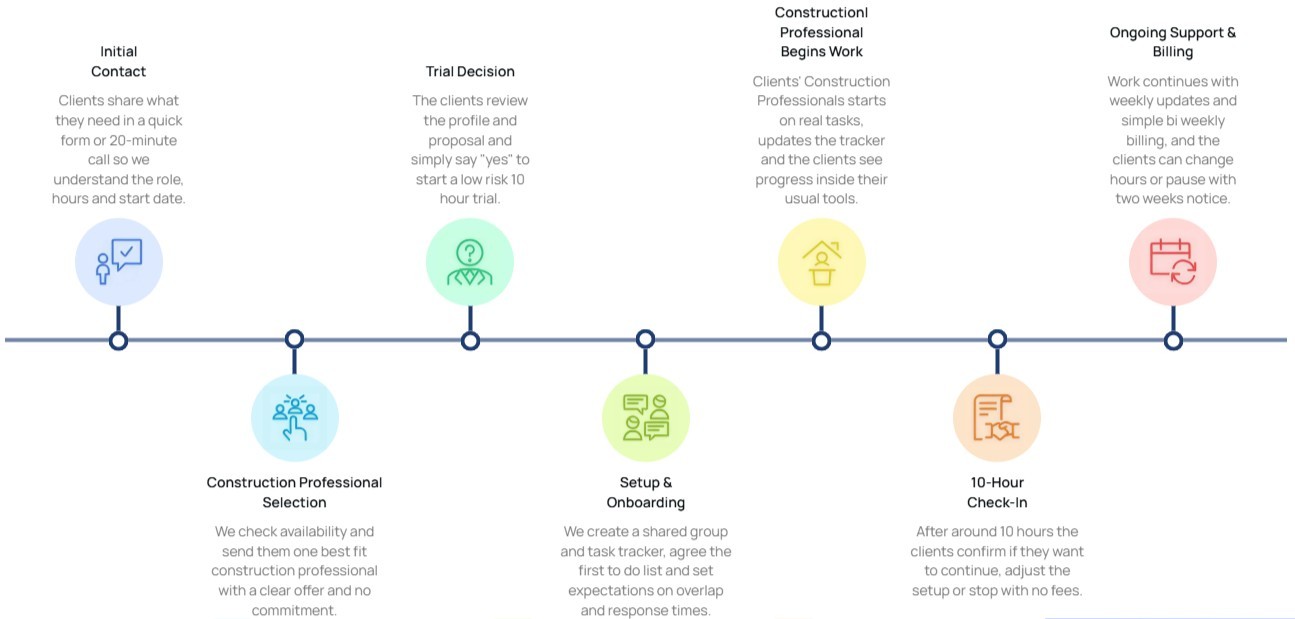
10-hour free trial
Flexible billing tied to actual hours worked
Cancel or pause with two weeks' notice
Capacity scales with project phase and CO volume
Self-managed and managed tiers available
Frequently asked questions
Implementation note: Wrap this section in FAQPage schema markup (schema.org/FAQPage) to qualify for rich results in Google.
Will the CO professional follow our contract's specific pricing methodology?
Yes. The kick-off captures your contract's CO methodology including labor markup, material markup, overhead, profit, bond cost, and any custom provisions. Pricing comes back per the contract, not a generic markup.
Can the professional handle T&M ticket reconciliation?
Yes. T&M reconciliation against directives, daily reports, and CO submissions is part of standard scope, especially on projects with heavy directive activity.
Do AEdigo's CO professionals support claims-stage documentation?
Yes. Where COs escalate to claims, the CO documentation becomes the foundation of the claim. The professional pool includes experience packaging documentation for claims-stage review and dispute resolution.
Can the professional handle subcontractor CO roll-up?
Yes. Subcontractor CO review, reconciliation, and roll-up into the GC's owner-side submission is a common scope item. Verification of subcontractor pricing and entitlement happens before the CO rolls up.
What about schedule impact and time entitlement?
Schedule impact analysis tied to the baseline and current schedule update is part of standard scope. Unsupported time arguments lose entitlement, so the analysis runs alongside the cost work, not after it.