
Clash detection is the easy half. Anyone with Navisworks can produce a clash report.
Closing those clashes is where most coordination programs break down. The list grows. Nobody owns the resolution. Trades push back on whose model has to move. Open items compound week over week, and the team eventually accepts a coordination pass with hundreds of clashes parked for later, meaning the field will catch them.
Resolution is the work that actually protects the project. It's the coordination meetings, the trade-by-trade negotiation, the model updates, and the verification cycle that proves the conflict is closed and stays closed.
AEdigo gives construction teams pre-vetted clash resolution professionals who are fluent in Navisworks, Revizto, and the trade dynamics that drive coordination outcomes. They own the resolution loop end-to-end and report progress weekly.
What clash resolution services actually deliver
Resolution is the difference between knowing about a problem and not having it anymore. The output is fewer open clashes, plus the discipline to keep new ones from reopening.
Typical outputs from a clash resolution professional working through AEdigo:
Clash assignment with clear trade ownership
Trade-by-trade coordination of conflict resolution
Model updates verified against resolved clashes
Coordination meeting facilitation and minutes
Decision tracking covering what was agreed, by whom, and when
Re-detection cycles to verify resolution holds
Open-item aging reports with escalation flagging
Pre-construction coordination sign-off documentation
When you actually need clash resolution support
Your clash report has hundreds of open items and the list is growing instead of shrinking.
Coordination meetings have stopped producing decisions and turned into status updates.
Trades are bouncing clashes back to each other without resolution.
Your VDC lead is running detection but not driving closure.
You're approaching a coordination sign-off date and the open clash count is too high.
A subcontractor's model came in late and is creating downstream conflicts.
Field issues are tracing back to coordination work that was parked months ago.
How AEdigo runs clash resolution work
1. Open-item triage
The first pass is structuring what's already there. Pulling open clashes, grouping them by interface and trade, and separating real conflicts from model errors and tolerances. Most projects come in with a clash report that's 60% noise. Triage cuts that down before any meeting time gets spent.
2. Trade ownership assignment
Every real clash gets assigned a primary owner (the trade who has to move first) and a secondary owner if needed. Without ownership, clashes sit. With ownership, they move.
3. Coordination meeting facilitation
The clash resolution professional runs or supports the coordination meeting, working through the prioritized open list, capturing decisions, and assigning model updates with deadlines. Meetings end with action items, not just a list.
4. Verification cycle
Once a clash is reportedly resolved, the professional re-runs detection on the affected interface to verify. This is the step most coordination programs skip, and the step that prevents closed clashes from reopening at the worst possible moment.
5. Weekly resolution report
Open clash count trend, resolution velocity by trade, aging of unresolved items, and escalation flags, issued every week.
Tools clash resolution professionals work in
Navisworks Manage for the clash database, viewpoint management, and re-run cycles
Revizto for issue tracking and multi-stakeholder coordination
BIM Collaborate Pro for cloud model coordination
Revit for direct model edits when authorized
Solibri for rule-based model checking
Dynamo for automation around clash export and reporting
What separates a resolution professional from a clash spotter
Spotting clashes is software work. Closing them is coordination work, and that requires construction context, trade dynamics, and the discipline to drive a decision through a room of people who all want someone else's model to move.
AEdigo vets clash resolution professionals on:
Navisworks and Revizto fluency at production level
Coordination meeting facilitation experience
Trade-specific construction knowledge across MEP, structural, façade, and fire protection
Decision tracking discipline covering who agreed to what, when
Comfort with cross-stakeholder negotiation
Aging-report and escalation discipline
Verification rigor through re-detection cycles, not marked-resolved acceptance
Use cases by stakeholder
General contractors
Multi-trade resolution coordination
Coordination meeting facilitation
Pre-mobilization sign-off coordination
RFI-to-clash linkage and resolution tracking
Subcontractors
Internal clash resolution before model issue
Conflict resolution against GC coordination models
Trade interface negotiation support
Design firms
Cross-discipline clash resolution before IFC issue
Authority submission coordination
Design-phase coordination cycle management
What good resolution velocity actually looks like
Resolution work is measurable. Most projects don't measure it, which is why most projects can't tell whether coordination is converging or drifting until it's too late.
On a healthy coordination program, these numbers tend to move together:
Open critical clash count trending down week over week, even as new model revisions come in
Resolution velocity per trade staying inside a predictable band, not zero one week and a hundred the next
Open-item aging staying inside defined thresholds, with no critical clash open longer than two weeks without escalation
Re-detection cycles confirming closed clashes stay closed
Coordination meeting time per cycle decreasing, not because the work is shrinking, but because the prep is better
Why most teams can't see this
These metrics aren't visible by default in Navisworks or Revizto. Someone has to pull the data, structure the report, and put it in front of project leadership every week. That work, the reporting layer, is often the first thing that gets cut when the in-house team is overloaded, which means project leadership flies blind on coordination health.
AEdigo's weekly resolution report is part of the engagement, not an add-on. The team that pays for the resolution work gets the visibility on whether it's working.
Clash resolution services vs. the alternatives
Most teams default to one of three patterns: load resolution onto the in-house VDC lead, accept that the field will catch what coordination missed, or treat coordination as a one-time pre-construction event.
All three are expensive. In-house VDC leads who run detection rarely have the calendar capacity to drive resolution to closure. Field-caught clashes carry RFI cost, schedule cost, and margin cost. One-time coordination passes don't survive contact with model revisions.
AEdigo runs resolution as a continuous service, owned by a single coordinator, reported weekly, and tied to verification cycles, not a checklist that someone signs at handover.
How engagement works
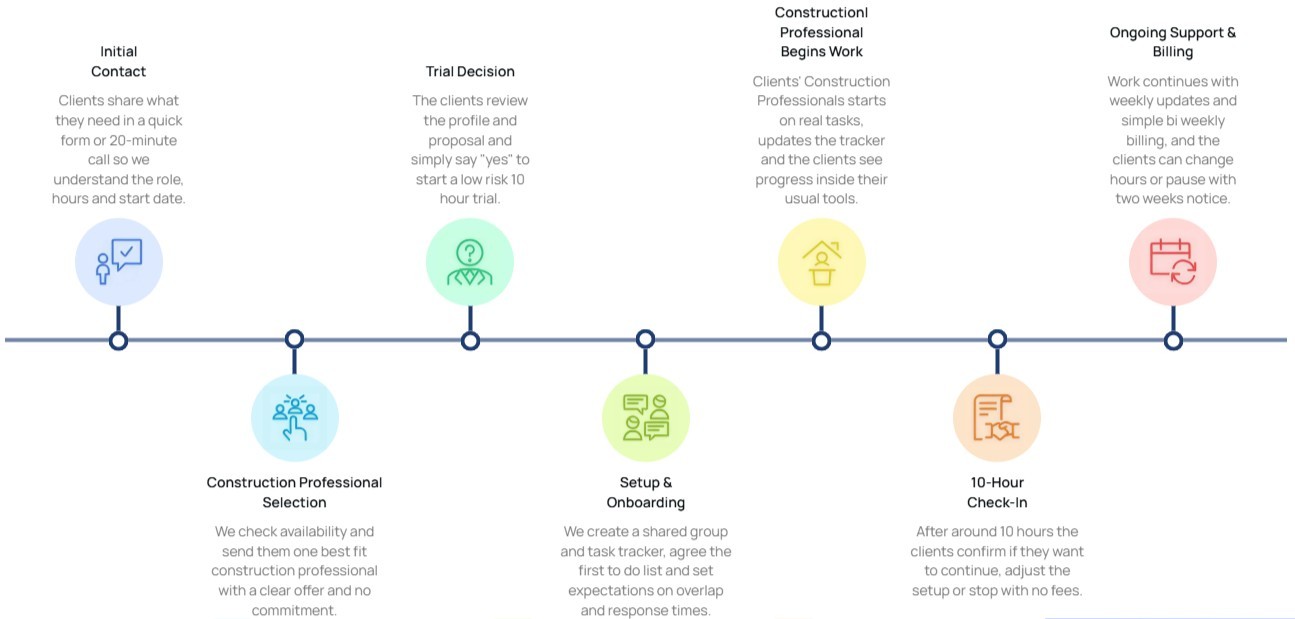
10-hour free trial
Flexible billing tied to actual hours worked
Cancel or pause with two weeks' notice
Adjust hours as coordination workload moves
Self-managed and managed tiers available
Frequently asked questions
Implementation note: Wrap this section in FAQPage schema markup (schema.org/FAQPage) to qualify for rich results in Google.
Is clash resolution a separate service from clash detection?
It can be either. Some clients run detection in-house and bring AEdigo in just for resolution. Others have AEdigo run the full cycle. Resolution-only engagements are common when the in-house VDC team has the bandwidth to detect but not to drive closure.
Can the resolution professional update models directly, or only track decisions?
Both options exist. Some clients give AEdigo's professional direct model-edit authority for specific trades. Others use them as the coordinator who drives the model-edit work back into the trade modeler's queue. The kick-off call sets the authority boundary.
How do you handle disputes between trades over who has to move?
Trade priority is set during the BIM Execution Plan or coordination plan kick-off. Architectural typically sets the envelope, structural anchors next, and MEP routes around. When that's not enough, the resolution professional documents the conflict, prepares the decision options for the project team, and escalates with cost and schedule context attached.
What's a realistic open-clash count at coordination sign-off?
It depends on project type and complexity. As a working benchmark, fewer than 50 open critical clashes at sign-off on a typical commercial project is healthy. Anything over 200 indicates the resolution work hasn't really been done.
Do AEdigo's resolution professionals work with Revizto or other coordination platforms?
Yes. Revizto is a common alternative to Navisworks for coordination work. We match the professional's software fluency to the platform you already run.