
Closeout is where retention sits, owner relationships sour, and project teams burn out. The closeout documentation requirement is contractual, but the work usually gets handled by team members who have already mentally moved to the next project.
The result is closeout that drags. Retention sits in the owner's hands. As-builts arrive incomplete. O&M manuals show up missing major equipment. Warranty documentation is informal and won't be retrievable when the owner actually needs it. The contractor leaves money on the table and damages the next-project relationship.
AEdigo gives general contractors, subcontractors, and project management firms on-demand access to pre-vetted closeout coordinators. They prepare closeout documentation packages, manage owner submission cycles, coordinate subcontractor closeout deliverables, and support retention release through the final 90 days of the project.
What closeout documentation services actually deliver
The output is a complete closeout package that meets contract requirements, supports retention release, and gives the owner the documentation they actually need for facility operations.
Typical outputs from a closeout coordinator working through AEdigo:
As-built drawing packages compiled and verified
O&M (operations and maintenance) manual compilation across all systems
Warranty documentation packaging including manufacturer warranties and contractor warranties
Subcontractor closeout deliverable coordination and consolidation
Final inspection and punch list documentation
Project record document compilation including RFIs, submittals, and change orders
Owner submission package preparation in the contract's required format
Retention release documentation and follow-through
When you actually need closeout support
You're entering the final 90 days of the project and closeout documentation isn't started.
Retention release is delayed because closeout documentation is incomplete.
Subcontractor closeout deliverables aren't being collected on cadence.
O&M manual compilation is bottlenecked because of missing manufacturer documentation.
An owner has rejected a closeout submission and you need a clean re-issue.
Multiple projects are closing out simultaneously and the in-house team can't carry the volume.
Warranty documentation is informal and an owner is asking for the formal package.
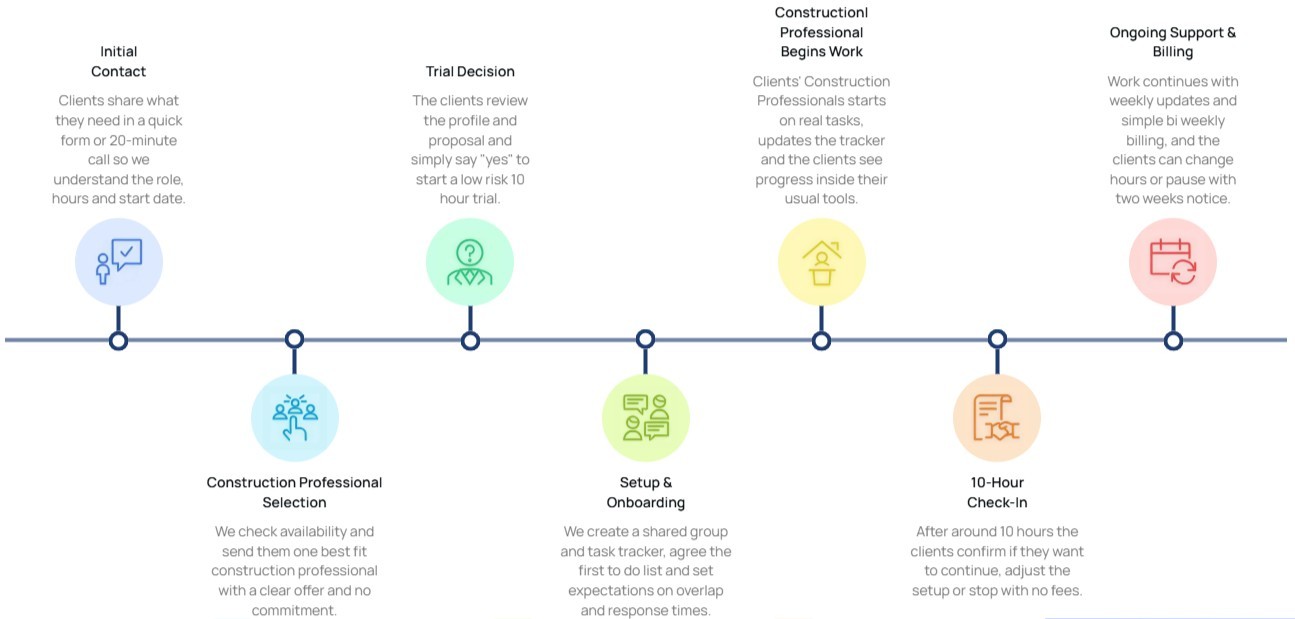
How AEdigo runs closeout documentation work
1. Match against project type and closeout requirements
The match accounts for project type, contract closeout requirements, and the documentation volume the closeout package will carry.
2. Kick-off on closeout requirements and timeline
Contract closeout requirements, owner submission format, retention release process, subcontractor deliverable list, and timeline alignment to substantial completion. The kick-off locks the closeout framework.
3. Subcontractor coordination
Subcontractor closeout deliverables (warranties, O&Ms, as-builts) get tracked, chased, and consolidated into the GC's owner submission. Subcontractor coordination is where most closeout programs lose time.
4. Documentation compilation
As-builts, O&Ms, warranties, project record documents, and contract-specific deliverables get compiled into the owner submission format. Each document gets verified against contract requirements before package assembly.
5. Owner submission and revision rounds
The package gets submitted to the owner per the contract's required format. Comment response, revision rounds, and retention release follow-through are part of standard scope.
Tools closeout coordinators work in
Procore for closeout documentation management
Autodesk Construction Cloud (BIM 360 / ACC) for cloud closeout workflows
Bluebeam Revu for closeout package assembly and PDF compilation
Microsoft SharePoint for office-side closeout filing
CMiC, Sage, and Viewpoint Vista for ERP-driven closeout workflows
Submittal Exchange and similar tools for subcontractor deliverable coordination
What separates a closeout coordinator from a project admin
Anyone can compile a binder. The coordinator who delivers a closeout package owners accept on first submission knows the contract requirements, the subcontractor coordination patterns, and the owner submission format expectations.
AEdigo vets closeout coordinators on:
Project management software fluency
Contract closeout requirement experience across major contract forms
Subcontractor coordination and deliverable tracking discipline
O&M manual compilation experience
Warranty documentation packaging experience
As-built coordination experience
Owner submission format experience across project types
Communication skills for subcontractor follow-up and owner review cycles
Use cases by stakeholder
General contractors
Full project closeout documentation packages
Subcontractor closeout deliverable coordination
Owner submission preparation
Retention release documentation and follow-through
Subcontractors
Trade-side closeout documentation for retention release
GC-side closeout deliverable preparation
Warranty and O&M documentation for trade scopes
Owners and program managers
Owner-side closeout review and acceptance support
Multi-project portfolio closeout coordination
Closeout documentation QC against contract requirements
Common closeout failures that delay retention release
Closeout failures show up in predictable patterns. If your past closeouts have struggled, the issue is process, not effort.
Closeout work started too late, leaving compressed timeline against substantial completion.
Subcontractor deliverables not tracked, creating gaps in the closeout package.
O&M manual compilation bottlenecked by missing manufacturer documentation.
As-built drawings incomplete or inconsistent with project record documents.
Warranty documentation informal, with no formal package for owner handover.
Owner submission format not matched, generating reject-and-resubmit cycles.
Retention release follow-through abandoned, leaving retention with the owner indefinitely.
What healthy closeout looks like
Projects that close out cleanly and projects that drag through closeout differ on a small set of operational habits. The contractors who get this right and the ones who don't share the same realization at the wrong time.
The markers of closeout that actually works:
These habits don't require special tools or new processes. They require consistent calendar attention from someone whose role is dedicated to closeout, not someone who has already mentally moved to the next project. That's the difference between closeout that supports retention release on time and closeout that drags into the next quarter.
Closeout work starts at substantial completion minus 90 days, not at substantial completion.
Subcontractor closeout deliverables get tracked weekly with chase cycles, not at retention release.
O&M manual compilation runs in parallel with construction, not after.
As-built coordination happens through construction, with the closeout pass verifying rather than producing.
Warranty packages get assembled per system and consolidated at handover.
Owner submission format gets locked at the kick-off, not discovered at submission.
Retention release follow-through continues until retention is actually released.
Closeout documentation services vs. the alternatives
The alternatives are: have the project manager run closeout alongside the next pursuit, hand it to a junior admin without closeout context, or accept that closeout will drag.
Project managers running closeout alongside the next pursuit usually deliver one badly. The next pursuit wins the calendar.
Junior admins without closeout context produce packages that meet format requirements and miss the contract-driven deliverable requirements.
Dragging closeout costs retention, owner relationship, and team morale. The cost compounds across projects.
AEdigo runs closeout as a managed engagement: experienced closeout coordinators, your contract requirements, your subcontractor list, with owner submission coverage and retention release follow-through.
How engagement works
10-hour free trial
Flexible billing tied to actual hours worked
Cancel or pause with two weeks' notice
Engagements typically run during the final 90 days of the project
Self-managed and managed tiers available
Frequently asked questions
Implementation note: Wrap this section in FAQPage schema markup (schema.org/FAQPage) to qualify for rich results in Google.
When should closeout documentation work start?
Substantial completion minus 90 days is the standard target. Earlier engagement allows subcontractor coordination, O&M compilation, and as-built verification to run in parallel with construction completion. Starting at substantial completion compresses the closeout timeline against retention release windows.
Can the coordinator handle subcontractor closeout deliverable coordination?
Yes. Subcontractor closeout coordination including warranty collection, O&M consolidation, and as-built verification is part of standard scope. Most closeout delays trace to subcontractor deliverable gaps, so this coordination is the highest-impact closeout work.
Does the work include O&M manual compilation?
Yes. O&M manual compilation across all building systems is part of standard scope. The coordinator works inside the contract's required format and the owner's facility management requirements.
Can the coordinator handle owner submission and revision rounds?
Yes. Owner submission preparation, comment response, and revision rounds are part of standard scope. The engagement runs through retention release, not to first submission.
What about projects with custom owner closeout formats?
The match process accounts for owner format experience. Federal, institutional, healthcare, and corporate owners each carry different closeout submission requirements, and the coordinator pool includes experience across major formats.