
Commercial architectural work doesn't fail on the design idea. It fails on the production work that follows: construction documents, code coordination, MEP integration, accessibility compliance, and the revision cycles that compress as the bid date approaches.
Most commercial firms hit the same problem. The senior architects spend their time on production drawings instead of design and client work. Project managers pull double duty on documentation. Authority comment cycles eat senior calendars. The firm trades senior time for output that doesn't need senior judgment.
AEdigo gives commercial architecture firms, design-build contractors, and developers on-demand access to pre-vetted architectural professionals. They handle CD production, code coordination, permit packages, design development, and revision rounds, working inside your firm's standards and your project's authority context.
What commercial architectural design services actually deliver
Typical outputs from a commercial architectural professional working through AEdigo:
Construction document sets across architectural, interior, and coordination scopes
Design development drawings progressing schematic concepts to CD
Permit submission packages aligned to local authority requirements
Tenant fit-out and base building documentation
Code analysis including occupancy, accessibility, and life safety
Specifications and door, window, partition, and finish schedules
Coordination drawings and clash review against MEP and structural sets
Authority comment response cycles and revision rounds
When you actually need commercial design support
Your firm's principals are doing CD production instead of design and client work.
Multiple projects are stacking into design development and CD simultaneously.
Permit submissions are slipping and authority comment cycles are stacking up.
A tenant fit-out program is generating volume the in-house team can't carry.
A design competition or fast-track project is eating bandwidth from active client work.
An authority cycle generated heavy comments and revision capacity is short.
You're entering a new market and need someone who knows local commercial code requirements.
How AEdigo runs commercial design work
1. Match against project type and software stack
Office and retail specialists don't get matched to industrial scopes. Revit-led firms don't get placed with AutoCAD-only professionals. The match accounts for project type, code context, and software fluency.
2. Kick-off on standards and templates
Titleblock, drawing numbering, layer standards, specification format, schedule templates, and authority submission requirements. Twenty minutes up front prevents weeks of comment-cycle rework.
3. Production cadence
Drawing production happens on the cadence your firm needs. The professional adapts to your team's rhythm and review process.
4. Internal review pass
Before client release or authority submission, the package goes through self-review against the firm's quality standards and the authority's checklist. Avoidable comment cycles get caught here.
5. Progress report
Drawings completed, drawings in review, drawings under revision, and what's queued. Project leadership sees the production pipeline as it actually is.
Tools commercial architectural professionals work in
Autodesk Revit for primary BIM-led commercial production
AutoCAD for AutoCAD-led firms and 2D-driven scopes
Bluebeam Revu for redline and authority comment management
SketchUp and Rhino for design development and concept work
Lumion, Enscape, and Twinmotion for commercial rendering
Authority submission portals and templates (varies by jurisdiction)
What separates a production architect from a CAD operator
Production-ready commercial drawings require code fluency, authority context, MEP coordination instincts, and detail discipline. A CAD operator can produce a sheet that looks complete and miss any of those.
AEdigo vets commercial architectural professionals on:
Commercial building code fluency including IBC and local amendments
Accessibility code experience including ADA and equivalents
Authority submission experience and comment response habits
MEP and structural coordination instinct
Specification and schedule discipline
Detail library development and reuse
Code analysis and life safety planning experience
Software fluency across the commercial stack
Use cases by stakeholder
Architecture firms
CD production for office, retail, industrial, and mixed-use projects
Design development progression from schematic to CD
Permit submission preparation and authority comment response
Tenant fit-out documentation
Design-build contractors
In-house architectural production support
Permit and submission cycles
Coordination with structural and MEP design
Developers and owners
Owner-side design QC and review
Permit cycle management on owner-managed projects
Tenant coordination drawings on multi-tenant assets
Where commercial firms can offload production
Commercial firms scale slowly because senior time gets consumed by production work. The offload points are usually consistent across firms.
CD production once design intent is locked in design development.
Permit packages aligned to authority submission templates.
Authority comment response cycles, which generate volume work that doesn't need senior time.
Specifications and schedules, which require coordination but not design judgment.
Code analysis documentation, which is procedural against the project type.
Tenant fit-out work, where the design judgment is small and the production volume is large.
What good commercial CD production looks like
Commercial CD work that runs cleanly shares a small set of operational habits. Most commercial firms know what those habits are. The challenge is maintaining them under real schedule pressure.
The markers of a CD pipeline that's actually working:
Specifications progress alongside drawings, not after them.
Schedules carry verified dimensions, not best-guess copies from earlier phases.
Code analysis updates with every design progression milestone.
Consultant integration happens continuously, not as a batched coordination event.
Authority comment cycles get response packages reviewed internally before re-submission.
Detail libraries get maintained and reused, not rebuilt every project.
Internal review passes catch the predictable mistakes before they reach owner or authority.
Trade interfaces commercial design has to handle right
The trade interfaces that drive most commercial coordination problems are predictable. Documentation discipline at these interfaces is what separates a CD set that builds cleanly from one that generates field RFIs.
Curtain wall to structure, where anchor design and tolerance assumptions get missed.
MEP through structure, where penetration coordination drives ceiling height and routing.
Roofing to perimeter conditions, where flashing details affect both architectural and structural scopes.
Storefront to base building, where finish transitions and water management require detailed integration.
Vertical transportation interfaces, where elevator and escalator scopes affect structural and mechanical systems.
Acoustic and fire-rated assemblies, where rated wall and floor coordination requires consistent detailing across drawings.
Commercial design services vs. the alternatives
The alternatives are: hire more in-house architects, contract to a freelance drafter without architectural depth, or stretch the senior team across design and production.
Hiring full-time works for firms with steady project flow. It doesn't fit firms with cyclical pursuit volume or growth phases.
Freelance drafters without commercial code fluency produce drawings that miss authority requirements, generating comment cycles and rework.
Stretching the senior team is the most expensive option. The principals stop doing the work that grows the firm.
AEdigo runs commercial design support as a managed engagement: vetted architectural professionals, your firm's standards, your authority context, with internal review and progress reporting.
How engagement works
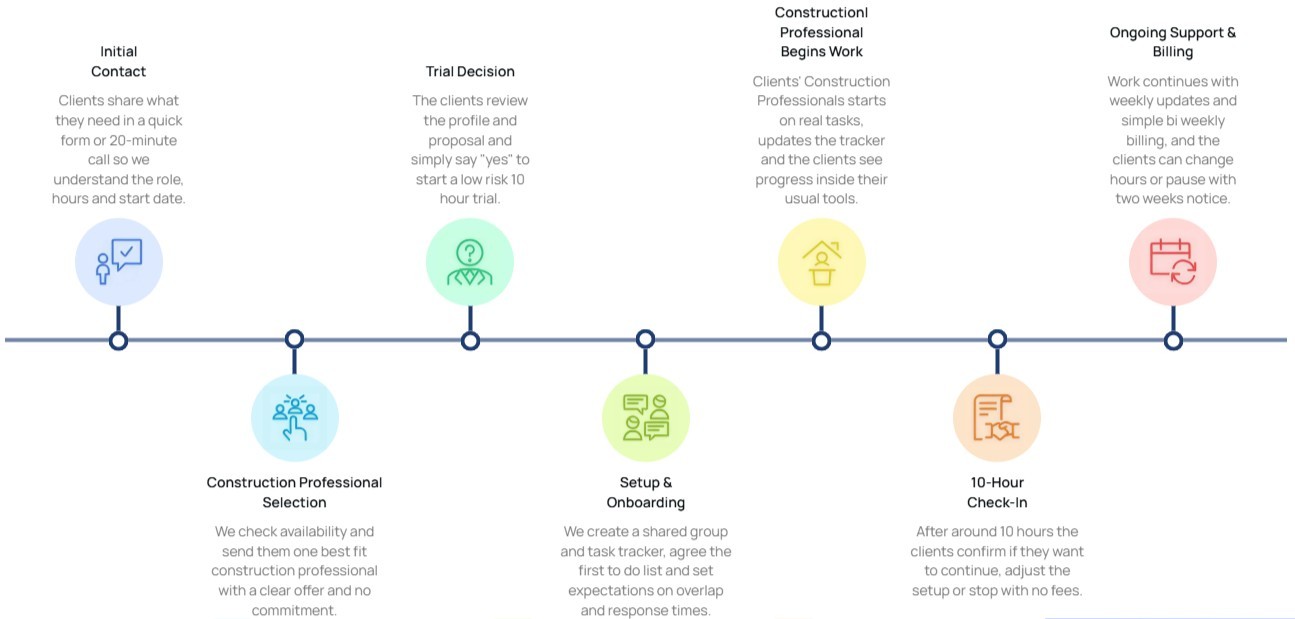
10-hour free trial
Flexible billing tied to actual hours worked
Cancel or pause with two weeks' notice
Capacity scales with project volume
Self-managed and managed tiers available
Frequently asked questions
Implementation note: Wrap this section in FAQPage schema markup (schema.org/FAQPage) to qualify for rich results in Google.
Can the professional work to commercial code requirements in our market?
Yes. The match process accounts for code context. IBC, local amendments, accessibility codes, and authority submission templates get locked at kick-off, so the drawings come back permit-ready for your specific market.
Will the drawings follow our firm's titleblock and detail library?
That's the default. The kick-off captures your titleblock, layer standards, detail library, specification format, and schedule template. Drawings come back in your firm's format.
Can the professional handle authority comment response cycles?
Yes. Authority comment response is part of standard scope. The professional revises drawings, updates the revision log, and re-submits the package without restarting the engagement.
Do AEdigo's commercial professionals work in Revit or AutoCAD?
Both. The professional pool covers Revit-led firms and AutoCAD-led firms. The match process accounts for software fluency before placement.
Can the professional handle code analysis and life safety planning?
Yes. Code analysis including occupancy, area calculations, accessibility compliance, and life safety planning is part of standard scope. The professional pool includes architects with code analysis experience across project types.