
Owners ask 'what's it going to cost?' before drawings exist. The answer they get drives go/no-go decisions, financing conversations, and the project's whole risk profile.
Bad early estimates lose deals. They also commit margin to projects that should never have been pursued. The team that gets early estimates right closes more pursuits, walks away from bad ones earlier, and keeps both their margin and their owner relationships intact.
Conceptual and preliminary estimation isn't detailed estimating with less detail. It's a different discipline. It runs on parametric models, historical cost data, comparable project benchmarks, and the experienced judgment to know which factors actually move the number.
AEdigo gives general contractors, subcontractors, design firms, and owners on-demand access to pre-vetted conceptual estimators. They work inside your historical cost database, your benchmark library, and your project comparables, with progress reporting and replacement coverage if the fit isn't right.
What conceptual estimation services actually deliver
The output isn't a polished estimate. It's a defensible number with the assumptions, comparables, and risk factors documented well enough to support a decision. Without that documentation, the estimate is a guess in a spreadsheet.
Typical outputs from a conceptual estimator working through AEdigo:
Order of magnitude (ROM) estimates with clear precision banding
Parametric estimates based on building type, square footage, and quality tier
Historical-cost-based estimates referenced to comparable completed projects
Schematic phase estimates aligned to early-stage drawing sets
Cost-per-unit benchmarks (per square foot, per bed, per key, per parking space)
Sensitivity analysis showing the impact of major scope decisions
Risk and contingency recommendations with documented rationale
Comparison estimates across design alternates
When you actually need conceptual estimation
An owner is asking for a budget number before schematic design is complete.
You're deciding whether to pursue a project and need a quick check before committing estimating time.
A developer is testing project feasibility and needs an order of magnitude estimate.
You're comparing design alternates and need cost impact for each.
A capital planning cycle requires a budget figure for projects that don't yet have drawings.
Your in-house team is heads-down on detailed estimating and conceptual work is slipping.
You're competing for a project where the early estimate is part of the qualification package.
How AEdigo runs conceptual estimation work
1. Scope and reference data alignment
The estimator captures the project parameters (building type, scale, quality tier, location factor, schedule) and aligns to your historical cost database, your office's benchmark library, and any project comparables you've designated as reference. Most conceptual estimate disputes trace back to misaligned reference data.
2. Parametric and comparables work
The estimate gets built parametrically (cost per square foot, per unit of capacity, per major component) cross-checked against comparables your office has actually delivered. Generic published unit prices are reference points, not the answer.
3. Sensitivity and risk analysis
Major scope decisions, location factors, schedule risk, and market conditions get tested for sensitivity. The output shows how the estimate moves under different assumptions, so the decision-maker isn't betting the number on a single set of inputs.
4. Documentation pass
Every assumption, every comparable, every adjustment factor gets documented. A conceptual estimate without documented basis is a number nobody can defend in a budget conversation.
5. Owner or stakeholder review support
The estimator stays available through review cycles, refines based on stakeholder feedback, and updates the estimate as design progresses or scope shifts.
Tools conceptual estimators work in
RSMeans for unit-cost referencing and assembly-level pricing
Historical cost databases (in-house or licensed) for project comparable data
CostX for BIM-integrated parametric estimating where models exist
Trimble WinEst and similar tools for early-stage assembly pricing
Excel models built around your office's cost structure and adjustment factors
BIM-based ROM tools where conceptual models are available
Industry benchmark sources (ENR, Turner Index, regional cost reporters) for market adjustment
What separates a conceptual estimator from a detailed estimator
Detailed estimating is a measurement discipline. Conceptual estimating is a judgment discipline. Both require accuracy, but the inputs and the output expectations are different.
AEdigo vets conceptual estimators on:
Experience across multiple building types and quality tiers
Discipline on parametric methodology and comparables-based estimating
Ability to apply location, escalation, and market condition adjustments defensibly
Risk and contingency judgment appropriate to the precision band
Documentation habits strong enough to defend the estimate in a budget conversation
Comfort with ambiguity, including the ability to estimate from incomplete information without overclaiming precision
Sensitivity analysis discipline for scope and assumption testing
Communication skills for owner and stakeholder review cycles
Use cases by stakeholder
General contractors and developers
Pursuit-stage cost evaluation before bid commitment
Pre-design budget development for clients
Feasibility-stage cost analysis on new pursuits
Design alternate cost comparisons during pre-construction
Design firms
Schematic design phase budget alignment
Cost-driven design decision support
Owner budget discussions with documented basis
Owners
Capital planning budget development
Independent cost validation against contractor early estimates
Project go/no-go decision support
Common conceptual estimation mistakes
Early-stage estimates fail in predictable ways. If your current process is hitting any of these, the issue is methodology, not estimator effort.
Using generic unit costs without adjustment for location, market, or quality tier.
Stating estimates with false precision the data doesn't support.
Skipping sensitivity analysis, leaving the owner without a sense of how the number could move.
Using comparables from a different building type or scale without acknowledging the gap.
Underdocumenting assumptions, so the estimate can't be defended in review.
Ignoring escalation and market condition adjustments on projects with long schedules.
Treating detailed estimating discipline as the answer to early-stage uncertainty.
Conceptual estimation services vs. the alternatives
The alternatives are: have the senior estimator do conceptual work between detailed bids, contract published cost data into a generic spreadsheet, or skip the early estimate and price the project once drawings exist.
Senior estimators stretched between conceptual and detailed work usually deliver one badly. The detailed bid gets the time. The conceptual estimate becomes a quick spreadsheet that doesn't survive the budget conversation.
Generic cost data without office-specific adjustment produces estimates that anyone could produce, which means they don't reflect your firm's actual delivery cost. The owner finds out at bid time.
Skipping early estimates leaves go/no-go decisions to instinct. The cost of pursuing the wrong projects, or walking away from the right ones, is hard to measure but real.
AEdigo runs conceptual estimation as a managed engagement with your reference data, your comparables, and your office's adjustment methodology, producing estimates that stand up in stakeholder review.
How engagement works
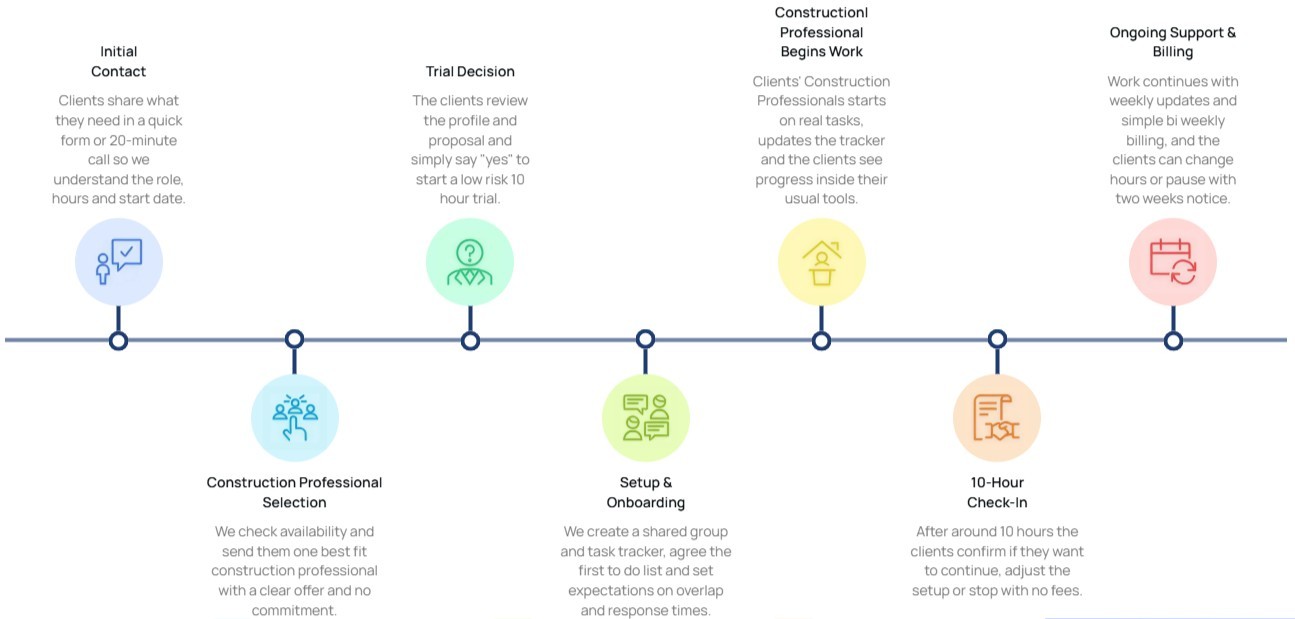
10-hour free trial
Flexible billing tied to actual hours worked
Cancel or pause with two weeks' notice
Capacity scales with pursuit and pre-construction volume
Self-managed and managed tiers available
Frequently asked questions
Implementation note: Wrap this section in FAQPage schema markup (schema.org/FAQPage) to qualify for rich results in Google.
How precise is a conceptual or preliminary estimate?
Precision depends on input quality. ROM estimates typically run plus or minus 15 to 30 percent. Schematic-stage estimates with comparables data tighten to plus or minus 10 to 20 percent. The estimator documents the precision band based on what the inputs actually support, rather than overclaiming.
Can the estimate work from our historical cost data instead of generic published rates?
That's the preferred approach. The kick-off captures your historical cost database, project comparables, and adjustment factors. Estimates built from your firm's actual delivery cost are more defensible than ones built from generic published rates.
Can the estimator support the owner or stakeholder review cycle?
Yes. Conceptual estimates almost always face review cycles, and the estimator stays engaged through them. Refinements based on stakeholder feedback and updates as scope evolves are part of the engagement.
What if our project doesn't have any drawings yet?
Conceptual estimating is designed for that situation. The estimator works from project parameters (building type, scale, quality tier, location, schedule), parametric models, and comparables. Drawings are useful when they exist but not required for ROM-stage estimates.