
Project margin is decided in execution. The bid sets the upside; the execution layer either protects it or gives it away. Cost and change tracking is where that protection happens, and it's where most contractors quietly leak margin without seeing it until closeout.
The work isn't conceptually hard. It's the discipline to track committed cost against budget, change order entitlement against the contract, T&M tickets against directives, and aging on each. The contractors who do it well keep their margin intact through the project. The ones who don't run a guess at month-end and find out at retention release how much they actually made.
AEdigo gives general contractors, subcontractors, owners, and project management firms on-demand access to pre-vetted cost and change tracking coordinators. They run cost reports, CO log management, T&M reconciliation, and aging analysis, working inside your office's accounting tools and your project's contract structure.
What cost and change tracking services actually deliver
Typical outputs from a cost and change tracking professional working through AEdigo:
Budget-to-actual cost reporting against the project's cost code structure
Committed cost tracking including subcontracts, purchase orders, and material commitments
Change order log management with aging analysis
T&M ticket reconciliation against directives and approved COs
Forecast-to-complete (FTC) and estimate-at-completion (EAC) calculations
Variance analysis between budget, committed, and actual
Owner cost reporting packages aligned to contract requirements
Closeout cost reconciliation and retention release support
When you actually need cost and change tracking support
Cost reports are slipping behind operational reality.
Change order log isn't current and aging is climbing.
T&M tickets are accumulating without reconciliation against directives.
Forecast-to-complete is being calculated reactively rather than as part of a regular cycle.
Multiple projects share one project accountant and the bandwidth is split too thin.
An owner is requesting cost reports the team can't produce in time.
Closeout retention is delayed because cost reconciliation isn't current.
How AEdigo runs cost and change tracking work
1. Match against accounting tools and contract structure
The match accounts for accounting platform, contract structure, and project complexity.
2. Kick-off on cost code structure and CO methodology
Cost code structure, committed cost tracking conventions, change order pricing methodology, T&M ticket workflow, and contract-specific reporting requirements. The kick-off locks the framework before the first cycle.
3. Cycle production
Weekly cost report cycles. Daily CO log updates. Weekly T&M reconciliation. Monthly forecast-to-complete refresh. Cadence runs on a defined schedule, not as a backlog flush at month-end.
4. Reconciliation discipline
Variance between budget, committed, and actual gets traced to causes during each cycle, not just flagged. T&M tickets get reconciled against directives. CO entitlement gets verified against contract provisions.
5. Weekly cost and aging report
Cost position, CO log status, T&M outstanding, forecast trend, and items at risk. Project leadership sees margin position weekly, with aging signals visible before they become disputes.
Tools cost and change tracking professionals work in
Sage 300 CRE for ERP-based project cost tracking
Viewpoint Vista for Vista-driven cost reporting
CMiC for end-to-end project financials
Procore Financials for Procore-based cost workflows
Excel models for forecast-to-complete and variance analysis
Microsoft Power BI for cost reporting visualization
Bluebeam Revu for T&M ticket review and reconciliation
What separates a cost coordinator from a project accountant
Project accountants close books. Cost coordinators run live cost management. The two roles overlap, but the discipline that protects margin during execution is the live cost work.
AEdigo vets cost and change tracking professionals on:
Accounting software fluency across the major construction ERP platforms
Cost code structure understanding and committed cost tracking habits
Change order entitlement and pricing methodology knowledge
T&M reconciliation experience
Forecast-to-complete and earned-value methodology
Variance analysis discipline
Owner reporting experience across major contract forms
Communication skills for field team and subcontractor follow-up cycles
Use cases by stakeholder
General contractors
Project cost management across active projects
Change order log management and aging tracking
T&M ticket reconciliation
Owner cost reporting packages
Subcontractors
Trade-side cost tracking against GC schedules of values
Change order preparation and aging tracking
T&M ticket preparation and reconciliation
Owners and program managers
Independent cost tracking against contractor submissions
Multi-project portfolio cost reporting
Claims-stage cost analysis
Common cost tracking failures that erode margin
Margin loss during execution traces to predictable failures. If your projects have hit any of these, the issue is cadence, not effort.
Committed cost not tracked, leaving budget-to-actual reports incomplete.
Change order entitlement not verified against contract before pricing.
T&M tickets not reconciled against directives, leaving disputed costs unprovable.
Forecast-to-complete calculated reactively at month-end rather than weekly.
Variance flagged without root-cause analysis, leaving project leadership without context.
CO log aging unmanaged, with stale items losing entitlement strength.
Owner reports built last-minute, missing data inputs.
What healthy cost tracking actually looks like in practice
Cost tracking that actually protects margin shares a small set of operational habits across projects. The contractors who get this right and the ones who don't differ on the same axis: continuous discipline rather than month-end reconstruction.
The markers of a cost tracking program that's actually working:
Committed cost gets tracked at every PO, subcontract, and material commitment, not retroactively.
Change order entitlement gets verified against the contract before pricing, not after rejection.
T&M tickets reconcile to directives weekly, not at month-end.
Forecast-to-complete refreshes weekly, with variance flagged before it compounds.
Cost narrative writing happens alongside the numbers, so the story is current.
Owner reports issue on cadence, with data inputs verified before issuance.
Aging on COs and outstanding T&M items gets escalated against defined thresholds.
Cost tracking services vs. the alternatives
The alternatives are: load cost tracking onto the project manager, hire a junior project accountant without execution context, or accept that cost tracking will run reactively.
Project managers loaded with cost tracking usually defer it during field-busy periods. Variance compounds and shows up at month-end as a surprise.
Junior project accountants without execution context produce reports that close books accurately and miss the live cost management discipline.
Reactive cost tracking is the most expensive option, because the visibility lag is where margin gets given away.
AEdigo runs cost and change tracking as a managed engagement: vetted coordinators, your accounting tools, your contract structure, with weekly cost and aging reports.
How engagement works
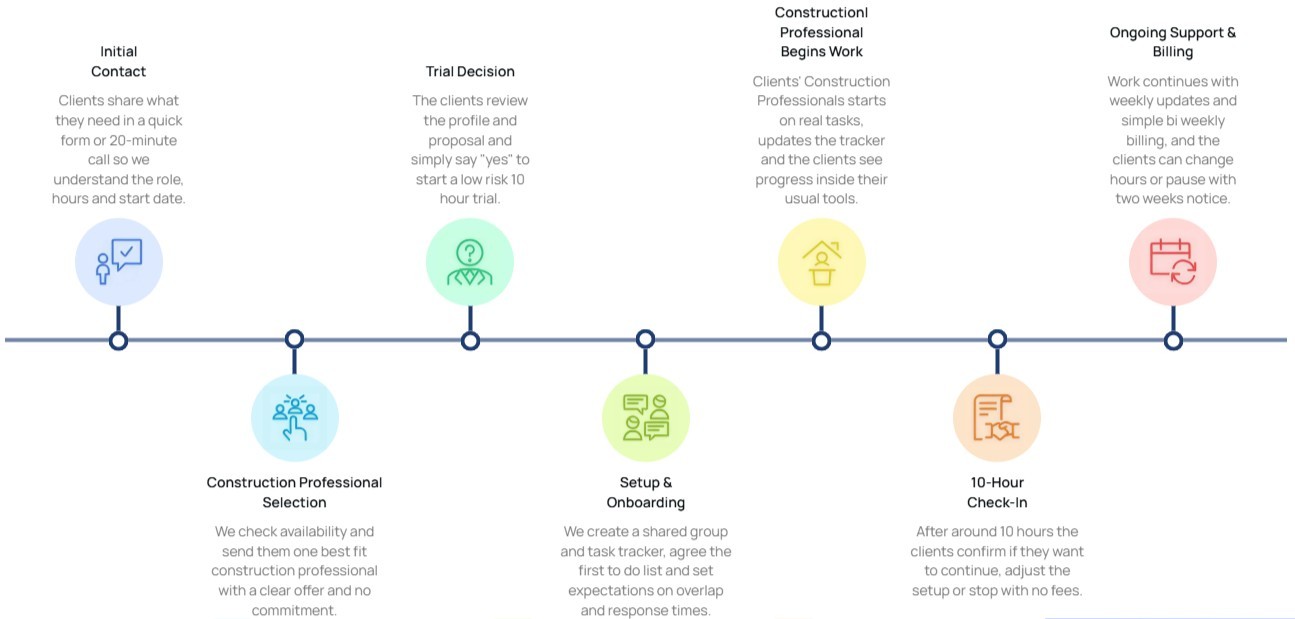
10-hour free trial
Flexible billing tied to actual hours worked
Cancel or pause with two weeks' notice
Capacity scales with project phase and cost volume
Self-managed and managed tiers available
Frequently asked questions
Implementation note: Wrap this section in FAQPage schema markup (schema.org/FAQPage) to qualify for rich results in Google.
Will the professional work inside our accounting platform?
Yes. The match process accounts for platform fluency before placement.
Can the professional handle change order pricing and entitlement review?
Yes. CO pricing aligned to contract methodology and entitlement verification against contract provisions are part of standard scope. The professional pool includes coordinators with contract fluency across major forms.
Does the work include forecast-to-complete and earned value?
Yes. FTC and EAC calculations are part of the scope on engagements where the project requires earned-value reporting. Methodology gets locked at kick-off to align with the contract's reporting requirements.
Can the professional reconcile T&M tickets against directives?
Yes. T&M reconciliation is part of standard scope on T&M-heavy projects. Tickets get verified against originating directives, daily reports, and approved COs before they roll up into the cost report.
How is variance analysis handled?
Variance between budget, committed, and actual gets traced to root causes during each weekly cycle. The cost narrative documents the variance, the cause, and any corrective actions. Variance reporting becomes a leading indicator, not a month-end surprise.