
Design development is the phase where projects either lock in or quietly fall apart. Schematic design intent has to translate into coordinated, dimensioned, specified drawings that can survive consultant integration, owner review, and the eventual progression into construction documents.
When DD goes well, the CD phase runs predictably. When DD goes badly, every issue gets pushed forward and shows up later, either as a coordination clash, a code violation, or a value-engineering crisis when the bid comes back high.
Most DD problems are capacity problems, not design problems. The senior architects and engineers know what needs to happen. They just don't have the production hours to make it happen on every project simultaneously.
AEdigo gives architecture and engineering firms on-demand access to pre-vetted professionals who handle DD-phase production. They progress drawings, integrate consultant input, build out specifications and schedules, and prepare the package for CD.
What design development services actually deliver
The output is a coordinated DD package ready for owner review and CD progression. Drawings are dimensioned, specifications are populated, consultant input is integrated, and the design is locked enough to bid against.
Typical outputs from a DD professional working through AEdigo:
DD-phase plans, sections, elevations, and details progressed from schematic
Specifications populated against the DD scope
Schedule production including doors, windows, partitions, and finishes
Consultant coordination including structural and MEP integration
Code analysis updates against the developed design
Owner review documentation and revision support
DD-stage cost estimate coordination with the estimating team
Package preparation for CD progression
When you actually need DD support
Multiple projects are stacking into design development simultaneously.
Schematic-to-DD progression is slipping and pushing CD start dates.
Consultant coordination is incomplete and DD packages are going to owner review with gaps.
Specifications and schedules are lagging the drawing progression.
Code analysis updates aren't keeping pace with design changes.
An owner has compressed the DD schedule and the in-house team can't absorb the timeline.
DD-stage cost feedback is arriving late, creating reactive design changes instead of proactive optimization.
How AEdigo runs DD work
1. Match against project type and DD complexity
Residential DD specialists don't get matched to commercial high-rise. Generalists don't get placed on hospitality, healthcare, or industrial scopes that carry typology-specific complexity. The match accounts for project type, software, and DD-stage experience.
2. Kick-off on standards and integration plan
Drawing standards, specification format, schedule templates, consultant integration plan, and owner review cycle. The kick-off establishes how the DD work will land inside the firm's broader workflow, not just inside the drawing set.
3. Coordinated production cadence
DD production runs in parallel with consultant integration. The professional pulls structural and MEP design as it lands and integrates it into the architectural set, rather than waiting for full consultant submissions.
4. Internal review against DD criteria
Before owner review, the DD package goes through internal review against firm quality standards, code analysis updates, and consultant integration completeness. DD packages that survive owner review on first delivery cost less than the ones that don't.
5. Progress report
Drawing progression, specification status, schedule completion, consultant integration status, and revision pipeline. Project leadership sees DD progress in real terms, not after-the-fact summaries.
Tools DD professionals work in
Autodesk Revit for BIM-led DD production
AutoCAD for AutoCAD-led firms
Bluebeam Revu for redline and consultant coordination
SketchUp and Rhino for DD-stage design refinement
Specification software (e.g., Masterspec, e-SPECS) for DD specification development
Owner submission tools and portals
What separates a DD professional from a CD drafter
DD work isn't drafting. It's design progression with coordination, integration, and translation responsibilities that determine whether the CD phase goes smoothly or breaks down.
AEdigo vets DD professionals on:
Architectural design progression experience across multiple project types
Consultant integration discipline including structural and MEP
Specification and schedule development habits
Code analysis fluency at the DD stage
Coordination instinct for trade interfaces that emerge during DD
Owner review and revision cycle experience
Documentation discipline strong enough to support CD progression without rework
Software fluency across the DD-phase stack
Use cases by stakeholder
Architecture firms
DD-phase production capacity across multiple projects
Schematic-to-DD progression management
Specification and schedule production
Consultant integration coordination
Engineering firms
Engineering DD coordination with architectural teams
DD-stage drawing production for structural and MEP scopes
Cross-discipline integration support
Design-build contractors
In-house DD support on design-build projects
Cost-driven DD optimization with the estimating team
Owner review cycle support
Why DD problems compound into CD
DD failures don't stay in DD. They migrate forward and show up in CD as coordination clashes, in bidding as cost surprises, and in construction as field rework. The list of recurring DD failures is short and predictable.
Specifications lagging drawing progression, leading to CD-stage spec rework.
Consultant integration deferred until the end of DD, creating coordination clashes.
Schedules built without dimensional verification, generating CD-stage corrections.
Code analysis not updated as design evolves, leaving exposure for later authority issues.
Owner review cycles handled reactively, generating revision compression at CD start.
DD packages issued without internal review, pushing quality issues into CD.
Consultant coordination handled informally, leaving integration gaps undocumented.
What separates DD that locks from DD that drifts
DD work that produces a coordinated, biddable package shares a small set of operational habits. DD work that drifts into CD shares a different set.
The habits of DD work that actually locks:
Specifications populate against the drawing scope as drawings progress, not after.
Consultant integration happens continuously, with structural and MEP design pulled into the architectural set as it lands.
Schedules and counts get verified against dimensioned drawings, not extrapolated from schematic.
Code analysis updates as design evolves, with occupancy, accessibility, and life safety all maintained current.
Owner reviews get prepared with internal review first, so comment cycles are response cycles not first-look cycles.
DD-stage cost feedback engages the estimating team during the phase, not after package delivery.
DD services vs. the alternatives
The alternatives are: have the senior team carry DD between client and design work, contract to a freelance drafter without DD-stage experience, or compress the DD timeline and absorb the CD-stage rework.
Senior teams stretched between DD and design work usually deliver one badly. The DD package ends up rushed, with consultant integration deferred and specifications lagging.
Freelance drafters without DD-stage experience produce drawings that look complete and miss the integration discipline that DD requires.
Compressing DD pushes the cost forward into CD, where the rework is more expensive and the schedule pressure is higher.
AEdigo runs DD work as a managed engagement: vetted professionals, your firm's standards, integrated consultant coordination, with internal review and progress reporting.
How engagement works
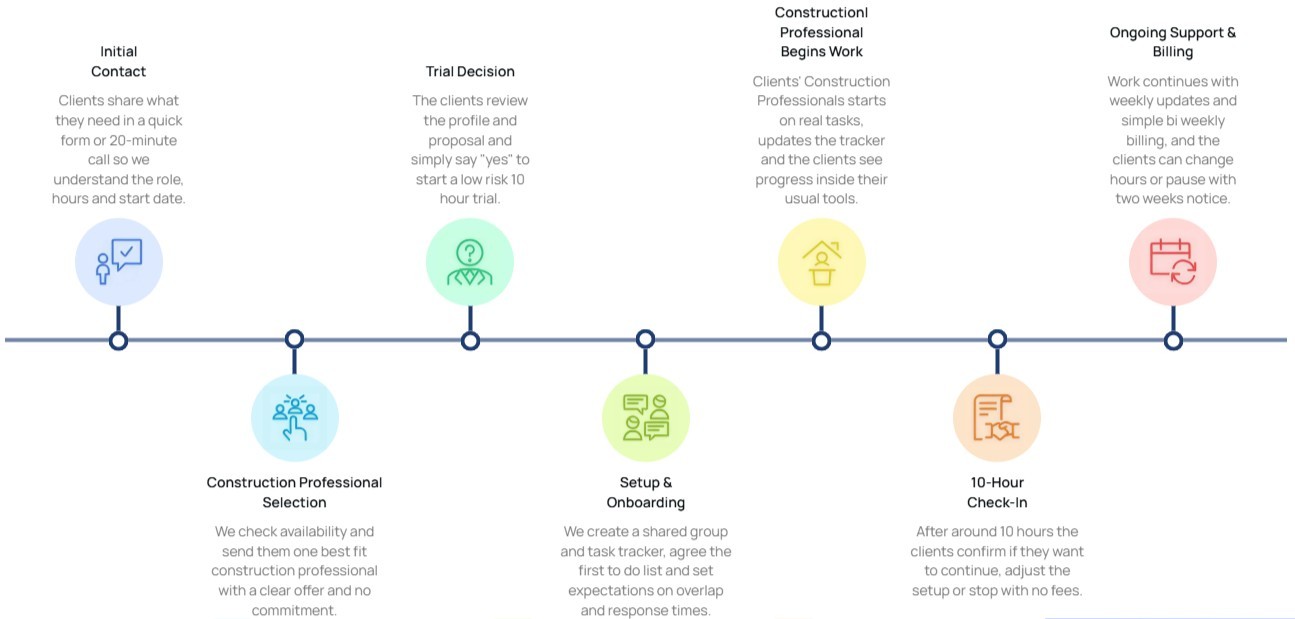
10-hour free trial
Flexible billing tied to actual hours worked
Cancel or pause with two weeks' notice
Capacity scales with DD pipeline volume
Self-managed and managed tiers available
Frequently asked questions
Implementation note: Wrap this section in FAQPage schema markup (schema.org/FAQPage) to qualify for rich results in Google.
Can the professional handle consultant integration during DD?
Yes. Consultant integration including structural and MEP coordination is part of standard scope. The professional pulls consultant design as it lands and integrates it into the architectural set, rather than batching coordination at the end of DD.
Will the DD work include specification development?
Yes. Specification development against the DD scope is part of standard scope. The professional populates specifications, schedules, and supporting documents in parallel with drawing progression.
Can the professional support owner review cycles during DD?
Yes. Owner review preparation, comment response, and revision rounds are part of standard scope on DD engagements.
Does DD work include code analysis updates?
Yes. Code analysis updates including occupancy, accessibility, and life safety progression against the DD scope are part of standard scope. The professional updates the code analysis as design evolves, rather than treating it as a one-time SD-stage exercise.
Can DD work coordinate with our estimating team for cost feedback?
Yes. DD-stage cost feedback is more useful when the DD professional engages with the estimating team during the phase, rather than handing off a finished package. This back-and-forth catches cost-driven design issues early.