
Detailed cost estimation is where bids are won, lost, or quietly committed at the wrong margin. It's also where most estimating teams hit a wall, because detailed work doesn't scale with bid volume the way takeoff does.
A detailed estimate has to carry every assembly priced, every vendor quote logged, every alternate broken out, every contingency justified, and every line traceable to a drawing or specification. That isn't measurement. It's discipline. And it takes more hours than most in-house teams can give it during bid season.
AEdigo gives general contractors, subcontractors, and estimating teams on-demand access to pre-vetted detailed estimators.
The work runs through a managed delivery layer with progress reporting and replacement coverage if the fit isn't right.
What detailed cost estimation services actually deliver
The output isn't a unit-price list. It's a defensible bid with assembly-level pricing, vendor quote integration, alternate breakouts, and the audit trail your estimator needs to walk a client through line by line.
Typical outputs from a detailed estimator working through AEdigo:
Assembly-level estimates aligned to your office cost code structure
Hard bid and GMP estimates across self-perform and subcontracted scopes
MEP detailed estimates including labor, material, and equipment breakdowns
Vendor quote tabulation and integration into the bid
Alternate and value engineering option pricing
Bid summary roll-ups with general conditions, fees, contingency, and escalation
Cost narrative documenting assumptions, exclusions, and clarifications
Comparison estimates against the engineer's estimate or owner budget
When you actually need detailed estimating support
Your estimating team is committed across multiple bids and detailed work is slipping.
A bid landed on your desk that's outside your office's normal scope or trade depth.
GMP development on a negotiated project is competing with active hard-bid work.
You're a sub bidding to multiple GCs simultaneously and need parallel detailed estimates.
An owner wants the bid broken into 30 alternates and your team can't carry the volume.
A late-stage scope change requires a complete re-estimate before the bid date.
You're chasing a project where the bid quality directly drives the qualification, and your team can't give it the time.
How AEdigo runs detailed estimating work
1. Match against trade and software
Civil estimators don't get placed on MEP work. Sage-only estimators don't get matched to teams running CostX or B2W. The match accounts for trade depth, software, and the bid type (hard bid, GMP, design-build).
2. Kick-off on assembly library and bid template
Cost code structure, assembly library, unit conventions, general conditions template, fee structure, contingency convention, and bid summary format. Misalignment here costs more than an entire bid period later.
3. Production cadence aligned to bid date
The estimator works backward from your bid date. Assemblies get priced, vendor quotes get integrated, alternates get broken out, and the bid summary gets reviewed before submission. The schedule is enforced, not aspirational.
4. Internal review pass
Before bid release, the estimate goes through a self-review against the assumptions, the cost narrative, and the drawing set. The review catches mismapped categories, missed assemblies, and conflicting assumptions that would show up at bid review otherwise.
5. Progress report
Bids in progress, hours logged, items remaining, vendor quotes pending, and any drawing or scope issues that affect accuracy. Project leadership sees the bid pipeline as it actually is.
Tools detailed estimators work in
Sage Estimating for assembly-based and trade-specific bid preparation
Trimble WinEst for unit-priced and assembly-priced bids
CostX for BIM-integrated detailed estimating
B2W Estimate for civil, heavy construction, and self-perform work
Cubit for end-to-end takeoff and estimating workflows
Excel models built around your office's cost structure
PlanSwift and OST for takeoff handoff into detailed estimating
Due to the specialized nature of these tools, availability of professionals may be more limited, and additional time might be required to match you with a suitably experienced estimator who aligns with your specific requirements.
What separates a detailed estimator from a unit pricer
Anyone can populate a unit price into a spreadsheet. The estimator who delivers a bid your team trusts knows when a published unit price doesn't apply, when an assembly needs to be split, when a vendor quote should be benchmarked, and when an assumption needs to be flagged.
AEdigo vets detailed estimators on:
Trade-specific construction knowledge across the scope they price
Assembly-level discipline and cost code mapping accuracy
Vendor quote integration and benchmarking habits
General conditions, fee, and contingency methodology
Drawing and specification interpretation skills
Escalation and market condition adjustment judgment
Documentation discipline strong enough to defend the estimate at bid review
Software fluency across the major detailed estimating platforms
Use cases by stakeholder
General contractors
Hard bid preparation for self-perform and subcontracted scopes
GMP development on negotiated work
Bid level scope verification against subcontractor proposals
Alternate and VE pricing for owner review cycles
Subcontractors
Trade-specific detailed estimates across MEP, steel, façade, finishes, civil
Parallel bid coverage for multiple GCs on the same project
Specialty scope estimating outside the in-house team's depth
Owners and developers
Independent cost estimates for owner-side bid evaluation
Pre-tender BOQ pricing for tendered procurement
Reconciliation against contractor bid submissions
Common detailed estimating failures
Bids that get questioned at review, lose against competitors, or commit margin at the wrong number usually trace back to a handful of predictable failures.
Assemblies priced from generic unit costs without office-specific adjustment.
Vendor quotes integrated without benchmark verification, allowing sandbagged pricing.
Alternates breakdowns missing key cost drivers, creating exposure on owner selection.
General conditions calculated off a stale percentage instead of project-specific build-up.
Contingency applied as a flat percentage without project-specific risk analysis.
Cost narrative missing key assumptions, leaving the estimator unable to defend at review.
Bid summary rolled up before the assemblies are reconciled, hiding errors in the total.
Detailed estimating services vs. the alternatives
The realistic alternatives are: hire a full-time detailed estimator, outsource to a low-cost shop, or stretch the in-house team and accept lower bid quality during peak season.
Hiring full-time works when bid volume is steady. It doesn't fit volume that spikes with bid season or specific market windows.
Low-cost shops produce bids your estimator can't verify against your assembly library or your office's risk methodology. The estimator either trusts the file or redoes it.
Stretching the in-house team during bid season usually means winning the wrong bids and walking away from the right ones, because every bid gets the same constrained time.
AEdigo runs detailed estimating as a managed engagement: vetted estimators, your assembly library, your cost codes, your bid template, with internal review and progress reporting.
How engagement works
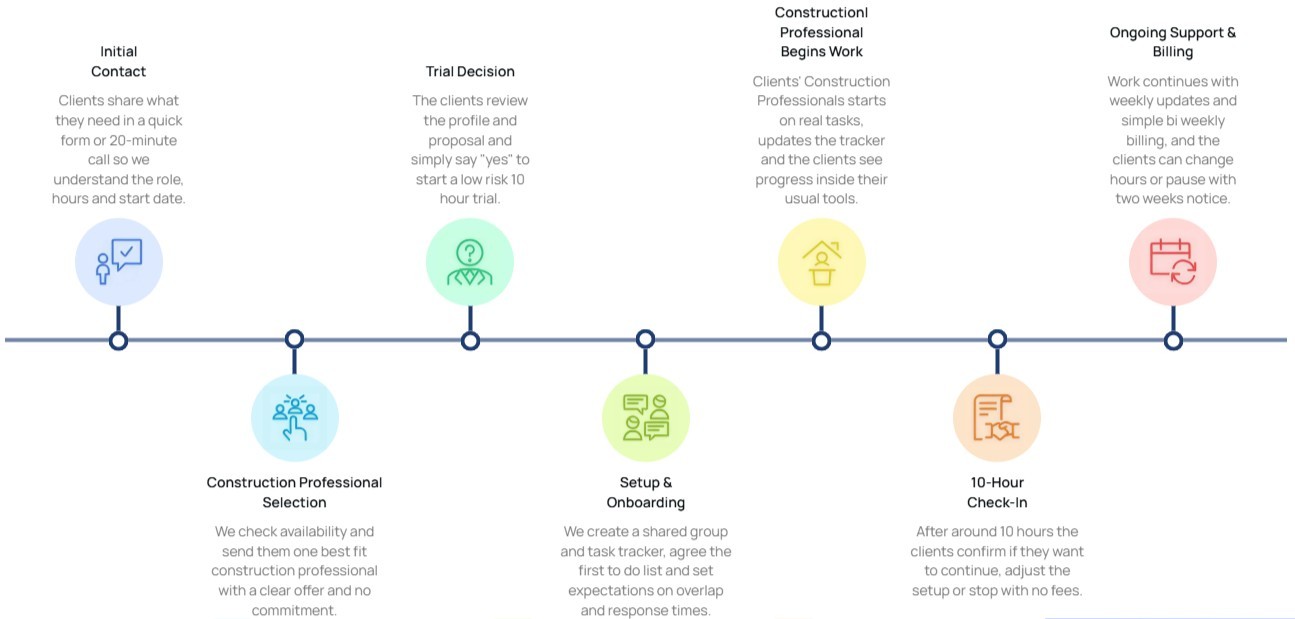
10-hour free trial
Flexible billing tied to actual hours worked
Cancel or pause with two weeks' notice
Capacity scales with bid volume
Self-managed and managed tiers available
Frequently asked questions
Implementation note: Wrap this section in FAQPage schema markup (schema.org/FAQPage) to qualify for rich results in Google.
Will the estimate use our office's cost structure and bid template?
That's the default. The kick-off captures your assembly library, cost codes, general conditions methodology, fee structure, contingency convention, and bid summary template. The estimate comes back in your office's format, not a generic one.
Can the estimator integrate vendor quotes and benchmark them?
Yes. Vendor quote tabulation and integration is part of standard scope. Benchmarking against assembly-level pricing or comparable project data flags sandbagged or out-of-range quotes before they hit the bid total.
Do AEdigo's estimators handle MEP, civil, or trade-specific scopes?
Yes. The professional pool covers architectural, structural, MEP, fire protection, civil, façade, finishes, and heavy construction. The match process accounts for trade depth before placement, so you don't get a generalist on specialty work.
What happens with late-stage scope changes during the bid period?
Scope changes are part of the bid period reality. The estimator handles late changes inside the same engagement, with the impact on the bid summary documented and ready for review.