
Drawings are the project's operating system. Field crews execute against the current set, subs submit against the IFC, and revisions ripple through every dependent workflow. When the drawing log is current and revision tracking is disciplined, the project runs smoothly. When they're informal, field uncertainty climbs, RFIs multiply, and the team eventually loses confidence in which drawing is actually the latest.
Document management is volume work that runs on cadence. The discipline isn't complicated. The bandwidth to maintain it consistently is.
AEdigo gives general contractors, subcontractors, owners, and project management firms on-demand access to pre-vetted document controllers. They run drawing logs, revision tracking, document distribution, and project filing, working inside your office's tools and your project's contract structure.
What drawing and document management services actually deliver
The output is a current, audit-ready drawing log and document control system. Project teams know which drawing is current. Field uncertainty drops. Audit and claims documentation is preserved continuously.
Typical outputs from a document control professional working through AEdigo:
Drawing log management with revision tracking and current set control
Document distribution including transmittals, acknowledgments, and routing
Revision rollout coordination across project teams and subcontractors
Document classification and naming standardization
Document control file structure maintenance
Audit-ready archive maintenance
Cross-reference linkage between drawings, specifications, and project records
Project closeout documentation handover packages
When you actually need drawing and document management support
Drawing log isn't keeping pace with revision releases.
Field crews are working off out-of-date drawings.
Revisions aren't being distributed consistently to subcontractors.
Document classification is inconsistent across project files.
Multiple projects share one document controller and bandwidth is split too thin.
An audit, claim, or owner request requires document records the team can't produce quickly.
Project closeout is approaching and document handover preparation isn't started.
How AEdigo runs drawing and document management work
1. Match against tools and contract structure
The match accounts for the project's document management platform, the contract structure, and the project's volume.
2. Kick-off on document standards
Drawing log structure, document classification, naming convention, transmittal format, distribution list, and contract-specific document requirements. The kick-off establishes the document control framework.
3. Cycle production
Daily updates on the drawing log. Weekly review on revision tracking. Monthly audit pass on classification and archive integrity. Cadence runs on a defined schedule.
4. Cross-reference linkage
Drawings get linked to relevant RFIs, submittals, COs, and field records as items close. Cross-reference linkage is what supports audit-readiness and claims documentation.
5. Weekly status report
Drawing log status, revision distribution status, classification audit status, and any documentation items at risk. Project leadership sees document control health weekly.
Tools document control professionals work in
Procore for project management and document control
Autodesk Construction Cloud (BIM 360 / ACC) for cloud document workflows
CMiC, Sage, and Viewpoint Vista for ERP-driven document control
Bluebeam Revu for transmittal and markup workflows
SharePoint and OneDrive for office-side document control
Microsoft Outlook and Teams for distribution and acknowledgment
What separates a document controller from a project admin
Anyone can update a log. The professional who keeps document control audit-ready knows the contract requirements, the cross-reference linkage that supports claims, and the cadence that maintains accuracy under volume.
AEdigo vets document control professionals on:
Project management software fluency across major platforms
Contract structure understanding across major contract forms
Drawing log management and revision tracking discipline
Cross-reference linkage habits
Document classification and naming standardization experience
Audit-readiness habits
Closeout documentation experience
Communication skills for distribution and acknowledgment cycles
Use cases by stakeholder
General contractors
Multi-project drawing log management
Revision distribution coordination
Subcontractor document control coordination
Closeout documentation preparation
Subcontractors
Trade-side drawing tracking
Submittal coordination against drawing revisions
Closeout documentation for retention release
Owners and program managers
Owner-side document control
Multi-project portfolio document control
Audit and claims preparation
Common document management failures
Document control failures show up in predictable patterns.
Drawing log inconsistent with the current revision set.
Revision distribution incomplete, with subs working off old drawings.
Document classification inconsistent across project files.
Cross-reference linkage missing, breaking audit-readiness.
Transmittal acknowledgments not followed up, leaving distribution gaps unprovable.
Archive integrity compromised by ad-hoc filing without standards.
Closeout documentation assembled at the last minute, generating retention delays.
What good drawing log discipline actually looks like
Drawing log discipline is what separates document control programs that hold up under field pressure from ones that drift. The discipline isn't complicated, but it requires consistent attention.
The markers of a drawing log program that's actually working:
Every revision intake gets logged within 24 hours of receipt.
Revision distribution lists are maintained per project and per stakeholder, not per drawing.
Acknowledgment tracking confirms distribution receipt, not just distribution attempt.
Superseded revisions get archived against retrieval, not deletion.
Cross-reference linkage between drawings and dependent records (RFIs, submittals, COs) gets maintained as items close.
Periodic drift detection compares the log to the field reality.
Drawing log audit gets passed monthly, not at closeout.
Document classification standards that actually scale
Most document control failures trace to classification drift. Naming conventions get followed for the first month, then individual project teams start improvising, and within a quarter the file structure is unreadable.
Classification standards that scale across projects share these characteristics:
Naming conventions are mechanical, not interpretive. Anyone applying them produces the same name.
File path structures are documented, with placement rules per document type.
Revision indicators are consistent (R0, R1, R2 or A, B, C, but not both across projects).
Date conventions are consistent (YYYY-MM-DD, not regional variations).
Classification gets enforced through the project management platform, not by individual discipline.
Audit cycles catch drift early, before it becomes uncorrectable.
Drawing and document management vs. the alternatives
The alternatives are: load document control onto the project manager, hire a junior admin without construction context, or accept that document control will run reactively.
Project managers loaded with document control work usually defer it during field crunches, creating drift between the log and field reality.
Junior admins without construction context produce log updates that look right and miss the contract-driven cycle requirements.
Reactive document control has the highest hidden cost. Drift, distribution gaps, and audit-stage documentation problems all show up as expensive surprises.
AEdigo runs document control as a managed engagement: construction-context professionals, your project tools, your contract structure, with weekly status reports.
These habits don't require special tools or new processes. They require consistent calendar attention and someone whose role is dedicated to the work, not someone for whom this is an extra responsibility on top of project management or field operations. That's the difference between a workflow that runs cleanly and one that has to be rescued at closeout.
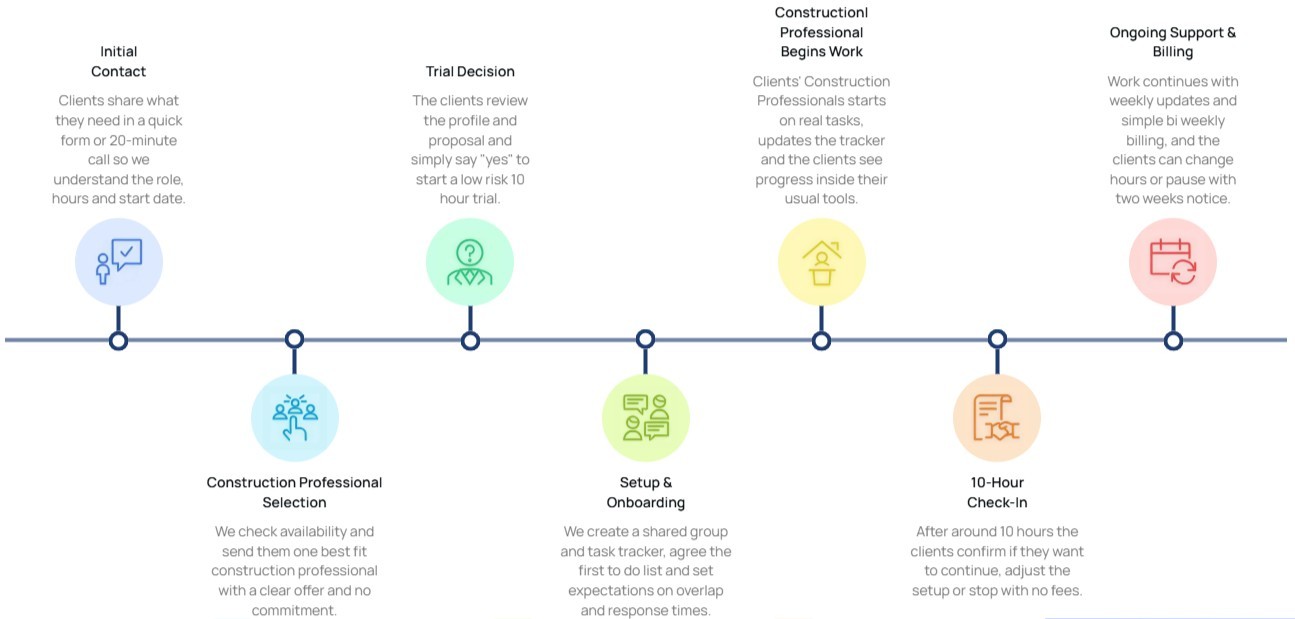
How engagement works
10-hour free trial
Flexible billing tied to actual hours worked
Cancel or pause with two weeks' notice
Capacity scales with project phase and workload
Self-managed and managed tiers available
Frequently asked questions
Implementation note: Wrap this section in FAQPage schema markup (schema.org/FAQPage) to qualify for rich results in Google.
Will the document controller work inside our project management platform?
Yes. The match process accounts for platform fluency before placement.
Can the controller handle revision distribution across subcontractors?
Yes. Revision distribution including subcontractor routing, acknowledgment tracking, and follow-up cycles is part of standard scope.
Does the work include cross-reference linkage between drawings and other project records?
Yes. Cross-reference linkage between drawings, specifications, RFIs, submittals, and COs gets maintained as items close. This is what supports audit-readiness and claims-stage documentation.
Can the controller handle closeout documentation preparation?
Yes. Closeout documentation including final drawing sets, archive packages, and owner handover materials is part of standard scope on closeout-focused engagements.
How is document control audit-readiness maintained?
Audit-readiness is treated as a daily habit, not a closeout deliverable. The controller maintains classification, naming, distribution records, and cross-reference linkage continuously, so an audit, claim, or owner request can be answered immediately.