
Master schedules don't run jobsites. Look-aheads do. The 2-week and 4-week views the field team actually executes against decide whether crews show up to ready work or to delays. When look-aheads are produced consistently and tied back to the master schedule, the field runs smoothly. When they're produced inconsistently or generated by gut feel, crews run into missing prerequisites, unresolved RFIs, and unreleased materials.
Most contractors know the field needs better look-aheads. They also know the in-house scheduler is busy running master schedule updates, owner reports, and claims documentation. Look-ahead production gets squeezed out of the calendar.
AEdigo gives general contractors, subcontractors, and project leadership teams on-demand access to pre-vetted schedulers and field coordinators who produce 2-week and 4-week look-ahead schedules tied to your master schedule. They work inside your office's look-ahead format and your field team's execution rhythm.
What look-ahead and short-term planning services actually deliver
The output is a usable look-ahead the field team executes against, with prerequisite tracking, dependency identification, and constraint logging.
Typical outputs from a look-ahead professional working through AEdigo:
3-week and 6-week look-ahead schedules tied to the master schedule
Prerequisite tracking including RFIs, submittals, and material deliveries
Constraint logging with assigned ownership for resolution
Crew loading and resource alignment for upcoming activities
Trade coordination across upcoming work fronts
Weekly work plans for foreman-level execution
Look-ahead variance analysis against previous look-ahead
Field-level schedule reporting integrated with master schedule updates
When you actually need look-ahead support
Field crews are showing up to work that isn't ready.
Master schedule updates are happening but look-aheads aren't being produced consistently.
RFI and submittal prerequisites aren't being tracked against upcoming work.
Material delivery coordination is breaking down at the field level.
Multiple projects share one scheduler and look-ahead bandwidth is split too thin.
Crew loading decisions are being made without forward visibility.
Owner-required look-ahead reports aren't being delivered on cadence.
How AEdigo runs look-ahead work
1. Match against project type and field rhythm
Building schedulers don't get matched to linear infrastructure. Office-based schedulers without field coordination experience don't get placed where the actual need is field-level look-ahead production.
2. Kick-off on look-ahead format and integration plan
Look-ahead format, master schedule integration, prerequisite tracking convention, constraint log structure, and field distribution. The kick-off locks the framework before the first cycle.
3. Cycle production
Weekly look-ahead cycles run on a defined cadence. Activities pulled from master schedule, prerequisites verified, constraints logged, look-ahead distributed to field, weekly work plan prepared.
4. Field coordination and feedback
Look-ahead doesn't end at distribution. The professional captures field feedback on prerequisites and constraints, escalates unresolved items, and adjusts the next cycle's look-ahead based on field reality.
5. Look-ahead variance report
Look-ahead activities completed, prerequisites resolved, constraints outstanding, and variance against previous look-ahead. Project leadership sees field execution health weekly.
Tools look-ahead professionals work in
Primavera P6 for master schedule integration
Microsoft Project for MS Project-led teams
Excel for look-ahead production and field distribution
Procore for look-ahead distribution and field tracking
Microsoft Teams and Outlook for field coordination
Lean planning tools (Last Planner System) for projects on lean methodology
What separates a look-ahead professional from a master scheduler
Master schedulers think in critical path. Look-ahead professionals think in field execution. The professional who delivers look-aheads field crews actually use understands construction sequencing, prerequisite management, and the tempo at which field work moves.
AEdigo vets look-ahead professionals on:
P6 or MS Project fluency at production level
Field coordination experience and field communication discipline
Prerequisite and constraint tracking habits
Crew loading and resource alignment knowledge
Trade coordination experience across upcoming work fronts
Lean planning fluency where applicable
Variance analysis discipline at the look-ahead level
Communication skills strong enough for foreman-level distribution
Use cases by stakeholder
General contractors
Project-level look-ahead production tied to master schedule
Cross-trade coordination at the field level
Owner-required look-ahead reports
Field-level constraint and prerequisite tracking
Subcontractors
Trade-specific look-aheads for self-perform crews
GC-side look-ahead integration
Material and crew loading for upcoming work
Project management firms
Owner-side look-ahead review
Multi-project look-ahead coordination
Common look-ahead failures
Look-aheads fail in predictable ways. If your projects have hit any of these, the issue is process, not effort.
Look-aheads produced inconsistently, breaking the link between master schedule and field execution.
Prerequisites not tracked, leaving crews showing up to unresolved RFIs and missing materials.
Constraints logged without ownership, leaving items unresolved week over week.
Look-aheads not tied back to master schedule, allowing field-level drift from project critical path.
Field feedback not captured, leaving the next cycle's look-ahead built from stale information.
Variance against previous look-ahead not analyzed, missing trend signals on field execution health.
Distribution informal, with foremen working from different versions of the look-ahead.
What separates a look-ahead program that works from one that drifts
Look-ahead programs that actually drive field execution share specific habits. The ones that drift share different habits.
Cycle cadence is enforced, not aspirational. Weekly means weekly.
Prerequisite tracking happens at the activity level, not the work-front level.
Constraints get owned and aged, not just logged.
Field feedback closes the loop into the next cycle, not just the master update.
Foremen receive a consistent look-ahead format, week over week.
Look-ahead variance becomes a project leadership metric, not a scheduler's internal note.
Look-ahead vs. master schedule update vs. weekly work plan
These three artifacts often get conflated. They serve different audiences and different purposes, and conflating them is one of the most common reasons look-ahead programs underperform.
The master schedule update is for project leadership and owners, focused on baseline variance and critical path.
The look-ahead is for project management and superintendents, focused on the next 3 to 6 weeks of executable work.
The weekly work plan is for foremen, focused on the specific activities, crews, and prerequisites for the upcoming week.
Each artifact has its own cadence, its own format, and its own audience. Producing one and calling it the others creates confusion across all three.
Look-ahead services vs. the alternatives
The alternatives are: have the master scheduler produce look-aheads on top of master updates, have superintendents produce look-aheads, or accept that look-aheads will be inconsistent.
Master schedulers stretched into look-ahead production usually deliver one badly. Master updates are calendar-bound; look-aheads are flexible and slip first.
Superintendents producing look-aheads pull time from field operations they should be running.
Inconsistent look-aheads create field execution problems that show up as crew idle time, missed dependencies, and avoidable schedule slip.
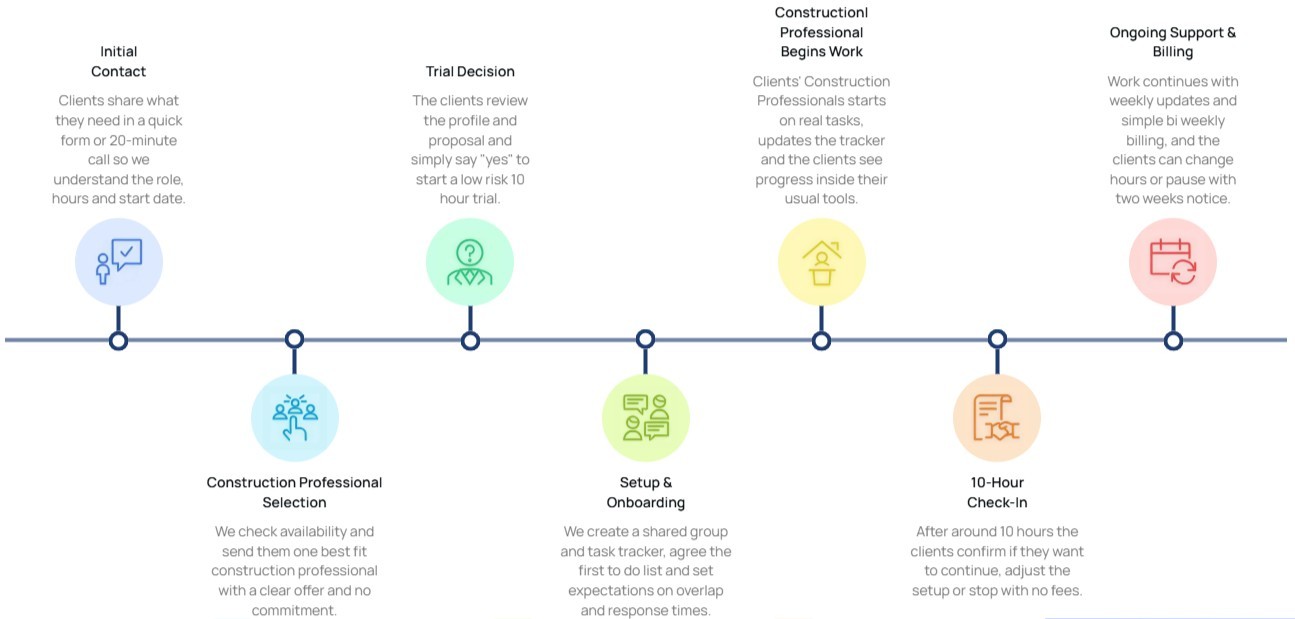
AEdigo runs look-ahead production as a managed engagement: vetted professionals, your master schedule, your office format, with progress reporting.
How engagement works
10-hour free trial
Flexible billing tied to actual hours worked
Cancel or pause with two weeks' notice
Capacity scales with project phase and workload
Self-managed and managed tiers available
Frequently asked questions
Implementation note: Wrap this section in FAQPage schema markup (schema.org/FAQPage) to qualify for rich results in Google.
Can the look-ahead tie back to our master schedule in P6 or MS Project?
Yes. Master schedule integration is part of standard scope. Look-ahead activities pull from the master schedule, with variance tracked against the master baseline.
Will the look-ahead include prerequisite tracking for RFIs, submittals, and materials?
Yes. Prerequisite tracking including RFI status, submittal approval, and material delivery readiness is part of standard scope. Items at risk against upcoming activities get flagged for escalation.
Can the professional handle weekly work plans at the foreman level?
Yes. Weekly work plans for foreman-level execution are part of standard scope on engagements that include field-level coordination.
Do you support Last Planner System or other lean planning methodologies?
Yes. The professional pool includes look-ahead specialists fluent in Last Planner System and other lean planning frameworks. The match process accounts for methodology fluency before placement.
How does field feedback get integrated back into the next cycle?
Field feedback gets captured during the look-ahead distribution cycle, with prerequisite changes, constraint resolution status, and variance information feeding into the next cycle's preparation.