
Permit drawings sit at a chokepoint. The owner can't break ground without them. The contractor can't bid without them. The project schedule is anchored to the day they get accepted by the authority. Anything that delays them delays the whole project.
Authority submission isn't drafting. It's drafting plus code compliance plus authority-specific format plus comment response cycles, all running on a calendar set by an authority that doesn't care about your project schedule.
Most permit delays come from preventable issues. Missing code documentation. Wrong submission format. Drawings that don't match the authority's submission template. Comment cycles that generate second-round comments because the first response was incomplete.
AEdigo gives architects, engineers, design-build contractors, and developers on-demand access to pre-vetted drafters and architectural professionals who specialize in permit-ready production. They work inside your authority's submission requirements, your project's code context, and your firm's standards.
What permit drawing services actually deliver
The output is a permit-ready package for authority review, with code documentation in place, format aligned to the authority's template, and supporting documents complete.
Typical outputs from a permit drawing professional working through AEdigo:
Permit-ready architectural and structural drawings
Code analysis documentation including occupancy, accessibility, and life safety
Energy code compliance documentation
Site, civil, and grading drawings where required
Authority-specific submission packages and forms
Comment response cycles and revised drawing packages
Coordination with consultants whose drawings join the submission
Submission portal upload and tracking
When you actually need permit drawing support
An authority comment cycle is generating revision volume your team can't absorb.
A permit submission was rejected and you need a clean re-issue.
Multiple permit submissions are stacking into the same window.
A renovation or addition project requires authority-specific documentation your team hasn't produced before.
An owner is moving multiple projects into permit simultaneously and the in-house team can't carry the volume.
How AEdigo runs permit drawing work
1. Match against authority and project type
The match process accounts for the specific authority context and the project type, so the professional already knows the submission framework.
2. Kick-off on submission requirements
Submission template, code documentation requirements, energy code compliance, supporting forms, and any authority-specific narrative or analysis. The kick-off locks the requirements before any drawing work begins.
3. Production cadence aligned to permit window
Permit work runs against authority review windows, not internal cadence. The professional schedules backward from the submission target to leave time for internal review.
4. Internal review against authority checklist
Before submission, the package goes through self-review against the authority's checklist and the firm's quality standards. Most authority comments are avoidable on first submission, and this review catches the predictable ones.
5. Comment cycle and revision rounds
Authority comments get implemented, the revision log gets updated, and the package gets re-submitted. Revision rounds are part of standard scope, so the engagement covers the full permit cycle, not just the first submission.
Tools permit drawing professionals work in
Autodesk Revit for BIM-led permit production
AutoCAD for AutoCAD-led firms and 2D-driven scopes
Bluebeam Revu for authority comment markup and response
Civil 3D for site and civil submission packages
Authority submission portals (varies by jurisdiction)
Energy code compliance tools (e.g., COMcheck, REScheck) for projects requiring them
What separates a permit-ready professional from a drafter
Anyone can draft a building plan. The professional who produces a package that survives authority review on first submission knows the code, knows the authority's review pattern, and knows what comment categories show up reliably on similar projects.
AEdigo vets permit drawing professionals on:
Building code fluency including IBC, IRC, and local amendments
Authority-specific submission experience
Energy code compliance documentation skills
Accessibility code experience
Comment response habits and revision discipline
Coordination with structural, MEP, and civil consultants
Documentation discipline including code analysis and supporting forms
Software fluency across the permit-stage stack
Use cases by stakeholder
Architecture firms
Permit submission packages across project types
Authority comment response cycles
Code analysis documentation
Renovation and addition permit drawings
Engineering firms
Permit-stage structural and MEP drawings
Authority coordination on engineering scopes
Code compliance documentation for engineering disciplines
Design-build contractors and developers
Permit packages on owner-led or design-build projects
Multi-project permit pipeline management
Authority comment response on tight schedules
Common permit submission failures that delay projects
Permit delays trace to predictable failures. If your past submissions have hit any of these, the issue is process, not effort.
Submission format not matching the authority's template, triggering reject-and-resubmit cycles.
Code documentation incomplete, generating clarification comments.
Energy code documentation missing or inconsistent with the architectural drawings.
Accessibility documentation missing required calculations or floor plans.
Consultant drawings not coordinated with the architectural package.
Authority comment responses incomplete, triggering second-round comments.
Revision logs not updated systematically, creating audit confusion.
Authority-specific submission patterns to know
Authorities run different submission frameworks. The differences between jurisdictions are large enough that a permit professional fluent in one isn't necessarily fluent in another. AEdigo's match process accounts for jurisdiction context, but understanding the variation helps you brief the kick-off.
Submission format requirements vary by jurisdiction (PDF set, individual sheets, BIM submission, online portal).
Code adoption versions vary, with some jurisdictions adopting current IBC and others running on legacy versions.
Energy code requirements vary in stringency and documentation format.
Accessibility code adoption varies, with some jurisdictions using ADA-only and others adding state or local equivalents.
Authority review patterns vary, with some jurisdictions running concurrent reviews and others sequencing through plan checkers.
Comment cycle counts vary, with some jurisdictions allowing unlimited revisions and others charging fees per cycle past the first.
Permit drawing services vs. the alternatives
The alternatives are: have the senior team carry permit work between design and CD work, contract to a freelance drafter without authority-specific experience, or accept that permit cycles will run long.
Senior teams stretched between design and permit work usually deliver one badly. The permit submission ends up rushed, with code documentation deferred and authority comments generating second-round revision cycles.
Freelance drafters without authority-specific experience produce submissions that look right and miss authority-specific format or code documentation requirements.
Accepting long permit cycles has the highest hidden cost. Project schedules anchor to permit acceptance, so every week of delay shows up as a week of carrying cost on the rest of the project.
AEdigo runs permit work as a managed engagement: authority-fluent professionals, your code context, your firm's standards, with internal review and full comment-cycle coverage.
How engagement works
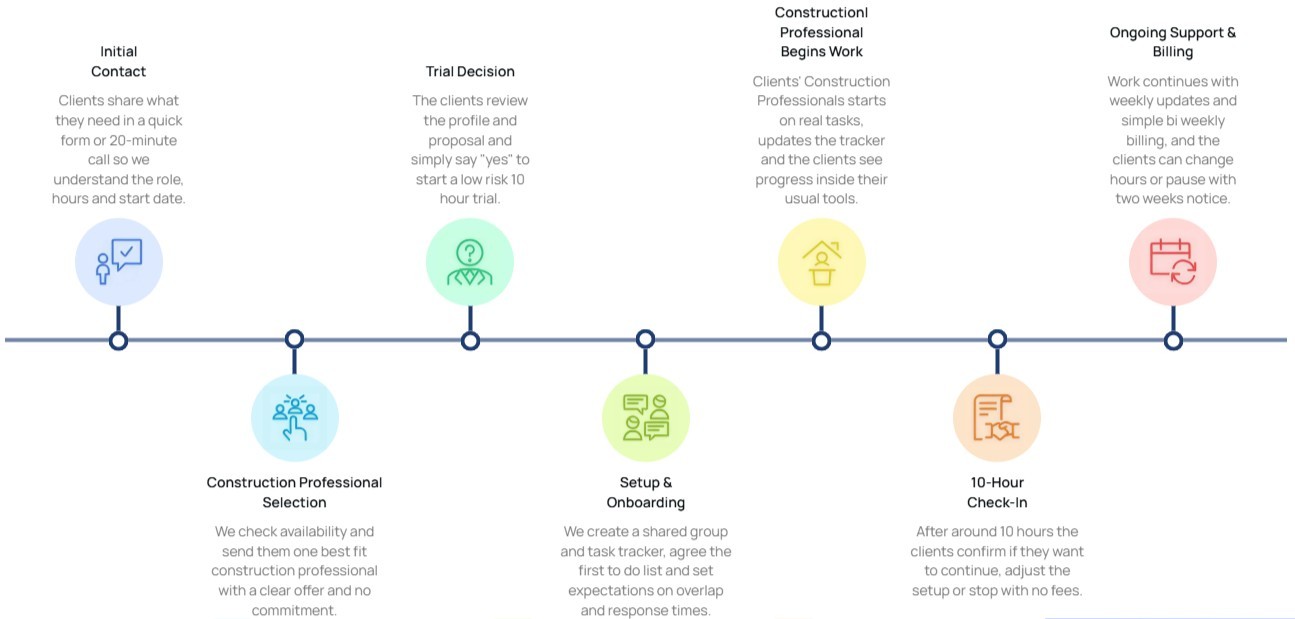
10-hour free trial
Flexible billing tied to actual hours worked
Cancel or pause with two weeks' notice
Capacity scales with permit pipeline volume
Self-managed and managed tiers available
Frequently asked questions
Implementation note: Wrap this section in FAQPage schema markup (schema.org/FAQPage) to qualify for rich results in Google.
Can the professional work to our specific authority's submission format?
Yes. The match process accounts for authority context. Submission format, code adoption version, and any authority-specific submission requirements get locked at kick-off, so the package comes back permit-ready on first submission.
Can the professional handle authority comment response?
Yes. Comment response is part of standard scope. The professional implements comments, updates the revision log, and re-submits without restarting the engagement.
Will the package include code analysis documentation?
Yes. Code analysis including occupancy, area calculations, accessibility, and life safety is part of the permit submission scope. The documentation gets prepared as part of the package, not as a separate engagement.
Can the professional coordinate with structural, MEP, and civil consultants?
Yes. Permit submissions usually require coordinated drawings from multiple disciplines. The professional handles coordination with consultants whose drawings join the submission, including format alignment and revision tracking.