
Progress reports are how owners, lenders, and senior project leadership see the project. When the reports are consistent, accurate, and on time, the project runs with full stakeholder visibility. When they slip, decisions get made against guesses.
Most progress reporting fails on the same axis: nobody on the project team has the calendar bandwidth to produce a clean report on the cadence the contract requires. The reports become inconsistent, late, or built last-minute from incomplete inputs.
AEdigo gives general contractors, subcontractors, owners, and project management firms on-demand access to pre-vetted project coordinators. They produce weekly, biweekly, and monthly progress reports against your contract requirements, using your project's data and your office's reporting standards.
What progress reporting services actually deliver
The output is the report the contract requires, on the cadence the contract sets, with the underlying data verified and the narrative coherent.
Typical outputs from a progress reporting professional working through AEdigo:
Weekly or biweekly progress reports for project leadership
Monthly owner reports aligned to contract requirements
Earned-value and physical-percent progress metrics
Schedule status integration including critical path and variance
Cost performance reporting including budget-to-actual
Submittal, RFI, and change order status reporting
Risk and issue tracking with action item integration
Photo and visual documentation integration
When you actually need progress reporting support
Reports are slipping past contract cadence and stakeholders are losing visibility.
Multiple projects share one project coordinator and reports are inconsistent across them.
An owner has compressed reporting requirements and the in-house team can't absorb the format.
Monthly reports are getting built last-minute, missing data inputs.
A lender or investor reporting requirement isn't being met consistently.
Project meetings run without supporting reports because the reporting cycle is behind.
The project has multiple reporting streams (owner, lender, internal) and consolidation is breaking down.
How AEdigo runs progress reporting work
1. Match against project type and reporting requirements
Owner-side reporting specialists don't get matched to internal project reporting. Cost-heavy reporting professionals don't get placed where the actual need is schedule and field status. The match accounts for the report types and the data sources.
2. Kick-off on report templates and data sources
Report templates, data sources, integration with the schedule and cost systems, narrative format, and contract-specific reporting requirements. The kick-off establishes the reporting framework before the first cycle.
3. Cycle production
Reports run on a defined cadence. Data pulled from project systems, narratives drafted, photos integrated, status verified, and the report assembled to template before issuance.
4. Internal review
Before issuance, the report goes through self-review against the contract requirements, the data sources, and the office's quality standards. Inconsistencies get caught before stakeholders see them.
5. Distribution and acknowledgment tracking
Reports get distributed per the contract distribution list. Acknowledgments and stakeholder questions get tracked, with response cycles handled inside the engagement.
Tools progress reporting professionals work in
Procore for project management data and reporting integration
Autodesk Construction Cloud for cloud project data and reporting
CMiC, Sage, and Viewpoint Vista for ERP-driven reporting
Primavera P6 and Microsoft Project for schedule data integration
Excel and Power BI for custom report production
Microsoft Word for narrative formatting and report assembly
What separates a reporting professional from a report generator
Anyone can populate a report template. The professional who delivers reports stakeholders trust knows what data signals matter, where data sources disagree, and how to translate operational reality into a written narrative that holds up under scrutiny.
AEdigo vets progress reporting professionals on:
Project management software fluency
Schedule and cost data integration habits
Narrative writing skill and reporting consistency
Construction context across project types
Contract structure understanding for owner-side reporting requirements
Risk and issue tracking discipline
Photo and visual documentation integration habits
Communication skills for stakeholder follow-up cycles
Use cases by stakeholder
General contractors
Owner monthly progress reports
Internal project leadership reports
Multi-project portfolio reporting
Lender and investor reporting on project-financed projects
Subcontractors
GC-side progress reports for trade scopes
Internal production reporting
Multi-project trade portfolio reporting
Owners and program managers
Independent progress reporting against contractor submissions
Multi-project portfolio reporting for capital programs
Lender and stakeholder reporting consolidation
Common progress reporting failures
Reporting failures show up in predictable ways. If your projects have hit any of these, the issue is bandwidth, not effort.
Reports issued late, with stakeholders losing the cadence.
Data inconsistencies between schedule, cost, and field status not reconciled before issuance.
Narratives that read as templates instead of project-specific updates.
Photos and visual documentation missing or inconsistent across reports.
Risk and issue tracking not integrated, leaving stakeholders without forward-looking context.
Report distribution gaps creating disputes about what was communicated.
Multiple reporting streams diverging, with internal and owner reports telling different stories.
What good progress reports actually do
Reports that build stakeholder confidence and reports that erode it differ on a small set of operational habits. Most reporting failures hit predictable patterns.
The markers of reporting that actually works:
These habits don't require special tools or new processes. They require consistent calendar attention and someone whose role is dedicated to the work, not someone for whom this is an extra responsibility on top of project management or field operations. That's the difference between a workflow that runs cleanly and one that has to be rescued at closeout.
Reports issue on cadence, not when stakeholders escalate.
Data inconsistencies between schedule, cost, and field status get reconciled before issuance.
Narratives are project-specific, not template language.
Photos and visual documentation are integrated systematically across reports.
Risk and issue tracking gives stakeholders forward-looking context.
Distribution and acknowledgment cycles get tracked, so report receipt is documented.
Multiple reporting streams stay aligned, so internal and owner versions tell the same story.
Progress reporting services vs. the alternatives
The alternatives are: have the project manager write reports, hire a junior coordinator without reporting context, or accept that reports will be inconsistent and late.
Project managers writing reports usually compress the work into the last hour before issuance, with data inputs incomplete and narratives generic.
Junior coordinators without reporting context produce reports that meet the format requirement and miss the substantive elements stakeholders actually use.
Inconsistent reporting damages stakeholder trust and creates dispute exposure during contract reconciliation.
AEdigo runs reporting as a managed engagement: vetted coordinators, your data sources, your contract requirements, with internal review and distribution coverage.
How engagement works
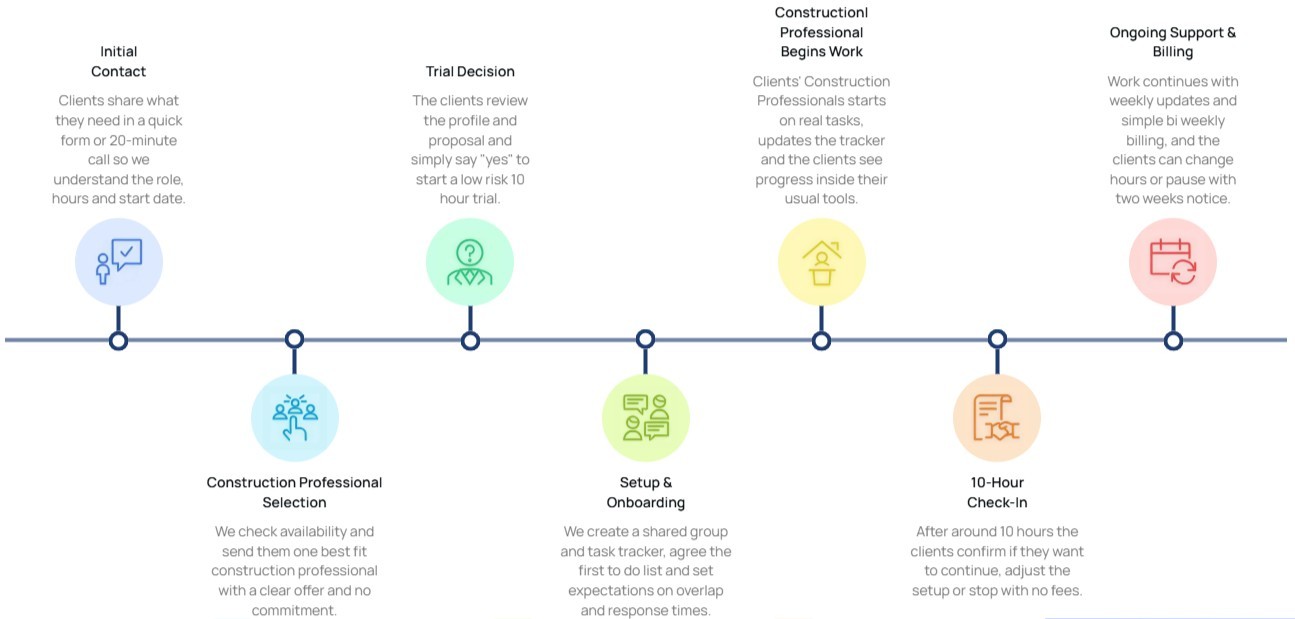
10-hour free trial
Flexible billing tied to actual hours worked
Cancel or pause with two weeks' notice
Capacity scales with reporting cadence and project volume
Self-managed and managed tiers available
Frequently asked questions
Implementation note: Wrap this section in FAQPage schema markup (schema.org/FAQPage) to qualify for rich results in Google.
Will the report follow our office's template and contract format?
Yes. The kick-off captures your office's report template, data sources, narrative format, and contract-specific reporting requirements. Reports come back in your format, ready for stakeholder distribution.
Can the professional integrate schedule, cost, and field status into one report?
Yes. Schedule data from P6 or MS Project, cost data from your ERP or accounting system, and field status from project management platforms get integrated into one coherent report. Reconciliation between sources happens before report issuance.
Do you handle owner reports, internal reports, or both?
Both. Many projects run multiple reporting streams (owner monthly, internal weekly, lender quarterly). The professional handles all streams within the engagement, with consistency maintained across them.
Can the professional handle stakeholder follow-up cycles after report issuance?
Yes. Stakeholder questions, clarifications, and follow-up cycles are part of standard scope. The professional tracks acknowledgments and handles responses without restarting the engagement.
How do photos and visual documentation get integrated?
Photo and visual documentation pulled from field teams or project management platforms gets organized, captioned, and integrated into the report on the cadence the report requires. Photo libraries get maintained across reporting cycles for visual continuity.