
Audit readiness is a daily habit that pretends to be a closeout problem. The contractors who pass audits, claims reviews, and disputes cleanly maintain their project files continuously. The ones who scramble through them are the ones who treated filing as something to handle later.
The cost asymmetry is significant. A contractor who maintains audit-ready files continuously spends a manageable amount per project. A contractor who reconstructs files at audit, claim, or dispute time spends more, in shorter timeframes, with the additional cost of weakened defensibility because the documentation isn't continuous.
AEdigo gives general contractors, subcontractors, owners, and project management firms on-demand access to pre-vetted coordinators who maintain project files against audit standards. They run filing structures, archive maintenance, cross-reference linkage, and audit response support, working inside your office's tools and your contract structure.
The work runs through a managed delivery layer with weekly progress reporting and replacement coverage if the fit isn't right.
What project filing and audit readiness services actually deliver
Typical outputs from a filing and audit readiness coordinator working through AEdigo:
Project filing structure setup and maintenance
Document classification and naming standardization
Archive maintenance with retention against retrieval
Cross-reference linkage between drawings, RFIs, submittals, COs, and field records
Audit response packages prepared from maintained files, not reconstructed
Document retention policy compliance
File integrity audits and drift detection
Closeout file compilation for owner handover
When you actually need filing and audit readiness support
Project filing is inconsistent across active projects.
An audit, claim, or owner request requires file documentation the team can't produce quickly.
Multiple projects share one coordinator and bandwidth is split too thin.
File structure has drifted from office standards over time.
A claim is forming and the underlying file documentation isn't strong enough.
A retention release is delayed because file documentation isn't current.
Document retention policy compliance is informal and audit-fragile.
How AEdigo runs filing and audit readiness work
1. Match against project tools and contract structure
The match accounts for the project management platform, the contract structure, and the project's filing complexity.
2. Kick-off on filing standards
Filing structure, document classification, naming convention, archive structure, retention policy, and contract-specific filing requirements. The kick-off establishes the filing framework before the first cycle.
3. Cycle maintenance
Daily filing as documents issue. Weekly classification audits. Monthly archive integrity checks. Cadence runs on a defined schedule, not as a backlog flush at closeout.
4. Cross-reference linkage
Cross-reference linkage between drawings, specifications, RFIs, submittals, COs, and field records gets maintained as items close. Linkage is what supports audit response and claims documentation.
5. Audit response support
When an audit, claim, or owner request arrives, response packages get prepared from the maintained files rather than reconstructed. Response time is hours, not weeks.
Tools filing and audit readiness coordinators work in
Procore for project management and document control
Autodesk Construction Cloud (BIM 360 / ACC) for cloud filing
Bluebeam Revu for document review and archive preparation
Microsoft SharePoint and OneDrive for office-side filing
CMiC, Sage, and Viewpoint Vista for ERP-driven filing workflows
Document retention policy enforcement through platform governance tools
What separates an audit-ready coordinator from a project admin
Anyone can file documents. The coordinator who maintains audit-ready records knows what audit questions look like, what cross-reference linkage supports response, and what filing discipline survives drift across multiple projects.
AEdigo vets filing and audit readiness coordinators on:
Project management software fluency
Contract structure understanding across major contract forms
Filing structure and classification discipline
Cross-reference linkage habits
Archive maintenance experience
Audit response experience
Document retention policy compliance
Communication skills for cross-stakeholder filing cycles
Use cases by stakeholder
General contractors
Multi-project filing structure maintenance
Audit and claims response file preparation
Document retention policy compliance
Closeout file compilation
Subcontractors
Trade-side project filing
Audit response for trade-specific scopes
Closeout documentation for retention release
Owners and program managers
Owner-side project filing
Multi-project portfolio audit readiness
Capital program documentation maintenance
Common audit-readiness failures
Audit failures show up in predictable patterns. If your past projects have hit any of these, the issue is process, not effort.
Filing inconsistent across projects, with each project team improvising structure.
Cross-reference linkage missing, leaving audit responses dependent on reconstruction.
Archive integrity compromised by ad-hoc filing without standards.
Document retention policy informal, leaving audit-fragile gaps.
Audit responses prepared from email archives and field memory rather than maintained files.
Closeout file compilation rushed, generating gaps in the handover package.
Filing maintained for current revisions but not for superseded versions, weakening dispute defense.
Why continuous filing costs less than reconstruction
The cost asymmetry between continuous audit-readiness and reconstruction at audit time is significant, and it shows up reliably across projects.
Continuous filing spreads the work across the project lifecycle, with predictable weekly cost.
Reconstruction concentrates the work into the audit window, often with premium-cost staffing.
Continuous filing produces stronger documentation because records are made at the time, not from memory.
Reconstruction always shows gaps. Audit reviewers notice gaps. Gap-filled documentation weakens defensibility.
Multi-project portfolios with continuous filing scale predictably. Reconstruction multiplies cost across each audited project.
The cost of audit failure (weakened entitlement, lost claims, retention delays) makes the choice obvious in retrospect, but only obvious continuously to teams that have been through it.
What audit reviewers actually look for
Audit reviewers, claims consultants, and owner reviewers share predictable evaluation patterns. The contractors who pass these reviews maintain documentation that anticipates them.
What reviewers consistently check:
Whether records were created at the time or reconstructed later, signaled by metadata, sequence, and naming consistency.
Whether cross-reference linkage between drawings, RFIs, submittals, and COs holds together coherently.
Whether the file structure follows a consistent standard or varies by project team.
Whether superseded revisions are archived against retrieval rather than deleted.
Whether transmittal and acknowledgment records support the distribution claims being made.
Filing and audit readiness services vs. the alternatives
The alternatives are: load filing onto the project manager, hire a junior admin without audit context, or accept that audit responses will require reconstruction.
Project managers loaded with filing usually defer it during field-busy periods.
Junior admins without audit context produce filing that looks correct and misses the cross-reference linkage that supports audit response.
Reconstruction at audit time costs more and produces weaker documentation than continuous maintenance.
AEdigo runs filing and audit readiness as a managed engagement: construction-context coordinators, your project tools, your contract structure, with weekly maintenance and audit response support.
How engagement works
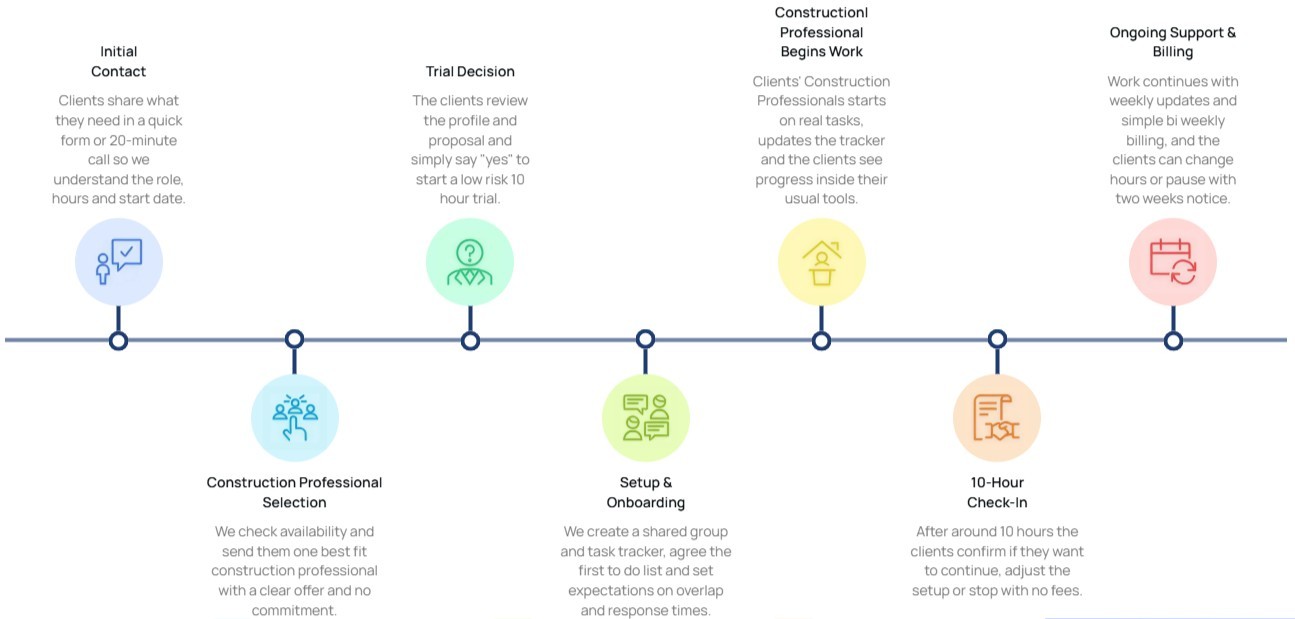
10-hour free trial
Flexible billing tied to actual hours worked
Cancel or pause with two weeks' notice
Capacity scales with project phase and filing volume
Self-managed and managed tiers available
Frequently asked questions
Implementation note: Wrap this section in FAQPage schema markup (schema.org/FAQPage) to qualify for rich results in Google.
Will the coordinator work inside our project management platform?
Yes. The match process accounts for platform fluency before placement.
Can the coordinator support an active audit or claim response?
Yes. Audit response support including file retrieval, cross-reference compilation, and response package preparation is part of standard scope. When the filing has been maintained continuously, response time is hours, not weeks.
Does the work include document retention policy compliance?
Yes. Retention policy enforcement through filing structure, classification, and archive maintenance is part of standard scope on engagements where the contract or office policy requires specific retention periods.
Can the coordinator handle multi-project portfolio filing?
Yes. Multi-project filing maintenance is a common scope. Filing standards get enforced across projects, with classification and cross-reference linkage maintained consistently.
How is archive integrity maintained?
Archive integrity gets verified through periodic checks. Files remain retrievable, metadata remains intact, and the archive structure mirrors the active filing structure for cross-period audit retrieval.