
Bid season hits, the estimating team is stacked, and the takeoff backlog grows. You bid late on three opportunities, soft on two more, and skip a project you should have chased. The volume mismatch between in-house takeoff capacity and bid volume is the most common reason mid-size contractors leave good projects on the table.
Takeoffs aren't bottlenecked because takeoff is hard. They're bottlenecked because takeoff is volume work that competes for the same calendar as detailed estimating, vendor pricing, and bid strategy.
AEdigo gives general contractors, subcontractors, and estimating teams on-demand access to pre-vetted quantity takeoff professionals. They are fluent in PlanSwift, On-Screen Takeoff, Bluebeam Revu, STACK, and the trade-specific takeoff conventions each scope requires. They work inside your assembly library, your unit conventions, and your bid template.
The work runs through a managed delivery layer with progress reporting and replacement coverage if the fit isn't right.
What quantity takeoff services actually deliver
The output is bid-ready quantities your estimator can drop into pricing, not a generic measurement spreadsheet. That distinction is what separates a useful takeoff from one your estimator has to redo.
Typical outputs from a quantity takeoff professional working through AEdigo:
Trade-specific quantity takeoffs across architectural, structural, MEP, and civil scopes
Bills of quantities (BOQs) formatted to your office standard
Material takeoffs with waste factors applied per scope
Square footage, linear, and volumetric measurements with discipline-appropriate breakdowns
Assembly-level takeoffs aligned to your cost code structure
Color-coded plan markups showing measured scope
Quantity comparisons against design alternates
Takeoff updates as the drawings revise during bid period
When you actually need takeoff support
Your estimating team is stacked across multiple bids and the takeoff backlog is growing.
You're chasing more bids this quarter than your in-house team can carry.
Bid season hits and turnaround windows are tighter than your internal capacity.
A specialty scope is outside your team's depth and you need a takeoff from someone who knows it.
You're a sub bidding to multiple GCs simultaneously and need parallel takeoffs.
A bid revision came in and the original takeoff has to be reworked fast.
You're deciding whether to chase a project and need a quick quantity check before committing estimating time.
How AEdigo runs takeoff work
1. Match against trade and software
Architectural takeoff specialists don't get placed on MEP scopes. PlanSwift-only estimators don't get matched to teams running Cubit or CostX. The match accounts for trade, software, and the level of detail your bid requires.
2. Kick-off on assembly library and conventions
Cost code structure, assembly library, unit conventions, waste factor conventions, and bid template format. Twenty minutes up front prevents an estimator having to remap categories after delivery.
3. Production cadence aligned to bid date
The takeoff professional works the schedule backward from your bid date. Drawings get marked up, quantities get extracted, the BOQ gets formatted to your template, and the package lands in your estimator's hands with time for pricing.
4. Revision cycle coverage
When drawings revise during the bid period, the takeoff updates with them. Revision rounds are part of standard scope, so the bid stays current.
5. Progress report
Bids in progress, hours logged, takeoffs delivered, takeoffs queued, and any drawing-quality issues that affected accuracy. Project leadership sees the bid pipeline in real terms.
Tools quantity takeoff professionals work in
PlanSwift for digital takeoff across disciplines
On-Screen Takeoff (OST) for plan-based quantity extraction
Bluebeam Revu for markup-driven takeoff workflows
STACK for cloud-based estimating and takeoff
Cubit for end-to-end takeoff and estimating
CostX for BIM-integrated quantity takeoff
Trimble WinEst for unit-priced bid preparation
BIM-based takeoff from Revit and Navisworks for projects with model deliverables
What separates a quantity surveyor from a measurer
Anyone can measure a wall length. The professional who delivers a takeoff your estimator trusts knows when to apply a waste factor, when a drawing is incomplete enough to flag rather than measure, and when an alternate bid scope is cheaper than the base.
AEdigo vets quantity takeoff professionals on:
Trade-specific construction knowledge across the scope they take off
Discipline on waste factors, lap allowances, and cost code mapping
Software fluency across the major takeoff platforms
Drawing interpretation strong enough to flag incomplete or conflicting documents
Awareness of bid-level versus construction-level accuracy expectations
Communication discipline for handling RFI-driven uncertainties during bid
Habit of documenting assumptions so the estimator can verify against the drawings
Speed without compromising accuracy on measurable scope
Use cases by stakeholder
General contractors
Multi-trade takeoffs for self-perform and bid coordination
Scope verification against subcontractor bids
Bid revision takeoffs during the bid period
Conceptual quantity checks for go/no-go decisions
Subcontractors
Trade-specific takeoffs across MEP, steel, façade, finishes
Parallel takeoffs for multiple GCs on the same project
Specialty scope takeoffs outside the in-house team's depth
Owners and design teams
Independent quantity verification against contractor bids
Pre-tender BOQ production for tendered procurement
Value engineering quantity comparisons
Common takeoff mistakes that lose bids
Most lost bids and lost margin trace to predictable takeoff failures. If your current process is hitting any of these, the issue is workflow, not estimator effort.
Measuring scope without flagging incomplete drawings, leading to RFI exposure during construction.
Inconsistent waste factor application across similar items.
Cost code mapping mistakes that throw off the bid summary.
Missed alternates that the estimator only catches at pricing review.
Takeoffs not updated when the drawings revise during bid period.
Generic assembly mapping that doesn't match your office's actual cost structure.
Volume work crowding out the careful review of high-cost items.
Quantity takeoff services vs. the alternatives
The alternatives are: hire more in-house estimators, contract takeoffs to the lowest-cost freelance shop, or skip bids you don't have time to pursue.
Hiring full-time works for contractors with steady, predictable bid volume. It doesn't fit estimating loads that spike around bid season or specific market windows.
Lowest-cost freelance shops produce takeoffs nobody on your bid team can verify against your assembly library. The estimator either trusts the file blind or redoes the work, neither of which is acceptable.
Skipping bids has the highest hidden cost. Every bid you don't pursue is revenue you walked away from, and the math compounds over a year.
AEdigo runs takeoff work as a managed engagement: vetted estimators, your assembly library, your cost codes, your bid template, with revision coverage and progress reporting.
How engagement works
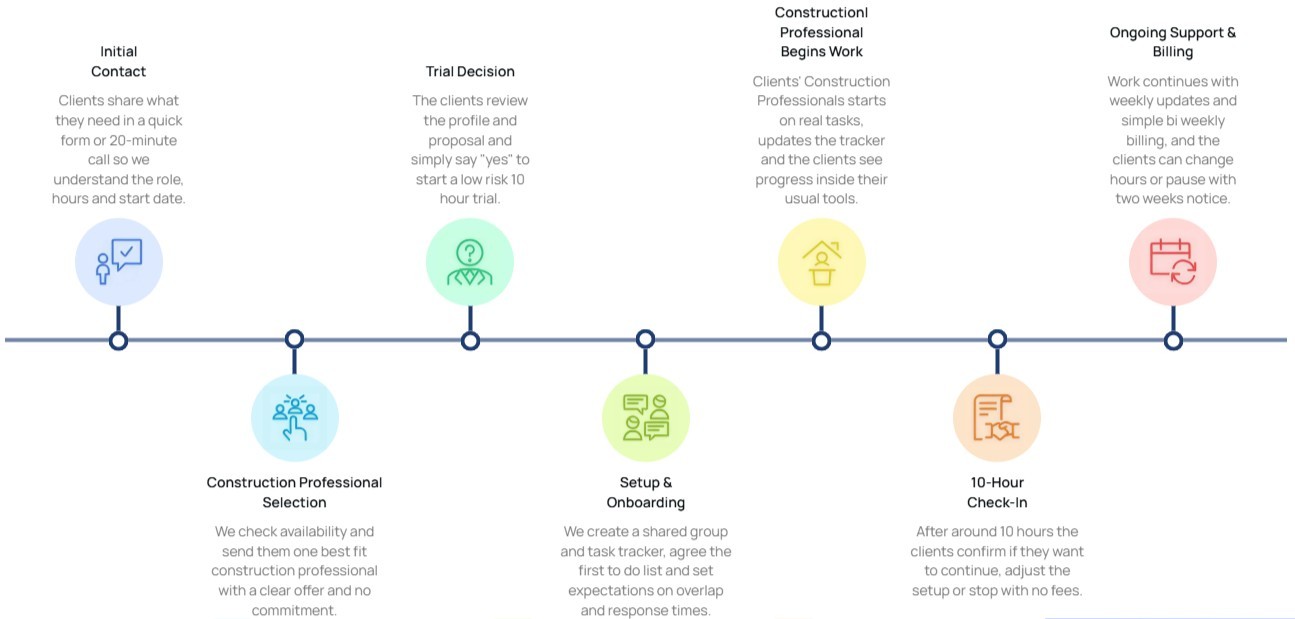
10-hour free trial
Flexible billing tied to actual hours worked
Cancel or pause with two weeks' notice
Capacity scales with bid volume
Self-managed and managed tiers available
Frequently asked questions
Implementation note: Wrap this section in FAQPage schema markup (schema.org/FAQPage) to qualify for rich results in Google.
Will the takeoff use our office's cost codes and assembly library?
That's the default. The kick-off captures your cost code structure, assembly library, unit conventions, and bid template format. The takeoff comes back mapped to your office, not generic categories your estimator has to remap.
What if drawings revise during the bid period?
Revision rounds are part of standard scope. When updated drawings come in, the takeoff updates with them, and the BOQ gets re-issued so the bid stays current.
Can AEdigo handle BIM-based takeoffs from Revit and Navisworks?
Yes. Model-based takeoffs are increasingly common, especially on projects with strong BIM deliverables. The takeoff professional pulls quantities directly from the model in CostX, Cubit, or Revit schedules, with reconciliation against drawing-based measurement where the model is incomplete.
How do you handle incomplete or conflicting drawings during bid?
The takeoff professional flags drawing issues rather than guessing through them. Flags become RFIs your estimating team can issue back to the design team, or assumption notes the bid carries clearly. Owners and contractors both prefer flagged uncertainty over silent assumptions.
Can AEdigo produce takeoffs for multiple bids in parallel?
Yes. Parallel takeoff capacity is one of the most common reasons firms engage AEdigo. The match process scales with your bid volume, and the managed delivery layer keeps each bid on its own schedule.