
RFI and submittal control is the day-to-day workflow that keeps construction documentation moving. Done right, response cycles run inside contract windows, aging stays manageable, and field crews aren't stuck waiting on clarifications. Done badly, the project accumulates a backlog that compounds into delay claims, scope disputes, and retention issues at closeout.
Most contractors know what good RFI and submittal control looks like. They also know that maintaining it under field pressure is what's actually hard. Items get logged but not routed. Routed but not chased. Chased but not closed. The log slowly diverges from operational reality.
AEdigo gives general contractors, subcontractors, owners, and project management firms on-demand access to pre-vetted RFI and submittal coordinators. They run intake, classification, routing, response tracking, comment consolidation, and aging analysis, working inside your project tools and your contract structure.
What RFI and submittal control services actually deliver
The output is two clean, current, contract-aligned workflows.
Typical outputs from an RFI and submittal control professional working through AEdigo:
RFI intake, classification, and routing
Submittal intake, sequencing, and routing for review
RFI response tracking with chase cycle management
Submittal comment consolidation and re-issue tracking
RFI and submittal aging analysis with escalation flagging
Cross-reference linkage to drawings, specifications, and field records
Audit-ready documentation maintained continuously
Weekly aging and risk reports
When you actually need RFI and submittal control support
RFI response cycles are slipping past contract windows.
Submittal aging is climbing.
Logs aren't current and field uncertainty is showing up in repeat RFIs.
Multiple consultants are providing inconsistent comments and consolidation is breaking down.
Multiple projects share one coordinator and bandwidth is split too thin.
An audit or claim requires log documentation the team can't produce quickly.
Cross-reference linkage between RFIs, submittals, drawings, and field records is informal and gaps are showing up.
How AEdigo runs RFI and submittal control work
1. Match against project tools and contract structure
The match accounts for the project management platform, the contract structure, and the project's RFI and submittal volume.
2. Kick-off on workflow standards
RFI numbering and classification, submittal naming and sequencing, routing rules, comment consolidation methodology, and contract-specific response windows. The kick-off locks workflows before the first cycle.
3. Cycle production
Daily intake. Weekly aging review. Monthly audit pass. Cadence runs on a defined schedule.
4. Cross-reference linkage
Each RFI gets linked to the originating drawing, specification, or field condition. Each submittal gets linked to its specification section and approved RFIs.
5. Weekly aging and risk report
Aging trend, items at risk against contract response windows, and any cycle gaps. Project leadership sees workflow health weekly.
Tools RFI and submittal control professionals work in
Procore for project management and document control
Autodesk Construction Cloud (BIM 360 / ACC) for cloud workflows
CMiC, Sage, and Viewpoint Vista for ERP-driven workflows
Bluebeam Revu for submittal markup and comment consolidation
Microsoft Outlook and Teams for routing and acknowledgment
SharePoint and OneDrive for office-side document control
What separates a control professional from a project admin
Anyone can update a log. The coordinator who keeps RFIs and submittals contract-aligned knows the contract response windows, the routing logic, the comment consolidation requirements, and the aging signals that flag risk.
AEdigo vets RFI and submittal control professionals on:
Project management software fluency
Contract structure understanding across major contract forms
RFI classification and routing experience
Submittal sequencing and schedule integration
Comment consolidation discipline
Aging analysis and escalation habits
Cross-reference linkage habits
Audit-readiness and claims-stage documentation experience
Use cases by stakeholder
General contractors
Project-wide RFI and submittal control
Multi-project portfolio coordination
Subcontractor submittal intake and review
Owner-side RFI submission
Subcontractors
Trade-side submittal preparation and routing
GC-side RFI submission and tracking
Specialty scope submittal management
Project management firms and owners
Owner-side RFI and submittal review coordination
Multi-project portfolio coordination
Independent aging and risk reporting
Common RFI and submittal control failures
Workflow failures show up in predictable patterns.
RFI response cycles deferred during field-busy weeks, creating compounding aging.
Submittals routed without sequencing against the schedule.
Comment consolidation handled informally, leaving comments unconsolidated or contradictory.
Cross-reference linkage missing, breaking audit-readiness.
Logs not current, creating disputes about what's open and what's closed.
Aging not flagged proactively, leaving project leadership without forward visibility.
Closeout audit revealing documentation gaps.
What healthy RFI cycles actually look like
RFI workflows that hold up under field pressure share specific operational habits.
Every RFI gets classified at intake, separating real-question RFIs from clarification or directive-driven items.
Routing rules are mechanical, not interpretive. Each RFI type has a defined initial recipient.
Response tracking runs against contract response windows, not generic targets.
Chase cycles run on a defined schedule, not when escalations happen.
Cross-reference linkage to originating drawings or specifications is captured at intake.
Closed RFIs get linked to the resolution (drawing revision, change order, field directive) so the audit trail is complete.
Aging gets reported weekly with items past threshold flagged for escalation.
Submittal sequencing and schedule integration
Submittal logs that just track receipt and approval miss the schedule integration that determines whether submittal work is actually supporting the project.
Submittal sequencing that supports the schedule looks like:
Each submittal has a required-by date driven by procurement lead time and installation schedule.
Long-lead items get prioritized on the submittal schedule, not buried in alphabetical order.
Subcontractor submittal due dates back-schedule from the GC's required-by date with realistic review buffers.
Reviewer comment cycles are captured in the submittal schedule, not assumed to be one-cycle.
Re-submission triggers a sequence shift, not a status update only.
Critical-path-dependent submittals get flagged for escalation if review cycles run long.
RFI and submittal control vs. the alternatives
The alternatives are: load the workflows onto the project manager, hire a junior admin without contract context, or accept that response cycles will run long.
Project managers loaded with RFI and submittal work usually defer it during field crunches.
Junior admins without contract context miss the contract-driven cycle requirements.
Long response cycles damage the schedule and create exposure during disputes.
These habits don't require special tools or new processes. They require consistent calendar attention and someone whose role is dedicated to the work, not someone for whom this is an extra responsibility on top of project management or field operations. That's the difference between a workflow that runs cleanly and one that has to be rescued at closeout.
How engagement works
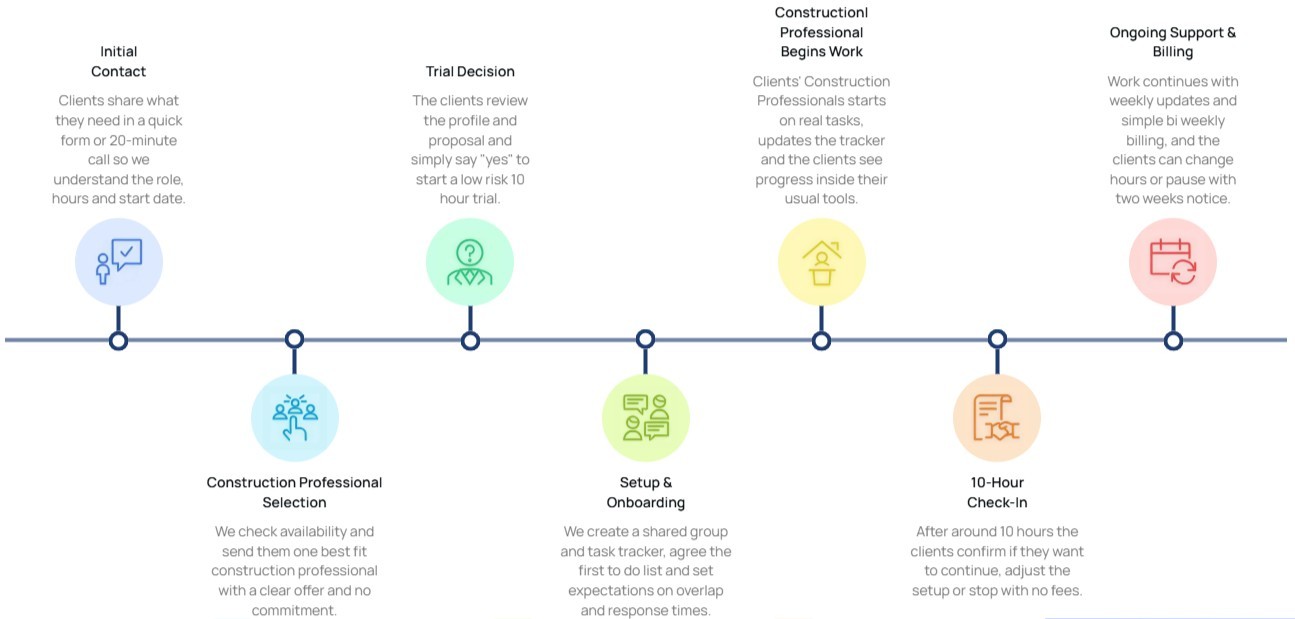
10-hour free trial
Flexible billing tied to actual hours worked
Cancel or pause with two weeks' notice
Capacity scales with project phase and workload
Self-managed and managed tiers available
Frequently asked questions
Implementation note: Wrap this section in FAQPage schema markup (schema.org/FAQPage) to qualify for rich results in Google.
Will the coordinator work inside our project management platform?
Yes. The match process accounts for platform fluency before placement.
Can the coordinator handle submittal review, or only routing?
Both options exist. Some clients use AEdigo only for routing and log management. Others have AEdigo handle the full submittal cycle including comment consolidation, re-issue tracking, and approval coordination.
How does aging analysis and escalation work?
Aging gets tracked continuously. Items past defined thresholds (typically tied to contract response windows) get flagged with escalation context.
Can the coordinator handle multi-project portfolios?
Yes. Multi-project portfolio coordination is a common scope. The coordinator manages multiple projects with cycle discipline maintained across each.
Does the work include audit-ready documentation maintenance?
Yes. Audit-readiness is part of the operating model, not a closeout add-on. Cross-reference linkage gets maintained continuously, so an audit or owner request can be answered immediately.