
Schedule updates are the most predictable scheduling work on the project, and the most often deferred. Weekly cycles slip to biweekly. Biweekly slips to monthly. By the time someone runs a real update, the schedule is months stale and project leadership is operating on field instinct instead of data.
The work isn't complicated. It's calendar discipline. Status pulled from field, progress measured, schedule updated, variance analyzed, look-ahead produced. The contractors who run schedule updates well make better mobilization decisions, defend variances more credibly, and avoid the closeout surprise of finding out the schedule didn't reflect reality for the last six months.
AEdigo gives general contractors, subcontractors, owners, and project management firms on-demand access to pre-vetted schedulers who run update cycles on the cadence the contract requires. They work inside your project's baseline, your office's update standards, and your contract's reporting requirements.
What schedule update services actually deliver
The output is a current, accurate schedule with progress measured, variances analyzed, and look-ahead produced. The schedule becomes a management tool, not a historical record.
Typical outputs from a schedule update professional working through AEdigo:
Weekly, biweekly, or monthly schedule updates against baseline
Progress measurement using earned-value or physical-percent methodology
Variance analysis against baseline and previous update
Look-ahead schedules including 3-week and 6-week formats
Critical path tracking with current path identification
Schedule narrative documenting status, variance, and recovery actions
Owner submission packages aligned to contract requirements
Subcontractor schedule integration support
When you actually need schedule update support
Update cycles are slipping past contract cadence.
Project leadership is making decisions against stale schedule data.
Variance analysis isn't happening, leaving root causes uncaptured.
Look-ahead schedules aren't being produced consistently.
Subcontractor schedule integration is informal and gaps are showing up.
Multiple projects share one scheduler and update bandwidth is split too thin.
An owner is asking for schedule reports the team can't produce in time.
How AEdigo runs schedule update work
1. Match against software and project complexity
P6-fluent schedulers don't get matched to MS Project-only teams. The match accounts for software, project type, and contract requirements.
2. Kick-off on update cadence and conventions
Update cycle (weekly, biweekly, monthly), progress measurement methodology, look-ahead format, narrative template, and contract reporting requirements. The kick-off locks the framework before the first cycle.
3. Cycle production
Status pulled from field, progress measured against baseline, variance analyzed, look-ahead produced, narrative drafted, owner package assembled. Cycle runs on a defined schedule.
4. Internal QA
Before issuance, each update goes through QA against the baseline, the previous update, and contract-specific reporting requirements. Variances get traced to root causes, not just flagged.
5. Progress and risk report
Schedule status, critical path movement, variance trends, look-ahead readiness, and emerging risk items. Project leadership sees the schedule as a current management tool.
Tools schedule update professionals work in
Primavera P6 for primary update cycles
Microsoft Project for MS Project-led teams
Asta Powerproject for Asta-driven projects
Procore Schedule for projects on the Procore platform
Excel for look-ahead production and reporting integration
Acumen Fuse for schedule QA and logic verification
What separates an update professional from a P6 user
Anyone can populate progress in a P6 file. The scheduler who delivers updates project leadership can act on knows where to dig for status, what variance signals matter, and how to translate field reality into schedule logic without breaking the network.
AEdigo vets schedule update professionals on:
P6 or MS Project fluency at production level
Construction context across project types
Variance analysis discipline and root-cause habits
Look-ahead production experience
Schedule narrative writing skill
Subcontractor integration experience
Earned-value or physical-percent methodology
Communication skills for status pull from field teams
Use cases by stakeholder
General contractors
Project schedule updates against baseline
Subcontractor schedule integration
Owner schedule reporting packages
Look-ahead production for field execution
Subcontractors
Trade-specific schedule tracking
Production schedule maintenance for self-perform work
Look-ahead schedules for field crews
Owners and program managers
Independent schedule tracking
Multi-project portfolio schedule reporting
Schedule QC against contract requirements
Common update cycle failures
Update problems show up in predictable ways. If your projects have hit any of these, the issue is cadence, not effort.
Updates deferred during field-busy weeks, creating compounding gaps.
Status pulled from secondary sources rather than verified field information.
Variance flagged without root-cause analysis.
Look-aheads produced inconsistently, breaking the link between master schedule and field execution.
Subcontractor schedule integration handled informally.
Critical path lost during updates, distorting project priority decisions.
Owner schedule reports produced reactively rather than as part of the standard cycle.
What separates an update that informs from one that just records
Schedule updates are useful in proportion to whether project leadership can act on them. Most updates fail this test, not because the data is wrong but because the analysis layer between data and decision is missing.
Updates that actually inform decisions share these characteristics:
These habits don't require special tools or new processes. They require consistent calendar attention and someone whose role is dedicated to the work, not someone for whom this is an extra responsibility on top of project management or field operations. That's the difference between a workflow that runs cleanly and one that has to be rescued at closeout.
Variance analysis traces every deviation to a root cause, not just a deviation amount.
Critical path movement gets called out explicitly with the new path identified.
Look-aheads tie back to the master schedule and flag dependency conflicts.
Recovery and mitigation actions get documented in the schedule narrative.
Subcontractor schedule integration confirms cross-trade dependencies are intact.
Earned-value or physical-percent tracking provides leading indicators, not lagging ones.
Owner reports get prepared as part of the standard cycle, not assembled reactively.
Schedule files get archived at every update cycle, preserving an audit trail.
Update narratives carry forward continuity from prior cycles, so reviewers can track variance trends across the project.
Schedule update services vs. the alternatives
The alternatives are: load updates onto the project manager, hire a junior scheduler without project context, or accept that updates will run inconsistently.
Project managers loaded with update work usually defer it during field-busy periods, creating compounding gaps.
Junior schedulers without project context produce updates that look complete and don't reflect field reality.
Inconsistent updates leave project leadership flying blind on schedule health.
AEdigo runs schedule updates as a managed engagement: vetted schedulers, your baseline, your update cycle, your contract reporting, with Progress and risk reports.
How engagement works
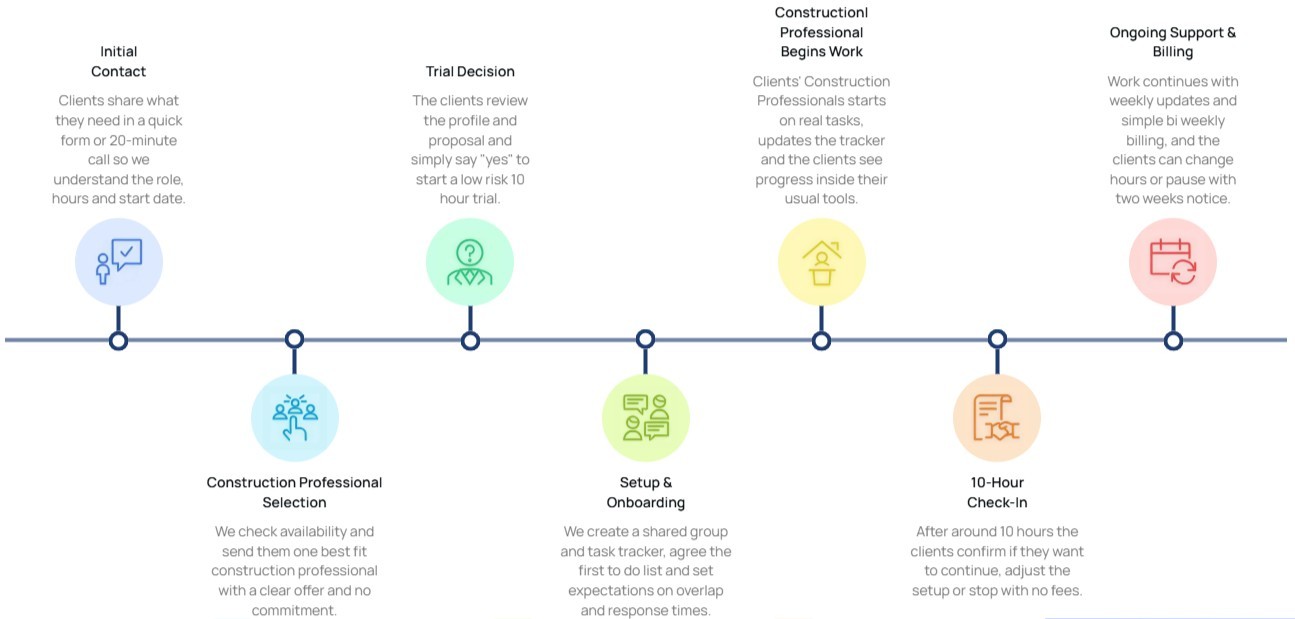
10-hour free trial
Flexible billing tied to actual hours worked
Cancel or pause with two weeks' notice
Capacity scales with project phase and schedule complexity
Self-managed and managed tiers available
Frequently asked questions
Implementation note: Wrap this section in FAQPage schema markup (schema.org/FAQPage) to qualify for rich results in Google.
What update cadences do AEdigo's schedulers support?
Weekly, biweekly, and monthly update cycles are all standard. The cadence aligns to the contract requirement and the project's complexity. Some projects run weekly internal updates with monthly owner reports.
Will the updates include look-ahead production?
Yes. Look-ahead schedules including 2-week and 4-week formats are part of standard scope on update engagements. Look-aheads tie to the master schedule and get produced on the cadence the field team needs.
Can the scheduler integrate subcontractor schedules into the master?
Yes. Subcontractor schedule integration is part of standard scope. Cross-trade dependencies and integration discrepancies get verified during each update cycle.
Does the schedule narrative include variance analysis?
Yes. Variance analysis with root-cause documentation is part of the schedule narrative on each update cycle. The narrative documents the variance, the cause, and any recovery or mitigation actions.
Can the scheduler produce contract-specific owner reports?
Yes. Owner reporting packages including schedule narrative, variance analysis, critical path status, and milestone tracking are part of standard scope on engagements where the contract requires them.