
Transmittals are the documented proof that the right people received the right documents on the right date. They sound administrative until a dispute forms and the project has to prove that a specific revision reached a specific subcontractor before a specific milestone. At that point, transmittal records become the most important documents on the project.
Most contractors handle transmittals informally because the work is mundane until it isn't. Distribution gets sent through email. Acknowledgments don't get tracked. The transmittal log gets reconstructed from email archives at audit time. The records that should have been built continuously get assembled from memory.
AEdigo gives general contractors, subcontractors, owners, and project management firms on-demand access to pre-vetted document coordinators. They prepare transmittals, manage distribution, track acknowledgments, and maintain the transmittal log against contract requirements.
What transmittals and distribution services actually deliver
Typical outputs from a transmittal coordinator working through AEdigo:
Transmittal preparation in the contract's required format
Document distribution against project distribution lists
Acknowledgment tracking with chase cycle management
Transmittal log maintenance with audit-ready records
Distribution list management across projects and stakeholders
Cross-reference linkage between transmittals and dependent records
Audit-ready archive of historical transmittals
Closeout transmittal compilation for project handover
When you actually need transmittal support
Distribution is happening informally and acknowledgment tracking is incomplete.
An audit, claim, or dispute requires transmittal records the team can't produce quickly.
Multiple projects share one coordinator and bandwidth is split too thin.
Distribution lists are inconsistent across projects and stakeholders.
Subcontractor distribution coordination is breaking down.
Transmittal log is informal and reconstruction-dependent for audit responses.
Closeout is approaching and transmittal compilation isn't started.
How AEdigo runs transmittals and distribution work
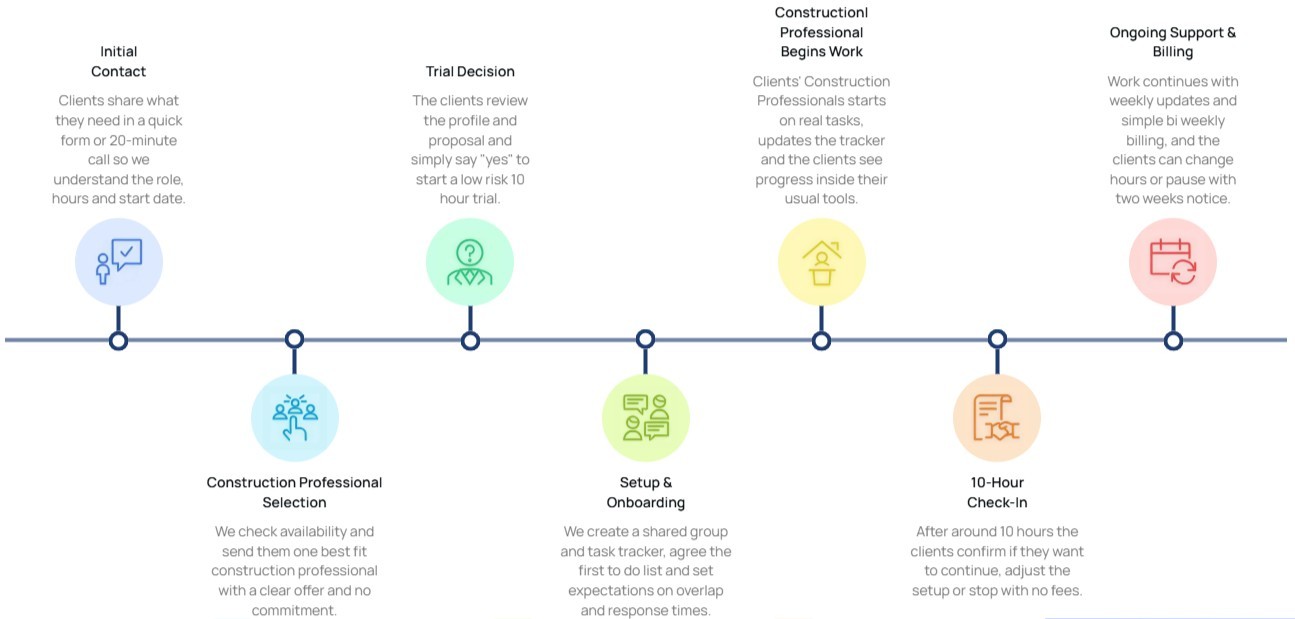
1. Match against tools and contract structure
The match accounts for the project management platform, the contract structure, and the project's transmittal volume.
2. Kick-off on transmittal standards
Transmittal format, distribution list structure, acknowledgment tracking convention, chase cycle cadence, and contract-specific transmittal requirements. The kick-off establishes the transmittal framework before the first cycle.
3. Cycle production
Daily transmittal preparation as documents issue. Weekly chase cycles for outstanding acknowledgments. Monthly audit pass on the transmittal log. Cadence runs on a defined schedule.
4. Acknowledgment tracking
Acknowledgment outstanding gets chased on a defined cycle. Chase patterns vary by recipient type and contract requirement, with escalation thresholds defined at kick-off.
5. Weekly status report
Transmittals issued, acknowledgments outstanding, chase cycle status, and any items at risk. Project leadership sees distribution health weekly.
Tools transmittal coordinators work in
Procore for transmittal preparation and distribution
Autodesk Construction Cloud (BIM 360 / ACC) for cloud-based distribution
Bluebeam Revu for transmittal markup and PDF assembly
Microsoft Outlook and Teams for distribution and acknowledgment tracking
SharePoint for office-side transmittal archiving
CMiC, Sage, and Viewpoint Vista for ERP-driven transmittal workflows
What separates a transmittal coordinator from a project admin
Anyone can attach a document to an email. The coordinator who maintains audit-ready transmittal records knows the contract requirements, the chase cycle discipline, and the cross-reference linkage that supports claims and disputes.
AEdigo vets transmittal coordinators on:
Project management software fluency across major platforms
Contract structure understanding across major contract forms
Transmittal format experience across owner formats
Distribution list management discipline
Acknowledgment tracking and chase cycle habits
Cross-reference linkage habits
Audit-readiness habits
Communication skills for chase cycles across stakeholders
Use cases by stakeholder
General contractors
Project-wide transmittal preparation and distribution
Multi-project portfolio transmittal coordination
Subcontractor distribution coordination
Closeout transmittal compilation
Subcontractors
Trade-side transmittal preparation
GC distribution acknowledgment tracking
Closeout transmittal documentation for retention release
Project management firms
Owner-side transmittal coordination
Multi-project portfolio transmittal management
Audit and claims transmittal documentation
Common transmittal failures that create exposure
Transmittal failures show up most expensively at audit, claim, or dispute. The patterns are predictable.
Distribution sent without formal transmittals, leaving distribution unprovable.
Acknowledgment tracking incomplete, with no record of who received what.
Chase cycles run informally, leaving outstanding acknowledgments to age indefinitely.
Distribution lists inconsistent across projects, creating confusion and gaps.
Transmittal log reconstructed at audit time, with gaps that erode credibility.
Cross-reference linkage missing, so transmittals can't be tied to dependent records.
Archive integrity compromised by ad-hoc filing, making historical retrieval slow or impossible.
What good transmittal records actually contain
Transmittal records that hold up under audit and dispute share specific characteristics.
Each transmittal carries a unique identifier, date, sender, recipient list, and document inventory.
Distribution method gets documented (email, platform, courier, in-person).
Acknowledgment receipt gets captured with timestamp.
Cross-reference to drawings, RFIs, submittals, or other dependent records gets linked.
Archive structure mirrors the active transmittal structure for retrieval.
Distribution list gets versioned, so historical distribution can be reconstructed accurately.
What chase cycles actually look like in practice
Acknowledgment chase cycles separate transmittal programs that produce audit-ready records from ones that produce eventual disputes. Most contractors run chase cycles informally, which means they don't run them at all.
Chase cycles that actually work share specific operational patterns:
First chase happens within a few days after distribution, before the recipient has fully forgotten the transmittal arrived.
Second chase happens at the one-week mark, with escalation to the recipient's project leadership.
Third chase happens at two weeks, with a formal escalation note documenting the chase pattern.
Each chase gets logged with timestamp, recipient, method, and response status.
Chase patterns vary by recipient type. Subcontractors get chased differently from consultants and owners.
Items past chase thresholds get flagged for project leadership escalation, not buried in the log.
Transmittal services vs. the alternatives
The alternatives are: load transmittal work onto the project manager, hand it to a junior admin without contract context, or accept that distribution will run informally.
Project managers loaded with transmittal work usually defer it during field-busy periods.
Junior admins without contract context produce transmittals that meet format requirements and miss the cross-reference linkage that supports claims.
Informal distribution is the most expensive option. The cost shows up at audit, claim, or dispute.
These habits don't require special tools or new processes. They require consistent calendar attention from someone whose role is dedicated to the work. That's the difference between transmittal records that hold up under audit and ones that don't.
Most contractors learn this the expensive way during their first major dispute. The contractors who learned it earlier maintain transmittal discipline continuously, and the cost asymmetry between maintenance and reconstruction is what motivates the discipline.
How engagement works
10-hour free trial
Flexible billing tied to actual hours worked
Cancel or pause with two weeks' notice
Capacity scales with project phase and transmittal volume
Self-managed and managed tiers available
Frequently asked questions
Implementation note: Wrap this section in FAQPage schema markup (schema.org/FAQPage) to qualify for rich results in Google.
Will the coordinator work inside our project management platform?
Yes. The match process accounts for platform fluency before placement.
Can the coordinator handle distribution to subcontractors and consultants?
Yes. Distribution to subcontractors, consultants, owners, and other stakeholders is part of standard scope. Distribution lists get maintained per project and updated as the team evolves.
How are acknowledgments tracked?
Acknowledgment receipt gets captured with timestamp and recipient identification. Outstanding acknowledgments get chased on a defined cycle, with escalation thresholds set at kick-off.
Will the transmittal log support audit and claims documentation?
Yes. The transmittal log is maintained as audit-ready documentation continuously, not assembled at closeout. Cross-reference linkage, distribution records, and acknowledgment evidence get preserved as items close.
Can the coordinator handle closeout transmittal compilation?
Yes. Closeout transmittal compilation including final distribution, owner handover transmittals, and retention release documentation is part of standard scope on closeout-focused engagements.