
Value engineering gets called in when the bid is over budget. By that point, half the easy savings are gone, the design team is defensive, and the owner is looking for someone to blame. Most VE exercises end up being scope cuts dressed up as optimization, which is why owners distrust the process.
Real value engineering protects scope while cutting cost. It finds the items where the cost-to-value ratio is wrong, replaces or repackages them, and documents the trade-offs so the owner can decide. It takes construction context, estimating discipline, and design-side fluency to do it right.
AEdigo gives general contractors, subcontractors, design firms, and owners on-demand access to pre-vetted value engineering professionals. They run the analysis, develop the proposals, document the trade-offs, and stay engaged through owner review.
What value engineering services actually deliver
The deliverable isn't a list of cuts. It's a structured set of options with cost impact, scope impact, schedule impact, and trade-off documentation, ready for owner decision.
Typical outputs from a VE professional working through AEdigo:
Constructability review identifying high-cost-low-value items
VE proposal packages with cost, scope, schedule, and quality impact
Material substitution analysis with delivery and warranty implications
System-level VE comparing alternative approaches (structural, MEP, envelope)
Design simplification proposals reducing fabrication or installation cost
Procurement-driven VE leveraging supply chain or vendor alternates
Owner review documentation including risk and life-cycle implications
Implementation tracking through design revisions and bid updates
When you actually need VE support
Your bid came in over budget and you need a structured path to reconcile.
An owner has asked for VE options and your team can't produce them in the available window.
A design team is reluctant to entertain VE proposals and you need a third party with construction context to drive the conversation.
You're at the schematic-to-design-development handoff and the cost trajectory is heading the wrong direction.
Material costs have escalated since the original estimate and you need to find offsets.
Your team has VE ideas but no bandwidth to develop them into reviewable proposals.
An owner is testing project feasibility against a tight budget and needs early VE analysis.
How AEdigo runs VE work
1. Cost driver analysis
The VE professional reviews the estimate, identifies the cost drivers, and isolates the items where the cost-to-value ratio is high. Generic VE exercises that touch every line item waste time. Targeted VE concentrates effort where the math actually moves.
2. Option development
For each cost driver, the VE professional develops one or more alternative approaches: material substitution, system-level alternative, simplification, or procurement-driven swap. Options get scoped, costed, and assessed for scope and schedule impact.
3. Trade-off documentation
Each option gets documented with cost impact, schedule impact, scope impact, quality impact, and life-cycle implications. The owner sees what they're trading and what they're keeping. This is the step that distinguishes VE from cost-cutting.
4. Owner and design team review
The VE professional supports the owner and design team through review cycles, refines proposals based on feedback, and rebuilds analysis when assumptions change.
5. Implementation tracking
Approved VE proposals get tracked through design revisions and bid updates. Implementation gaps (where the design didn't actually adopt the approved VE) get flagged before they become construction issues.
Tools VE professionals work in
Detailed estimating tools (Sage, WinEst, CostX) for option pricing
Bluebeam Revu for VE markup and design coordination
Excel models for option comparison and trade-off analysis
BIM tools (Revit, Navisworks) for system-level VE evaluation
Life-cycle costing tools for long-horizon comparisons
Procurement databases for material and supplier alternatives
What separates a VE professional from a cost cutter
Cost cutters look for the largest line items and propose deletions. VE professionals look for the highest cost-to-value ratios and propose alternatives that protect scope while reducing cost. The difference shows up in owner trust.
AEdigo vets VE professionals on:
Construction context across multiple trades and project types
Estimating discipline for option costing
Design-side fluency to engage productively with architects and engineers
Material and procurement knowledge for substitution analysis
Schedule impact judgment on system-level VE
Life-cycle costing experience for owner-facing trade-off conversations
Documentation discipline strong enough to support owner review
Communication skills for cross-stakeholder review cycles
Use cases by stakeholder
General contractors
Bid reconciliation against owner budget
Pre-construction VE during GMP development
Late-stage VE on projects where market conditions moved costs
Constructability review for design coordination
Owners and developers
Independent VE analysis during design
Early-stage feasibility VE before bid
Project budget reconciliation outside the contractor relationship
Design firms
VE response support to contractor proposals
Design-stage VE to align with budget targets
Cost-driven design decision support
Common VE mistakes that erode trust
VE exercises fail in predictable ways. If your past VE work has hit any of these, the issue is process, not effort.
Proposing scope cuts dressed up as optimization, which damages the owner relationship.
Generic VE exercises that touch every line item without prioritizing cost drivers.
Material substitutions without warranty, delivery, or quality impact disclosure.
System-level VE proposed without coordination with the design team.
Cost impact stated without scope and schedule impact alongside it.
Approved VE not tracked through design revisions, leading to implementation gaps.
Treating VE as a one-time pre-construction event instead of an ongoing discipline.
VE results worth measuring
Value engineering is one of the few construction disciplines where the math is supposed to be obvious. Cost saved, scope held, schedule maintained. In practice, the math gets blurred because the trade-offs aren't documented, the schedule impact isn't calculated, and the owner can't tell whether the VE protected scope or quietly reduced it.
A VE program that's actually working produces measurable outcomes the owner can audit:
Cost reduction quantified per option, with the basis of pricing documented.
Scope impact stated explicitly per option, not buried in narrative.
Schedule impact tied to the baseline schedule.
Quality and life-cycle implications noted alongside first-cost impact.
Owner acceptance rate per option tracked across review cycles.
Implementation tracking confirming approved options actually made it into the design.
VE services vs. the alternatives
The alternatives are: have the senior estimator do VE between bids, ask the design team to self-VE, or skip the discipline and accept owner-driven scope cuts.
Senior estimators rarely have time for VE between active bids, so the analysis is rushed and shallow.
Design teams asked to self-VE usually defend their original choices, which is human but doesn't move cost.
Owner-driven scope cuts are the most expensive option. They damage the design, sour the owner relationship, and create rework when the cuts get partially restored later.
AEdigo runs VE as a managed engagement with cost-driver analysis, option development, trade-off documentation, and implementation tracking.
How engagement works
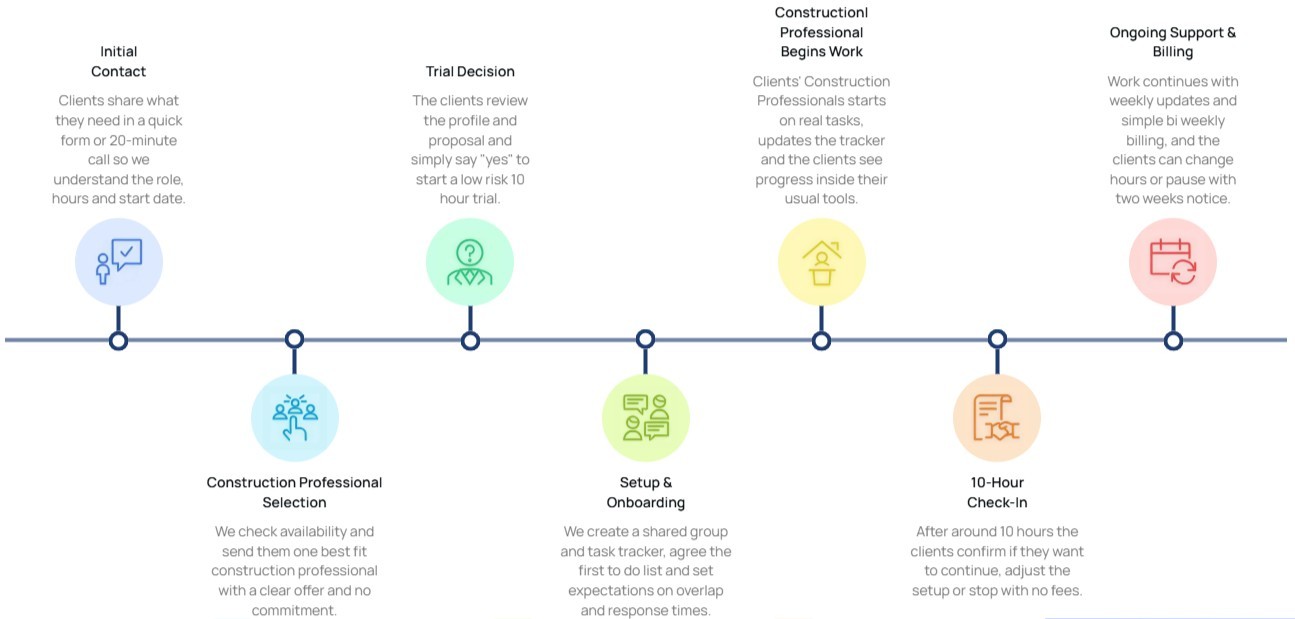
10-hour free trial
Flexible billing tied to actual hours worked
Cancel or pause with two weeks' notice
Capacity scales with VE workload
Self-managed and managed tiers available
Frequently asked questions
Implementation note: Wrap this section in FAQPage schema markup (schema.org/FAQPage) to qualify for rich results in Google.
Can VE work happen during design, or only after bid?
Both. Pre-bid and design-stage VE is more effective because more options are still available. Post-bid VE is reactive and constrained, but still valuable when the bid is over budget. The match process accounts for the project phase before placement.
Will the VE professional engage productively with our design team?
That's part of the vetting. VE done badly damages the contractor-design relationship. The professional pool is screened for design-side fluency and cross-stakeholder communication, so the work supports the project rather than creating friction.
Do AEdigo's VE professionals consider life-cycle cost, not just first cost?
Yes. First-cost VE that ignores life-cycle implications often gets reversed by the owner during operations. The VE professional documents life-cycle implications alongside first-cost impact, so the owner sees the full picture.
Can VE work be packaged as formal VE proposals for owner review?
Yes. Formal VE proposal packaging including cost impact, scope impact, schedule impact, life-cycle implications, and risk documentation is the standard deliverable for owner-facing VE engagements.
How do you track VE implementation through design and bid updates?
Approved VE proposals get tracked through design revisions and bid updates as part of the engagement. Implementation gaps where the design didn't actually adopt the approved VE get flagged so they don't become construction issues.