
Version control sounds simple until a project hits the third revision cycle on a critical drawing. Then it gets complicated fast. Field crews work off whatever drawing they printed last. Subcontractors submit against the wrong revision. The drawing log shows one version current; the field actually has another. Disputes form around which version was actually issued, when, and to whom.
Most projects don't have a real version control problem until they do. By that point, the documentation drift has been compounding for months, and untangling it eats time the project doesn't have.
AEdigo gives general contractors, subcontractors, owners, and project management firms on-demand access to pre-vetted coordinators who run version control and revision tracking. They maintain drawing logs, document revision histories, transmittal records, and acknowledgment tracking, working inside your office's tools and your project's contract structure.
What version control and revision tracking services actually deliver
Typical outputs from a version control professional working through AEdigo:
Drawing version logs with full revision history
Document revision histories across project records
Transmittal records with distribution and acknowledgment tracking
Version control file structure maintenance
Cross-reference linkage between revisions and originating documents
Audit-ready archive of superseded revisions
Subcontractor revision distribution coordination
Closeout version handover preparation
When you actually need version control support
Drawing log doesn't match what's actually current in the field.
Subcontractors are submitting against superseded revisions.
Revision history is informal and an audit, claim, or owner request requires it formalized.
Multiple revision cycles have created drift between the log and the field.
Transmittal records are inconsistent and acknowledgment tracking is incomplete.
Multiple projects share one coordinator and bandwidth is split too thin.
Version control file structure has become inconsistent and needs standardization.
How AEdigo runs version control and revision tracking work
1. Match against tools and contract structure
The match accounts for the project management platform, the contract structure, and the project's revision volume.
2. Kick-off on version standards
Revision numbering, version naming convention, transmittal format, distribution list, file structure, and contract-specific revision tracking requirements. The kick-off locks the framework before the first cycle.
3. Cycle production
Daily updates on revision intake. Weekly review on distribution and acknowledgment. Monthly audit pass on archive integrity. Cadence runs on a defined schedule.
4. Drift detection
Periodic checks compare the official version control system to the drawing set the field is actually using. Drift gets flagged and reconciled before it becomes a dispute.
5. Weekly status report
Revision distribution status, acknowledgment outstanding, drift status, and any items at risk. Project leadership sees version control health weekly.
Tools version control professionals work in
Procore for project management and document control
Autodesk Construction Cloud (BIM 360 / ACC) for cloud document workflows
Bluebeam Revu for transmittal and revision management
Microsoft SharePoint and OneDrive for office-side version control
CMiC, Sage, and Viewpoint Vista for ERP-driven version control
Microsoft Outlook and Teams for distribution and acknowledgment
What separates a version control professional from a project admin
Anyone can rename a file with a revision number. The professional who maintains version control under real project pressure knows what drift looks like, what acknowledgment gaps create exposure, and how to reconcile field reality with the documented version.
AEdigo vets version control professionals on:
Project management software fluency
Drawing log management and revision history discipline
Transmittal and acknowledgment tracking habits
Drift detection and reconciliation experience
Document classification and naming standardization
Cross-reference linkage habits
Audit-readiness and claims-stage documentation experience
Communication skills for distribution cycles across stakeholders
Use cases by stakeholder
General contractors
Project-wide version control and revision tracking
Multi-project portfolio version management
Subcontractor revision distribution coordination
Closeout version handover preparation
Subcontractors
Trade-side revision tracking
Submittal coordination against current revisions
Closeout version documentation
Owners and program managers
Owner-side version control
Multi-project portfolio version management
Audit and claims preparation
Common version control failures
Version control problems show up in predictable patterns.
Drawing log inconsistent with the current revision set in the field.
Transmittal acknowledgments incomplete, leaving distribution gaps unprovable.
Revision history informal and reconstruction-dependent during audit.
Archive integrity compromised by ad-hoc filing.
Subcontractor revision distribution incomplete.
Drift between official log and field reality undetected for extended periods.
Closeout version handover assembled from incomplete records.
How version drift happens and how to prevent it
Version drift between the official log and field reality doesn't happen suddenly. It happens through small lapses that compound across revision cycles.
The mechanisms that produce drift:
Revisions distributed without acknowledgment tracking, leaving distribution gaps invisible.
Field crews printing drawings on their own initiative, working off whatever copy is closest.
Subcontractors maintaining their own document libraries with different revision dates than the GC's.
Cloud-based platforms used inconsistently, with some teams pulling from the platform and others using emailed PDFs.
Revision indicators inconsistent across discipline (architectural revs at R3 while structural is at C).
Archive cycles run informally, leaving superseded revisions accessible alongside current ones.
Prevention through cycle discipline
Drift prevention isn't a tool problem. It's a discipline problem. Defined revision intake cycles, mechanical naming conventions, acknowledgment tracking, and periodic drift detection together produce a version control system that doesn't drift.
Audit-ready archive maintenance
Most version control programs maintain current revisions reasonably well and treat the archive as a closeout problem. The archive is what supports audits, claims, and disputes, and the archive matters most when the project is already in trouble.
Archive maintenance that supports audit-readiness:
Every superseded revision gets archived against retrieval, with file path and metadata preserved.
Archive structure mirrors the active document structure, so audits can compare current to historical.
Transmittal records get linked to specific archived revisions, supporting distribution traceability.
Acknowledgment records get archived with the revisions they reference.
Periodic archive integrity checks confirm files remain retrievable and metadata remains intact.
Closeout archive packages get prepared from the maintained archive, not assembled from project records at the last minute.
Version control services vs. the alternatives
The alternatives are: load version control onto the project manager, hire a junior admin without construction context, or accept that drift will happen and reconcile it at audit or dispute.
Project managers loaded with version control usually defer it during field crunches.
Junior admins without construction context produce log updates that look right and miss the cross-reference linkage that supports audit-readiness.
Reconciling drift after the fact costs more than maintaining the system continuously.
AEdigo runs version control as a managed engagement: construction-context coordinators, your project tools, your contract structure, with progress reports and drift detection.
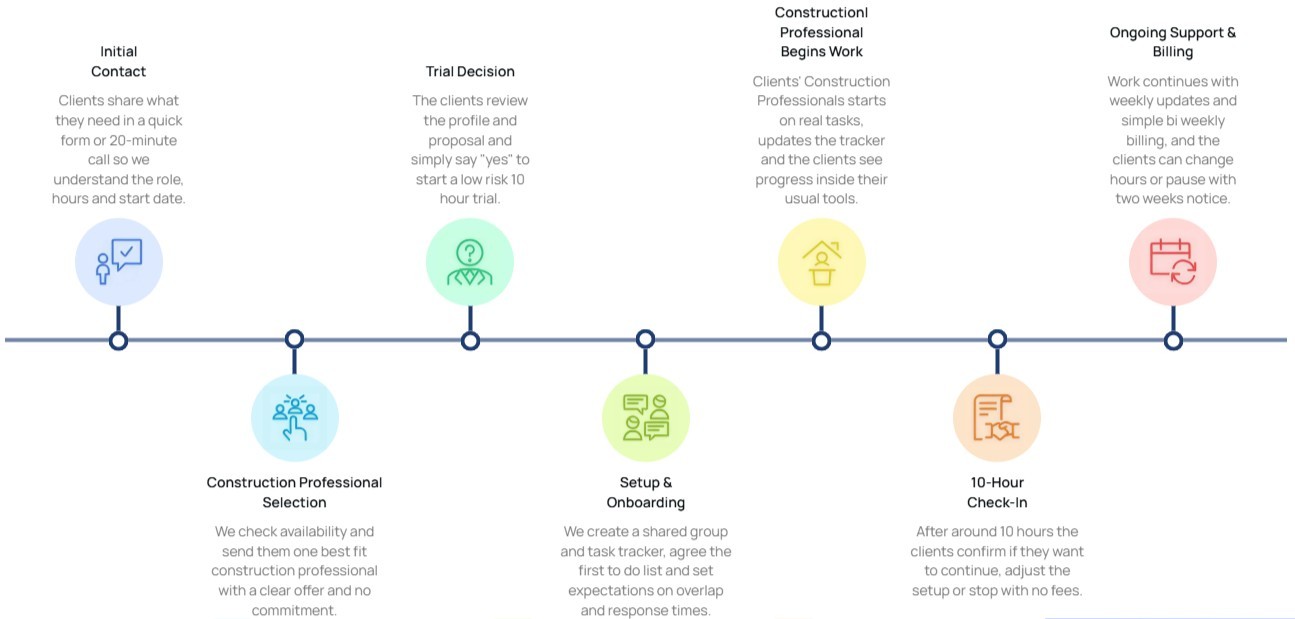
How engagement works
10-hour free trial
Flexible billing tied to actual hours worked
Cancel or pause with two weeks' notice
Capacity scales with project phase and workload
Self-managed and managed tiers available
Frequently asked questions
Implementation note: Wrap this section in FAQPage schema markup (schema.org/FAQPage) to qualify for rich results in Google.
Can the coordinator detect and reconcile drift between the log and field reality?
Yes. Drift detection is part of standard scope. Periodic checks compare the official version control system to the drawing set actually in use. Drift gets flagged and reconciled before it becomes a dispute.
Does the work include transmittal and acknowledgment tracking?
Yes. Transmittal preparation, distribution, and acknowledgment tracking are part of standard scope. Outstanding acknowledgments get followed up on a defined cycle.
Can the coordinator handle subcontractor revision distribution?
Yes. Subcontractor distribution including routing, acknowledgment tracking, and follow-up cycles is part of standard scope.
How is audit-readiness maintained?
Audit-readiness is treated as a daily habit, not a closeout deliverable. The coordinator maintains revision histories, transmittal records, and cross-reference linkage continuously, so an audit or owner request can be answered immediately.